



























%201.svg)


































How to Fight a Chase Chargeback: Deadlines, Evidence & Arbitration for Merchants

Estornos?
Não são mais problema seu.
Recover 4x more chargebacks and prevent up to 90% of incoming ones, powered by AI and a global network of 20,000 merchants.


 Mais de 600 avaliações
Chase's internal Visa deadline is day 18, not the 20 days the network allows. By the time most merchants open a chargeback notification, a substantial part of their window is already gone. Once Chase issues a decision, there is no bank-level appeal. Escalation to arbitration runs through Visa (~$600) or Mastercard (~$500), paid by the loser. Representment is the only realistic window to recover funds. Chase is both an issuer and an acquirer; when those incentives conflict, the cardholder wins. Provisional credits are issued before the investigation concludes. The variables merchants can control: response speed, reason-code precision, and documentation quality.
Chase has notably robust chargeback defenses. A proprietary risk scoring model evaluates transactions in the background. Cardholders who file frequent disputes get flagged, even when their claims are legitimate. High-value cases are escalated to specialized teams with more rigorous review standards. Behavioral analytics can identify dispute patterns that resemble known abuse profiles. On paper, the system has real teeth.
And yet, Chase chargebacks keep happening. Industry-wide, dispute rates spiked 78% year-over-year in Q3 2024. Friendly fraud accounts for roughly 70% of all chargebacks, and merchants who contest disputes manually win only ~18% of the time. Chase, holding an estimated 20-25% of the U.S. credit card market share, accounts for a disproportionate share of that volume.
Chase is simultaneously a card issuer and a merchant acquirer, two roles with directly opposing incentives. When they conflict, the cardholder wins. Retaining a loyal cardholder is worth more to Chase than any single disputed transaction. Factor in near-instant provisional credits, the industry-standard practice of absorbing low-value losses rather than investigating them, and card network rules that no issuer can override.
Within those constraints, even genuinely sophisticated internal systems have limited reach. And merchants are typically outside that reach.
Understanding Chase Chargebacks
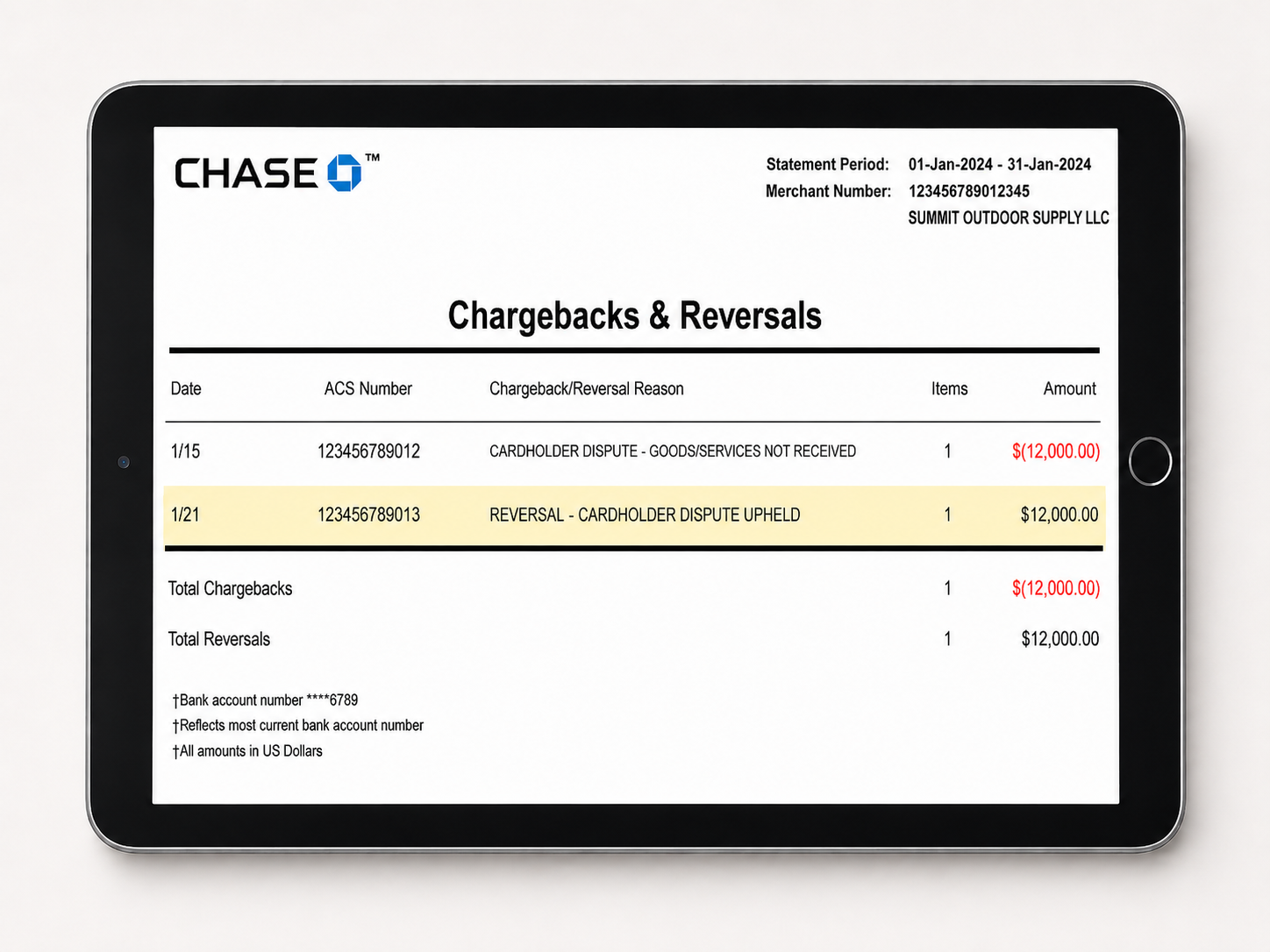
A Chase chargeback occurs when a customer disputes a completed transaction and Chase, as the card-issuing bank, withdraws the funds from your merchant account on behalf of the disputing cardholder.
Chase issues some of the most widely held consumer cards in the U.S. (Sapphire, Freedom, Ink) and simultaneously processes payments for merchants through Chase Payment Solutions. Because Chase is both a card issuer and merchant acquirer, a single disputed transaction can involve Chase investigating the claim, crediting the cardholder, and holding your funds. Simultaneously.
You'd expect that position to create balance. It doesn't. Issuer authority dominates under network rules, and Chase exercises it cardholder-first. For merchants, the conflict of interest isn't incidental. Regarding chargeback fees, Chase states that dispute fees can range from $25 to $100 per transaction; these fees increase based on a business’s dispute volume.
Chase Chargeback Process Step-by-Step
Chase’s role in the chargeback process depends entirely on how the transaction was processed. If you use Chase Payment Solutions, Chase is your acquirer. It represents you and manages the dispute on your behalf. If Chase issues the cardholder’s card, it acts as the decision-making authority. These roles can, and do, overlap simultaneously.
Here is a quick overview of the general Chase chargeback process and its window, so you can be better prepared when the next chargeback notice arrives.
Step 1: Dispute Filed
Under the Fair Credit Billing Act, cardholders have 60 days from their statement date to dispute a charge. That is the federal floor. In practice, Chase extends this to 120 days from the transaction date, or expected delivery date, in line with the card network rules. That extended window is Chase’s policy choice, not a legal obligation.
Step 2: Provisional Credit Issued
Chase credits the cardholder before any investigation concludes. The disputed amount is simultaneously debited from your account pending the outcome.
Step 3: Chargeback Notification
Your Chase chargeback time limit, the window to respond, is 20 calendar days for Visa and 45 calendar days for Mastercard. Your processor may impose shorter internal deadlines. Verify the exact deadline with your acquirer, as it will also be stated in the notification itself.
Step 4: Representment
This is your formal rebuttal to Chase, and any evidence submitted must directly address the specific reason code stated in the notification. Chase indicates the response window as 7 to 21 days, varying by card network and processor.
The deadline in your notification is absolute. Missing it results in an automatic loss. If Chase finds your evidence compelling, the provisional credit is reversed, and funds are returned. If not, Chase is explicit on this point: there is no appeal at the bank level. Escalation to pre-arbitration or arbitration runs through the card network, not Chase.
Step 5: Pre-Arbitration
If Chase rejects your representment, this is your last window before the card network takes over. Only pursue it if you have materially stronger evidence than what was submitted in representment.
Step 6: Arbitration
If pre-arbitration fails, the case moves to arbitration governed by Visa or Mastercard. Visa charges $600, and Mastercard charges $500, paid by the losing party. The network issues a final, binding decision that neither the merchant nor the issuer can appeal. Any further action must be taken through a court.
Common Chase Chargeback Reasons Codes Explained
Chase classifies chargebacks into four categories: fraud, authorization, consumer disputes, and processing errors. Each carries its own reason codes, timeframes, and evidence requirements. The codes below are presented in Chase’s own formatting in the Chargeback Timeframes and Reason Codes User Guide (REF-CHG-001).
Mastercard codes appear in legacy numbering, which is how Chase’s system displays them, without the 48xx prefix.
Another important thought worth highlighting is on response deadlines. Chase’s guide specifies the internal deadlines merchants must meet for Chase to represent them within network timeframes:
- Visa Allocation disputes (fraud): Day 18 from dispute initiation
- Visa Collaboration disputes (consumer/processing): Day 24 from dispute initiation
- Mastercard: Day 39 from dispute initiation
These are Chase’s internal cutoffs, set earlier than the network deadlines, to allow Chase time to process. The deadline in your notification falls within one of these windows. That said, here are Chase chargeback codes:
Category 1: Fraud Disputes
The cardholder claims they did not authorize or participate in the transaction. Visa routes fraud chargebacks through its Allocation workflow, which automatically assigns liability to the party deemed responsible. These are among the hardest chargebacks to win without the right terminal setup.
Visa Fraud Codes
Mastercard Fraud Codes
🔥On codes 10.1, 10.2, 70, and 71: These exist specifically because of EMV chip liability rules. If your terminal was not chip-enabled at the time of the transaction, Chase’s guide is explicit: there are no representment rights. Liability shifts to you automatically.
Read also:
- Códigos de motivo de estorno da Mastercard
- Mastercard Chargeback Survival Guide for Merchants
- Ultimate Guide to MasterCard's Excessive Chargeback Monitoring Program
Category 2: Authorization Issues
These chargebacks arise when a transaction is processed without valid authorization or when authorization is not used correctly. They are largely preventable and represent process failures rather than cardholder disputes.
Visa Authorization Codes
Mastercard Authorization Codes
🔥On code 42 (Mastercard Late Presentment): Chase’s guide specifies that a transaction is considered late if deposited more than 7 days after the transaction date for retail, or more than 30 days for card-not-present.
Category 3: Consumer Disputes
This category contains the highest concentration of friendly fraud. The cardholder acknowledges that a transaction occurred but disputes its outcome.
Visa Consumer Dispute Codes
Read also:
- Visa Chargeback Reason Codes: Guide for Merchants
- Guia prático para disputas de estorno de cartão Visa: regras, taxas, prazos e tudo o mais
- What Are Visa’s New VAMP Rules? A Guide for Merchants
- Entendendo o Verified by Visa (VBV) e a iniciativa 3D Secure
Mastercard Consumer Dispute Codes
🔥Note on Mastercard Code 54: Chase’s guide specifies that the original transaction amount must exceed US $50, and for retail purchases, the transaction must have occurred in the same state as, or within 100 miles of, the cardholder’s billing address.
Category 4: Processing Errors
These chargebacks result from errors in how the transaction was processed: duplicate charges, wrong amounts, incorrect currency, or being charged when payment was made by another method.
Visa Processing Error Codes
Mastercard Processing Error Codes
On Visa 12.1 (Late Presentment): Chase’s guide specifies that retail deposits made within 8 days of the transaction date may be represented if a valid, signed sales slip is provided. A late presentment is defined as a deposit made more than 8 days after the transaction date.
On Visa 12.5 (Incorrect Amount): Chase’s guide notes that disputes are valid only for the amount exceeding the authorized amount plus 15 percent for car rental businesses, and that chargeback protection limits for car rental merchants have been expanded under this code.
Category 5: Discover Chargebacks
Discover chargebacks work differently from Visa and Mastercard in one important way: Discover also still uses retrieval requests as a pre-dispute step, which Visa and Mastercard have largely eliminated.
Discover Chargeback Codes
Note on Code 05 and Code AP (Recurring Payment): At 730 calendar days, this is by far the longest chargeback window across any network in Chase's guide. A Discover transaction can be charged back nearly two years after the transaction date under this code. On Code AP, Chase's guide specifies that the cancellation date must have been at least 15 calendar days before the date the most recent disputed charge was posted to the cardholder's account for this code to be valid.
Category 6: American Express Chargebacks
American Express operates differently from Visa, Mastercard, and Discover. As both the card network and the issuer, Amex sets its own rules and applies them directly. Chase's guide covers Amex codes for merchants processing Amex through Chase Payment Solutions.
We covered Amex chargeback reason codes extensively.
Chase Chargeback Time Limits and Deadlines
Two clocks govern Chase chargebacks:
- The cardholder's window to file, and
- Your window to respond.
Cardholder filing window: Under the Fair Credit Billing Act, 60 days from the date the statement is sent or transmitted. Chase extends this to 120 days from the transaction or expected delivery date under Visa and Mastercard network rules. Here are Chase's chargeback merchant response deadlines:
Chase does not publish fixed internal buffers for Discover and Amex in the same format as it does for Visa and Mastercard. The deadlines in your notification remain the operative reference for those networks.
How Chase Cardholders File a Dispute
Chase cardholders can initiate a dispute through three channels:
- the Chase mobile app,
- the online account portal, or
- by calling the number on the back of their card.
The most common path is digital. When a cardholder logs into their account and expands a specific transaction, a “Dispute This Charge” option appears. The process takes minutes.
Note that disputes can only be filed on posted transactions. Pending charges cannot be disputed online or through the app. The transaction must have been settled first.
Once a cardholder files a dispute, Chase reviews the claim. If the cardholder appears to have a reasonable claim, Chase accelerates the dispute process, credits the cardholder provisionally, and notifies the payment brand, which then sends funds back to the card issuer. For a workflow where you’re using Chase as your processor, Chase, in turn, debits the funds from your settlement account and notifies the payment brand. All of this happens before you receive any notification.
For Discover and American Express cardholders specifically: When a Discover or American Express disputes a charge, the networks may first request more information through a retrieval request. During this retrieval request, no funds are taken from your account. A separate dispute will be initiated if the cardholder chooses to challenge the transaction further. Retrieval requests do not apply to Visa or Mastercard transactions, as stated earlier. The video below shows Amex chargeback process:
How Merchants Receive and Respond to Chase Chargebacks
Chase chargeback notifications to merchants are delivered through either SMS, mail, or your Chase Business account. Before deciding how to proceed, you ideally need to review the case reason and deadline from your Chase Business Account. The reason code and the supporting documentation from the cardholder tell you what evidence is required.
Responding: Accept or Fight
You have two options.
- Accept the chargeback if the dispute is valid, the evidence required is unavailable, or the disputed amount does not justify the cost of a full response. Accepting stops the process immediately.
- Submit evidence if you intend to fight. Supporting documentation must be submitted before the due date. In most cases, the documentation will be passed to the issuer, and the merchant will receive a provisional credit pending the final outcome.
Chase specifies the following as the core documentation required for a retrieval request, and the same logic applies to chargeback responses: a clear copy of the transaction receipt, proof of customer authorization such as a signature or consent for recurring billing, and any relevant order details, including shipping confirmation, invoices, or email communications.
After Submission
The issuing bank reviews the merchant’s response, often along with the customer, and makes a decision. If the documentation properly addresses the dispute, the dispute stops there. If it does not properly address the dispute, the issuer will continue the dispute process.
If the final decision is not in your favor, you can utilize arbitration, at which point the card network makes the final decision.
One point Chase is explicit about is that once the final decision has been made, it cannot be reversed. There is no bank-level appeal path.
Charge Errors vs. Fraudulent Charges
Charge errors (also called billing disputes or merchant/processing errors) are unintentional mistakes involving a transaction the cardholder recognizes but disputes for specific reasons, such as duplicate charges, incorrect amounts, charges after cancellation or refund, non-receipt of goods/services, not as described or defective merchandise, or credit not processed.
These fall under consumer disputes or processing errors and are often viewed as "legitimate" disputes from the issuer’s perspective.
Fraudulent charges, on the other hand, involve unauthorized use of the card. This involves:
- Third-party fraud: A criminal uses stolen card details for a transaction the legitimate cardholder did not make or authorize.
- Chargeback fraud: The cardholder made or authorized the purchase but later disputes it falsely (e.g., claiming “never received” or “never authorized” after receiving the benefit).
Practical Distinction for Merchants
If the cardholder complains about delivery, quality, cancellation, or billing issues with a transaction they acknowledge, it is typically a charge error or consumer dispute. Common codes: Visa 13.x series, Mastercard 4853, etc.
If the cardholder claims they never participated in the transaction at all (no knowledge or authorization), it is treated as fraud. Common codes: Visa 10.x, Mastercard 4837/4849, etc. The evidence requirements for merchants are stricter here.
Chase clearly separates “fraud/unauthorized use” from “billing or merchant errors” in its dispute process. Cardholders disputing billing/merchant errors are generally expected to contact the merchant first. Framing a dispute as fraudulent often results in faster provisional credits to the cardholder. Both types generally operate within the standard FCBA window.
Key Takeaway for Merchants: Consumer dispute/merchant error categories give you stronger grounds to fight with the appropriate documentation and communications. True fraud claims are harder to reverse and often shift liability unless you have compelling evidence (e.g., AVS/CVV match, 3D Secure authentication, or proof that the cardholder benefited). Friendly fraud blurs the line and is one of the largest sources of chargebacks. Hear from Chargeflow client Fenatics:
Tips to Protect Your Business from Chase Chargebacks
If you’re an experienced eCommerce merchant, you’re probably reading this because you need some real edge in chargeback prevention. So let’s get straight to that. We’ll uncover how to transform Chase’s data streams into actionable predictive intelligence and deploy autonomous controls that fill the gaps left by Chase’s native tools.
Use Chase Portal Analytics as Your Diagnostic Core
Mine the Chase Online Chargeback Management System and reports for reason‑code clusters, win‑rates, and provisional‑credit outcomes. These patterns expose subtle issues that the network never flags directly. For instance, you can turn descriptor confusion, subscription fatigue spikes, and regional mismatch disputes into operational signals. The output could inform strategies such as:
- Treating low win‑rates on merchant‑error codes (13.x / 4853) as product or policy gaps to fix.
- Managing recurring fraud‑code wins/losses (10.x / 4837) as authentication or risk‑strategy gaps to tighten.
Deploy Intelligent, Network‑First Prevention
For high‑volume operators, integrate third‑party systems that extend beyond Chase’s portal. This includes:
- Real‑time chargeback alerts: Systems that pull from Visa/Mastercard networks to surface disputes before they fully register in Chase, giving you a window to refund, clarify, or message the customer and often avoid the chargeback entirely.
- Post‑purchase risk‑scoring: Unlike checkout‑time fraud screens, tools like Chargeflow Prevent operate in the window after payment but before shipping or digital delivery. They apply ML‑driven scoring, merchant‑network behavior patterns, and signals to flag likely friendly fraud or policy abuse. This lets you verify, hold, or cancel high‑risk orders without blocking honest customers.
- Evidence‑automation assist: Automated chargeback systems can auto‑assemble evidence from your store, shipping, CRM, and payment data. These types of documentation will help you clarify merchant confusion when networks like Discover and Amex request transaction information. This removes manual drag, and you still decide which cases to fight.
Advanced Friendly Fraud Controls
For digital goods and subscriptions, insert “confirmation of benefit” steps: access logs, mandatory acknowledgments, or “I’ve used the service” flows, to reduce “didn’t use” disputes.
Build internal watch lists from combined Chase data and prevention‑tool signals (repeat emails, devices, and behavioral patterns), but avoid over‑blocking. Use them for extra verification, not broad bans.
Tighten visible self‑service cancellations and refunds on the consumer side. This reduces convenience‑driven disputes that Chase cardholders often shortcut straight to chargebacks.
How to Dispute Chase Chargebacks and Win
Winning consistently against Chase chargebacks requires speed and precision. Chase is explicitly pushing dispute resolution into tighter, automated windows. Merchants who lean into that rhythm consistently outperform those who treat chargebacks as one‑off fires.
The Core Workflow
- Respond immediately: Log into the Chase Online Chargeback Management System as soon as you’re notified and lock in the internal deadline. Build your own earlier cutoff (e.g., one business day sooner) to avoid portal or processor edge‑case delays.
- Classify the reason code: Separate merchant‑error codes from fraud‑type codes; each demands different evidence and strategy.
- Assemble targeted documentation: Only include what directly contradicts the stated claim: receipt, auth proof, delivery/service records, communications, and proof of benefit. Drop anything generic or “nice‑to‑have.”
- Submit a precise representment: Write a short, clear rebuttal that explicitly ties to the reason code and sub‑reason, and attach evidence in the same order the dispute is framed.
Use Chase reporting to spot recurring patterns (codes, merchants, categories) and adjust your policy, tracking, or fulfillment to close the gap.
Why Chargeback Automation Fits Chase’s Reality
Chase’s Online Chargeback Management Guide describes the system as one that streamlines retrieval requests and chargebacks and supports decreasing timeframes for dispute resolution. That language is from Chase’s own documentation. And it reflects the direction the entire dispute process is moving.
Merchants are progressively realising that the practical response to rising dispute volumes and card network policy is chargeback automation. Not because it is a trend. But because Chase’s internal windows, Day 18, Day 24, Day 39, depending on network and dispute type, leave little room for a manual evidence-gathering process that starts from scratch each time.
The merchants consistently recovering disputed revenue are typically doing three things systematically:
- Pulling evidence from store, shipping, and CRM systems automatically rather than assembling it manually per dispute.
- Mapping that evidence to the specific reason code on the notification, not submitting generic documentation packages.
- Submitting responses well inside Chase’s internal deadlines, not against them.
The tools that support this workflow should also not disrupt your operations, and the pricing should make sense. But most importantly, the workflow should be repeatable, reason‑code‑driven, and faster than the deadlines Chase operates within.
For merchants who already think in Chase‑centric patterns, that often means choosing a system that lives in the same rhythm as the Online Chargeback Management System. I mean one that’s built to automate the exact evidence‑pull, code‑mapping, and deadline‑tracking steps that Chase’s own design now expects of you. That’s how Chargeflow was built to operate.
Estornos?
Não são mais problema seu.
Recover 4x more chargebacks and prevent up to 90% of incoming ones, powered by AI and a global network of 20,000 merchants.


.png)
ARTIGOS relacionados



Dúvidas?
. Temos as respostas.
O Chargeflow coleta dados de dezenas de fontes externas de forma automática. Isso permite uma cobertura muito maior e taxas de sucesso muito melhores, pois as evidências apresentadas são muito mais abrangentes e convincentes.
O Chargeflow coleta dados como informações sobre pedidos, mensagens de clientes e detalhes de pagamento. Ele monta um processo completo de contestação para você, sem que você precise fazer nada.
Sim! O Chargeflow é compatível com mais de 50 processadores de pagamentos. Isso significa que você tem uma única ferramenta para todos os seus estornos, independentemente da forma como processa os pagamentos.
Você paga apenas uma porcentagem da receita que ajudamos você a recuperar. Sem taxas iniciais, sem assinaturas — apenas uma estrutura de preços baseada no sucesso.
Sim. A Chargeflow possui certificações SOC 2 Tipo 2, GDPR e ISO. Utilizamos os mais elevados padrões de segurança para proteger seus dados.
Precisa de mais ajuda?
Tem alguma dúvida? Estamos aqui para ajudar. Basta clicar no botão de chat para iniciar uma conversa com o suporte.