















El uso de datos y códigos de motivo para combatir el fraude interno


Contracargos?
Ya no es problema tuyo.
Recover 4x more chargebacks and prevent up to 90% of incoming ones, powered by AI and a global network of 20,000+ merchants.


 Más de 600 opiniones


En resumen:
- A reason code records the allegation, not proof of first-party intent.
- Join order, support, fulfillment, refund and dispute facts before classifying the cause.
- Use corroborated outcomes to inform a specific future-order or communication control.
- Keep network reason, customer complaint and internal classification as separate fields.
- Measure the next comparable cohort to see whether the policy change helped.
Chargeback reason codes and transaction data help you separate friendly fraud from true fraud. The code shows what the cardholder claimed; your order data shows what really happened.
Comprender el fraude «amigable» y el fraude «auténtico» en Contracargos
Most merchants see both friendly fraud and true fraud in their chargebacks. Our State of Chargebacks Report classed about 8 out of 10 cases in its raw 2023 Chargeflow-customer group as friendly fraud.
That is a past figure for one provider’s customers, not a current share for every merchant. Card issuers often file these disputes under fraud categories, which makes them hard for merchants to sort.
Definición del tipo de fraude
- Friendly Fraud: The real cardholder disputes a valid charge and claims they did not approve it.
- True Fraud: A third party uses the card without the cardholder’s consent.
Códigos de motivos principales del fraude amistoso
A chargeback reason code is the issuer’s stated reason for the chargeback. Codes are grouped so you can quickly see whether fraud was claimed. Knowing them helps you spot patterns and check whether a payment was approved.
Chargeflow automates chargeback responses, and we also keep a full reason code guide to help you find and prevent the causes. For prevention controls beyond reason-code analysis, compare friendly fraud prevention tools.
Here are the two main chargeback reason codes linked to friendly fraud:
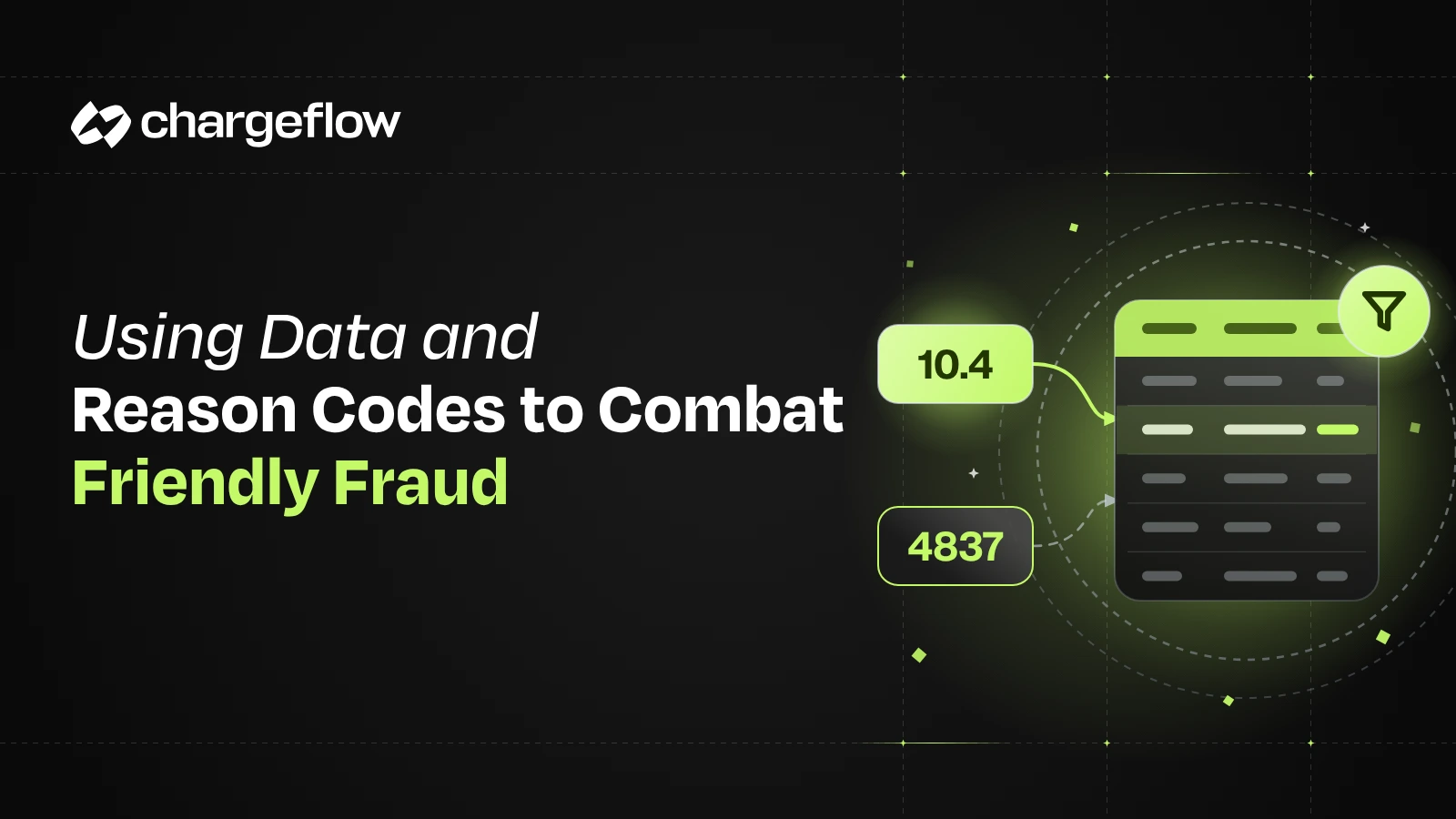
Visa 10.4 (Other Fraud: Card-Absent Environment)
Used for online, phone or mail orders where the card was not shown in person. The cardholder says they did not approve the payment. Sometimes they simply forgot the purchase, and no real fraud took place.
Mastercard 4837 (sin autorización del titular)
Used when the cardholder says they did not approve the payment. It covers both card-present and card-not-present sales. Even an approved payment can be disputed if the issuer thinks too little was done to check the buyer.
Review the full order and customer record. AVS, OTP and email results can support your review, but a matching credential alone does not prove consent or prove friendly fraud.
Scroll to compare all columns. Use the arrow keys when the table is focused.
| Reason code | What the cardholder claims | Data to check |
|---|---|---|
| Visa 10.4 (Other Fraud: Card-Absent Environment) | They did not approve an online, phone or mail order. | Account history, device and IP, delivery address, past orders, any 3D Secure result. |
| Mastercard 4837 (sin autorización del titular) | They did not approve the payment, in store or online. | Authorization record, AVS and CVV results, customer account activity, delivery proof. |
Análisis de los patrones relacionados con el fraude interno
Some cardholders forget they approved a purchase. Others know full well and dispute it anyway, a form of cyber shoplifting. Transaction data can support your review. Still, a family member using the card without the cardholder knowing does not prove the cardholder approved it.
Key data points to check include:
- Unusual transaction amounts that deviate from the cardholder’s typical spending: A big jump from normal spending can make a cardholder think they did not approve a payment. For example, a buyer who usually pays $100 for an order may dispute a $500 charge for more of the same items.
This pattern can also point to deliberate fraud. Look for broken return or cancel rules, where the buyer keeps the item and still files the chargeback.
- Frequent chargebacks or disputes from the same customer: Repeat “not authorized” chargebacks can signal cyber shoplifting, especially when past cases turned out to be friendly fraud. Forgetfulness happens, but many repeats usually point to intent.
- Irregular transaction times: Late-night orders or odd timing can point to a family member using the card while the cardholder was asleep or away.
Friendly fraud data review checklist ☐ Order amount compared with this buyer’s normal spend ☐ Past disputes or chargebacks from the same customer ☐ Order time and device compared with earlier orders ☐ Delivery proof and any return or cancel request ☐ Support messages before the dispute was filed |
Medidas preventivas basadas en el análisis de los códigos de motivo
Reason codes help you aim your prevention. You cannot stop cardholders from filing disputes, but you can keep enough evidence to prove a sale was real.
Eligible 3D Secure authentication can shift liability for some fraud disputes, depending on network, industry, monitoring and transaction rules. AVS or CVV checks, OTPs or issuer tips alone do not guarantee that shift, and non-fraud disputes stay separate. See Stripe’s 3DS liability-shift conditions and exceptions.
Here are a few ways to prevent these chargebacks:
- Update your payment terminals: Keep terminals and checkout software up to date so bugs do not create bad transactions.
- Use enhanced customer verification processes: Add one-time passwords, two-factor login and follow-up email checks.
- Use dynamic authentication services: Add CVV checks and address verification.
As you add these checks, teach your customers too. Explain how fraudsters steal card details through fake sites, scam support calls and card cloning.
Keep an open line with your customers and answer complaints fast. Many disputes can be solved before they reach the card issuer.
You can also show customers how to turn on stronger checks, such as two-factor login.
Buenas prácticas para gestionar disputas con el fraude amistoso
Protect your business while keeping good customer relations.
A continuación te ofrecemos algunas recomendaciones:
- Document transactions thoroughly: Save timestamps, IP addresses for online orders and customer details for each dispute.
- Respond promptly to disputes: Be kind but firm, especially when the cardholder does not remember approving the payment.
- Provide robust customer support: Help cardholders solve problems and see that the charge was real.
Domina Contracargos las soluciones avanzadas Chargeflow
Knowing reason codes is key to fighting chargebacks, especially friendly fraud cases. If the number of codes feels like a lot, our reason code guide covers each one. Chargeflow also goes beyond insights:
- Automates Chargeback Management: Chargeflow handles chargeback responses for you, so your team can focus on running the business.
- Real-Time Analytics: Dashboards show fraud and dispute patterns as they happen, so you can act fast.
- Proactive Alerts: Alerts tell you about a dispute early so you can act before it becomes a chargeback.
- Implementing Robust Verification Processes: Chargeflow Prevent reviews risky orders before they ship, which helps reduce disputes.
Working with Chargeflow can mean fewer chargebacks, happier customers and a stronger reputation. Let Chargeflow give you the tools and know-how to bring friendly fraud under control.
You can also read our chargeback reason codes guide for prevention steps by code. With Chargeflow, you manage chargebacks in real time, with early alerts and fraud prevention built in.
Turn reason-code analysis into a future-order control
Merchant operating checks
- Record the allegation: Keep the network reason, buyer complaint and disputed amount apart from your own fraud label.
- Validate the cause: Join order, support, delivery, refund and dispute records. A fraud code alone cannot prove first-party intent.
- Update the next decision: Change one message, shipping rule or repeat-abuse rule and measure the effect on the next similar group of orders.
These are suggested checks, not fixed thresholds or measured results, and not a claim that Chargeflow works with every ecommerce platform.
Put this into practice with claim classification, future-order repeat-abuse policy and comparable-cohort measurement.
Explore Chargeflow Prevent for ecommerce fraud and friendly-fraud prevention.
Use Confirmed History Before the Next Shipment
Explore ecommerce fraud and friendly-fraud prevention with Chargeflow Prevent, available through Shopify today.

Contracargos?
Ya no es problema tuyo.
Recupera cuatro veces más Contracargos y prevención , hasta un 90 % de las entradas, gracias a IA y a una red global de 20 000 comercios.




