





























%201.svg)




































Win Stripe Chargebacks: Your Guide to Protecting Your Business in 2026

Chargebacks?
Dat is niet langer jouw probleem.
Haal 4x meer chargebacks terug en voorkom tot 90% van de inkomende betalingen, dankzij AI en een wereldwijd netwerk van 20.000 handelaren.


 Meer dan 600 beoordelingen


TL;DR:
- What they are: Stripe chargebacks happen when a cardholder disputes a transaction through their bank; Stripe forwards your evidence but the card issuer decides the outcome.
- The fees: Stripe charges a $15 dispute fee when a chargeback is filed, plus a $15 counter fee if you challenge it (totaling $30 if you lose). Refunding at the inquiry stage, before a formal dispute exists, means neither fee applies.
- De doorlooptijd: Het hele proces duurt ongeveer 2-3 maanden; je hebt slechts 7-21 dagen de tijd om bewijsstukken in te dienen, afhankelijk van het kaartnetwerk.
- How to win: Validate the reason code, submit focused evidence (AVS/CVC, IP match, tracking, prior undisputed transactions), and use CE3.0 and 3D Secure where eligible.
- Win rates beat expectations: Merchants who formally contest disputes win about 50% of the time globally, 54% in the U.S. (Mastercard, 2025); most of the lost revenue comes from disputes nobody contests.
- Watch your ratio: A dispute rate above ~0.75% is high-risk and can trigger monitoring programs, reserves, or Stripe account termination.
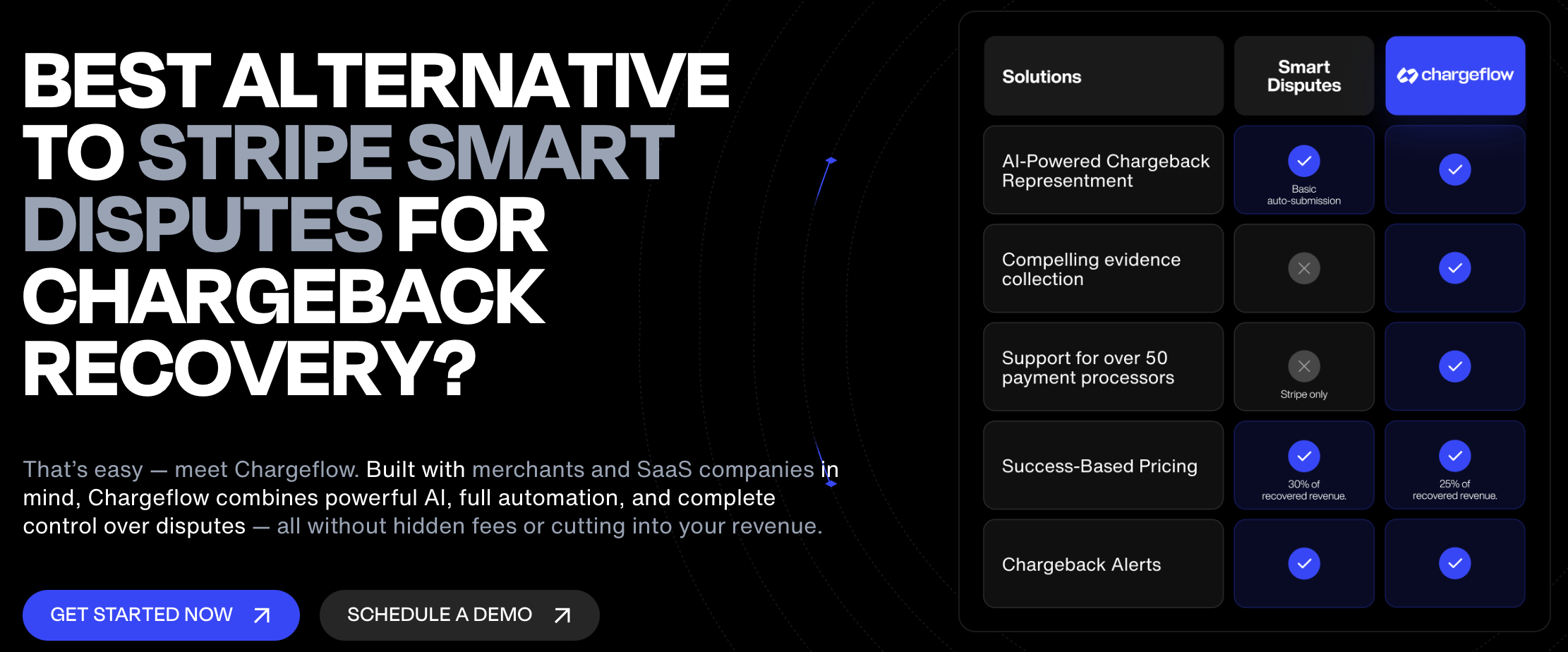
- Automate it: Chargeflow handles alerts, evidence, and filing across processors on autopilot with pay-per-win pricing; Stripe's own Smart Disputes tool automates eligible cases within Stripe only and charges 30% of the disputed amount on wins.
A Stripe chargeback happens when a cardholder disputes a transaction through their bank: Stripe forwards your evidence to the card issuer, who alone decides whether you keep the funds or lose them, usually within 2 to 3 months. If you need the fundamentals first, start with what is a chargeback; otherwise, read on for the Stripe-specific rules. Chargebacks can drain your revenue and threaten your Stripe account if you do not respond with the right evidence in time.
The losses are surging, and the patterns are similar across card networks. Yet, each card brand and payment service provider, like Stripe, has specific procedures and evidence requirements that you must understand to win cases.
Wanneer een kaarthouder via Stripe een geschil indient, treedt het platform op als tussenpersoon en helpt het je om je bewijsmateriaal in te dienen bij hun financiële partners of de kaartuitgever.
Stripe's role is to forward your evidence, not to determine the outcome. That decision rests with the card issuer, who evaluates whether your evidence meets their rules. If it doesn't, the issuer will reject your case and award the chargeback to the cardholder. This process typically takes 60 to 75 days, depending on the card brand involved (Visa, Mastercard, American Express, and Discover).
Read on to gain insights into the Stripe chargebacks lifecycle, learn step-by-step tips to win disputes with strong evidence, the dangers of excessive chargebacks, and how to lower your dispute rate, and proactive measures to prevent chargebacks before they happen.
Understanding Stripe Chargebacks
Stripe chargebacks occur when cardholders dispute transactions through their bank, triggering a process where you, the merchant, must prove transaction validity. Before launching a formal Stripe chargeback, some card issuers often choose to investigate a payment and request further information about the charge. This preliminary process is called an enquiry or retrieval.
To prevent an enquiry or retrieval from becoming a chargeback, submit all relevant documentation to Stripe or issue a full refund if appropriate. Refunding resolves the enquiry before it becomes a formal dispute, so you avoid the dispute fee entirely.
Most enquiries and retrievals arise from the cardholder claiming they do not recognize a transaction. The illustration below shows how Stripe chargebacks work:
Een typische levenscyclus van een Stripe
Here's how a Stripe chargeback works in five steps:
- Stap 1: De kaarthouder betwist een transactie: De kaarthouder neemt contact op met zijn bank en voert redenen aan als „transactie niet herkend“ of „product niet ontvangen“. De bank schrijft het betwiste bedrag af van Stripe.
- Step 2: Stripe Retrieves Funds: Stripe recovers the full amount from your merchant account and assesses a $15 dispute fee.
- Stap 3: Stripe een melding over een terugvordering: Je ontvangt een melding via het Stripe , e-mail, webhooks en de API, met daarin de redencode, het bedrag van het geschil en de reactietermijn.
- Stap 4: Je kiest een reactie: Op dit moment kunt u kiezen of u:
- Het geschil aanvaarden (zonder verweer).
- Challenge it by submitting evidence through Stripe's guided dispute form. Stripe introduced a new $15 dispute counter fee, added on top of the existing dispute fee (totalling $30 if you lose).
- Doe niets; dan wordt het geschil automatisch geaccepteerd.
- Step 5: Cardholder's Bank Issues Ruling: De uitkomst van het geschil kan een van de volgende zijn:
- You Won: Your compelling evidence was sufficient to counter the customer's claim, and the issuer has no choice but to return the chargeback amount to your Stripe account.
- You Lost: The bank upheld the chargeback due to insufficient or weak evidence from you. The customer will retain the chargeback amount, and you'll incur both the dispute counter fee and chargeback fee ($30).
Stripe Chargeback Fees at a Glance
| Scenario | Cost to You |
|---|---|
| Chargeback filed by the cardholder | $15 kosten voor geschillenafhandeling |
| You challenge the chargeback and lose | $15 counter fee on top of the dispute fee ($30 total) |
| You refund an enquiry or retrieval before it becomes a chargeback | Er worden geen kosten in rekening gebracht bij geschillen |
Key Takeaway: The entire dispute process, from dispute filing to card issuer decision, typically takes 2 to 3 months. This timeline generally can't be shortened, unless you choose to accept the dispute directly through the Dashboard or API. Merchants have 7 to 21 days to contest a chargeback.
Now that you understand how Stripe chargebacks work, let's explore how to win them.
Hoe je Stripe kunt winnen
Stripe calls chargebacks "the dark side of a completed payment," and they're not wrong! A $1 fraudulent chargeback costs U.S. merchants $4.61 in fees, fraud losses, and operating expenses, up 32% from $3.16 in 2022, according to the 2025 LexisNexis True Cost of Fraud Study. That's like paying for a customer's purchase and extra penalties unless you fight back.
Contested disputes are more winnable than most merchants assume: Mastercard's 2025 State of Chargebacks Report found merchants win an average of 50% of the chargebacks they formally contest worldwide (54% in the U.S.). The real problem is that most merchants never contest at all. Among large enterprises, only 11% represent more than half of the chargebacks they receive, leaving easily winnable disputes on the table. Why? Many lack a clear process or struggle with submitting manual evidence.
Volg deze stappen om uw slagingspercentage bij geschillen te verbeteren.
Stap 1: Controleer de klacht
Review the reason code to determine if the claim is valid:
- Invalid Claims (e.g., friendly fraud): ALWAYS contest with strong evidence.
- Gegronde klachten (bijvoorbeeld een niet-geleverd product of dubbele facturering): Overweeg om de klant rechtstreeks een terugbetaling te geven of de kwestie rechtstreeks met hem op te lossen. Je moet Stripe nog steeds het bewijsmateriaal Stripe de communicatie Stripe als zij ermee instemmen het bedrag terug te storten.
Voorbeeld: Als de kaarthouder beweert dat de transactie niet herkend wordt, verzamel dan bewijsmateriaal, zoals een AVS-match, om aan te tonen dat de factuurgegevens overeenkomen met zijn of haar gegevens en dat hij of zij toestemming heeft gegeven voor de transactie.
Stap 2: Leg tijdig nauwkeurig bewijsmateriaal voor, voordat stilzwijgen als een vonnis gaat gelden
Verzamel bij het reageren op de terugboekingsmelding alle relevante documentatie die de oorspronkelijke aankoop bevestigt, en dien deze in. Vermijd overbodige details, zoals lange inleidingen, onnodige productbeschrijvingen, klachten over de klant of opmerkingen over de vermeende onrechtvaardigheid van het geschil.
Banken behandelen dagelijks duizenden geschillen. Uw reactie moet dus opvallen. Voorbeelden van bewijsmateriaal dat u kunt indienen, zijn onder meer:
- Voor alle geschillen:
- Orderbevestiging met klantgegevens.
- Bevestigingen via AVS of CVC.
- Een IP-adres dat overeenkomt met het factuuradres.
- Eerdere transacties van dezelfde klant waarover geen onenigheid bestaat.
- Voor fysieke goederen:
- Verzendgegevens met ontvangstbevestiging.
- Handtekening van de klant bij aflevering.
- Communicatielogboeken (bijvoorbeeld een e-mail ter bevestiging van een bestelling).
- Voor digitale producten:
- Bewijs van download of gebruik (bijv. tijdstempels van inloggen, accountactiviteit).
- Screenshots die de transactie aan de identiteit van de klant koppelen.
Match Your Evidence to Stripe's Reason Code
Stripe's dispute form only shows the fields relevant to your specific reason code, and pre-fills some of them automatically from data it already holds. Stripe maps each network's dispute reasons into a handful of categories; the underlying Visa reason codes below show what the issuer's system actually records for that category. Here is what tends to win for each category, and what Stripe fills in for you:
| Reden van het geschil | Visa Reason Code | Evidence That Tends to Win | What Stripe Pre-Fills |
|---|---|---|---|
| Fraudulent (card not present) | 10.4 | AVS/CVC match, IP address matching the billing address, device details, prior undisputed transactions from the same customer | 3D Secure and ECI liability-shift data, plus Visa CE 3.0 transaction history for eligible cases |
| Product or service not received | 13.1 | Tracking number with delivery confirmation, signed delivery receipt, carrier proof of delivery | Shipping details, if your integration passes them to Stripe at checkout |
| Product komt niet overeen met de beschrijving | 13.3 | Product listing matching what shipped, communication showing the customer accepted the item, return policy terms | Refund policy details from your account settings |
| Duplicate charge or processing error | 12.6.1 | Receipts showing the charges were for separate orders, or proof only one charge actually processed | Transaction and payment metadata Stripe already holds |
| Subscription canceled or credit not processed | 13.6 / 13.7 | Cancellation policy, proof of the cancellation date, evidence the refund or credit was already issued | Customer and product details tied to the original payment |
A few rules apply no matter the reason code: you get one submission per dispute with no edits afterward, so assemble every file first. Combine same-type evidence into a single file, keep the combined upload under 4.5MB (19 pages for Mastercard disputes), and skip audio, video, or links to outside pages, since the issuing bank will not follow them.
Pro Tip: Use automation tools like Chargeflow with Stripe's native features to speed up evidence collection. Automation fetches comprehensive and contextualized data, including the customer's fraud score, increasing win rates by up to 80% for fraudulent disputes.
Stap 3: Dien je aanvraag binnen de gestelde termijnen in
Je hebt slechts 7 tot 21 dagen de tijd om te reageren, afhankelijk van het kaartnetwerk. Als je de deadline mist, wordt je aanvraag automatisch afgewezen. Gebruik het gestructureerde formulier Stripe om bewijsstukken te uploaden en zorg ervoor dat de bestanden:
- Leesbaarheid: Gebruik 12-punts lettertype, bold , tekstvakken of een pijl om de aandacht te vestigen op relevante informatie en vermijd het markeren met kleur.
- Wees concreet: snijd screenshots bij zodat alleen relevante informatie zichtbaar is (bijvoorbeeld een leveringsbevestiging of handtekening) en leg uit waarom deze informatie relevant is.
Voorbeeld: Bij een geschil over een "niet ontvangen product" dient u een trackingnummer in te dienen waaruit blijkt dat het pakket op het adres van de kaarthouder is afgeleverd (omcirkeld in de schermafbeelding), met de opmerking: "Dit bevestigt de levering op [datum]."
Stap 4: Bekijk andere mogelijkheden
- Direct oplossen: Neem contact op met de kaarthouder om een vervangend product of een tegoedbon aan te bieden, vooral bij geschillen over kleine bedragen. Als de kaarthouder ermee instemt het geschil in te trekken, dien dan het bewijs van het gesprek in bij Stripe.
- Controleer of het geschil in aanmerking komt voor CE 3.0: Als het geschil in aanmerking komt voor CE 3.0, Stripe het grootste deel van het benodigde bewijsmateriaal Stripe , waardoor het eenvoudiger wordt om te reageren.
- Use 3D Secure: If liability shift coverage is applicable through 3D Secure, submit data evidence to shift liability to the issuer.
Pro Tip: You could do all these: verify the dispute reason code, collect compelling evidence tailored to the claim, submit within 7-21 days on Stripe's form, and still lose chargebacks due to systemic issues, such as inconsistent card issuer policies, human error in evidence review, delayed chargeback notice, or evolving fraud tactics due to AI. These systemic challenges make it imperative to automate chargeback responses for consistent and comprehensive evidence submissions that adapt to fraud patterns and reduce errors.
What's New in Stripe Disputes for 2026
Stripe now offers its own automated evidence tool alongside the manual dispute form, and a new category of disputes tied to AI-driven checkout is starting to show up in reason codes.
Stripe Disputes
Smart Disputes is Stripe's built-in AI tool for eligible card disputes. It uses an AI rules engine to pull evidence from your transaction data and Stripe's own network data, tailors it to the dispute reason, and submits the packet automatically before your deadline if you take no action. It requires no extra integration work if you already use Stripe, and you can turn off auto-submit in your Dashboard settings if you would rather respond manually. Stripe only charges its Smart Disputes fee, 30% of the disputed amount, when you win; there is no fee on a loss. Stripe reports an average 18% increase in payment volume recovered by businesses using Smart Disputes compared to manual responses.
Smart Disputes only covers Stripe transactions and only the dispute reasons it deems eligible. If you process through more than one platform, run a high volume of manual-eligible reason codes, or want alerts before a dispute even reaches the formal chargeback stage, that is where a cross-processor tool like Chargeflow adds coverage Smart Disputes does not.
Stripe -bescherming tegen Stripe
Chargeback Protection is a separate Stripe product from Smart Disputes. Instead of fighting a dispute after it lands, Stripe automatically reimburses you the disputed amount plus the chargeback fee when a protected transaction turns into a fraud dispute, and you never submit evidence for that case. The service runs on Stripe Radar's fraud models to screen which transactions qualify, and it costs 0.4% of the transaction amount, charged on every payment you choose to protect.
Coverage is currently limited to businesses in the US and Europe using the latest version of Stripe Checkout, and it only reimburses disputes coded as fraud. Claims like "product not received," "not as described," or a canceled subscription still require you to build and submit your own evidence, Chargeback Protection will not cover them. The same exclusions apply to third-party chargeback insurance and fraud guarantees, so price any of them against your fraud-coded dispute share only. If you run your own checkout page, sell mostly through invoicing, or process across more than one platform, those transactions fall outside this coverage too, and a cross-processor tool remains the only way to catch every dispute type in one place.
Agentic Commerce and a New Kind of Liability Question
As more checkouts run through AI shopping agents instead of a person clicking buy, card networks and issuers are starting to see disputes where the cardholder claims they never authorized the purchase an agent made on their behalf. Merchants accepting agent-initiated payments should understand AI agent chargeback liability before volume grows, and review the Agentic commerce chargebacks evidence playbook to see what proof of authorization will hold up when the buyer was software, not a human.
The Dangers of Excessive Stripe Chargebacks (and What to Do If You're Already Facing a High Chargeback Ratio)
Card networks closely monitor businesses for excessive chargeback activity. While thresholds vary slightly by network, a dispute rate above 0.75% is generally considered high-risk. Exceeding the card network chargeback ratio can have serious consequences for your business, including:
- Controleprogramma’s: maandelijkse boetes tot duizenden dollars.
- Accountrisico’s: Stripe uw account blokkeren of beëindigen, waardoor de betalingsverwerking wordt verstoord.
- Reputation Damage: Other processors may reject you as high-risk. If you are weighing alternatives, see how Stripe compares on risk tolerance in Stripe vs Adyen and Stripe vs Shopify Payments.
Stripe takes excessive chargebacks seriously. They use machine learning to monitor transaction patterns, helping merchants identify when they are approaching a dangerous threshold. These models identify behavior that correlates with chargebacks and can alert you to possible issues.
You can also do the math yourself. To figure out your chargeback rate, divide the total number of chargebacks you received in a given month by the number of transactions processed that month, multiplied by 100.
.webp)
Lees meer over hoe de verschillende kaartnetwerken hun terugboekingspercentages berekenen.
What to Do If You're Facing an Excessive Chargeback Rate
It bears emphasizing that breaching the established chargeback-to-transaction ratio is a serious offense. You may face restrictions, fines, higher payment processing fees, burdensome reporting costs, account reserves, and the possibility of account shutdown.
Als je die nachtmerrie al meemaakt, raden we je aan om:
- Voorkom nieuwe geschillen: gebruik duidelijke factuurbeschrijvingen, verbeter de klantenservice en implementeer 3D Secure. Elk nieuw geschil, of je nu wint of verliest, zal in je nadeel werken.
- Use Chargeback Alerts: Tools like Chargeflow Alerts notify you of impending chargebacks before they reach full term. See how a chargeback alert service works if this fits your stack.
- Fight Fraud: Stripe Radar provides tools for ecommerce fraud prevention to reduce third-party fraud, which often leads to chargebacks.
- Automate Dispute Responses: Solutions like Chargeflow are famed for providing complete chargeback coverage, from alerts to evidence collection and dispute filing, saving time and boosting win rates, all on autopilot.
Zoals Mastercard verklaarde: "De meest effectieve oplossingen ter voorkoming van terugboekingen zijn gebaseerd op een robuust wereldwijd samenwerkingsnetwerk. Geautomatiseerde tools ... helpen handelaren en kaartuitgevers om fraude door de kaarthouder zelf aanzienlijk te verminderen door gebruik te maken van AI-gestuurde transactie-inzichten en risicomodellering. Deze aanpak helpt bij het opsporen en voorkomen van fraude door de kaarthouder zelf en bij het aantonen van legitieme transacties die door de kaarthouder zijn uitgevoerd."
See how Chargeflow helped Wordtune reduce its dispute rate by 29.7%, reduce fraudulent disputes by 33.5%, and achieve a 5.4x increase in chargeback recovery rate, all while growing its revenue, as reported by Stripe.
Frequently Asked Questions About Stripe Chargebacks
What is a Stripe chargeback?
A Stripe chargeback happens when a cardholder disputes a transaction through their bank. Stripe acts as an intermediary, forwarding your evidence to the card issuer, who alone decides the outcome.
How much does a Stripe chargeback cost?
Stripe charges a $15 dispute fee when a chargeback is filed, plus a $15 counter fee if you challenge it and lose, totaling $30. Refunding an enquiry or retrieval before it becomes a chargeback means neither fee applies.
How long do I have to respond to a Stripe chargeback?
You have 7 to 21 days to submit evidence, depending on the card network. The full process, from dispute filing to the card issuer's ruling, typically takes 2 to 3 months.
What evidence should I submit to win a Stripe dispute?
Strong evidence includes an order confirmation with customer details, AVS or CVC confirmation, an IP address matching the billing address, and prior non-disputed transactions from the same customer. For physical goods, add tracking details and a delivery signature; for digital goods, add proof of download or usage.
What happens if my Stripe chargeback ratio gets too high?
A dispute rate above roughly 0.75% is generally considered high-risk. Exceeding it can trigger monitoring programs with monthly fines, account freezes or termination from Stripe, and reputation damage that leads other processors to reject you as high-risk.
Can automation help me win more Stripe chargebacks?
Yes. Automation tools like Chargeflow handle alerts, evidence collection, and dispute filing on autopilot, which can increase win rates by up to 80% for fraudulent disputes. Over 20,000 merchants already use automation to simplify Stripe dispute responses.
What is Stripe Smart Disputes?
Smart Disputes is Stripe's own AI tool that compiles and submits evidence for eligible card disputes automatically, without extra integration work. Stripe only charges its fee, 30% of the disputed amount, when you win, and reports an average 18% increase in recovered payment volume compared to manual responses. It only covers Stripe transactions and reason codes Stripe deems eligible, so merchants on multiple processors or with alert and prevention needs often pair it with a broader tool.
What is Stripe Chargeback Protection, and how is it different from Smart Disputes?
Chargeback Protection automatically reimburses you for fraud disputes on protected transactions, so you never file evidence for those cases; Smart Disputes still files evidence, just automatically. Chargeback Protection costs 0.4% per transaction, covers only fraud-coded disputes, and is available to US and Europe businesses on the latest Stripe Checkout. It does not cover "product not received," "not as described," or subscription cancellation disputes.
Say Goodbye to Stripe Chargebacks
Chargeback volumes rose 8% in 2024, driven by friendly fraud and account takeover. Alarmingly, 84% of customers find filing chargebacks easier than requesting refunds (Chargeflow, 2025). So, leaving Stripe disputes to chance is like leaving your revenue unprotected.
Your chargeback ratio isn't just a number. It's a key metric for your Stripe account's health. Actively fighting and preventing false chargebacks is critical for maintaining an uninterrupted merchant account and long-term business sustainability.
Over 20,000 merchants have used automation tools like Chargeflow to simplify responses, save time, and boost win rates. You, too, can benefit from this solution.
Ready to Protect Your Revenue? Contact us to learn how to stop scammers in their tracks and recover meritless disputes on autopilot. You only pay for cases won, which is a win-win!
Chargebacks?
Dat is niet langer jouw probleem.
Haal 4x meer chargebacks terug en voorkom tot 90% van de inkomende betalingen, dankzij AI en een wereldwijd netwerk van 20.000 handelaren.


.png)
.webp)
.webp)
.webp)