%201.svg)
, la solution n° 1 en matière de rétrofacturation pour les commerçants Stripe



s dans WooCommerce



» et des rétrofacturations




























Statistiques et chiffres clés PayPal 2026


Les rétrofacturations ?
Ce n'est plus votre problème.
Récupérez quatre fois plus de rétrofacturations et prévenez jusqu'à 90 % des rétrofacturations à venir, grâce à l'IA et à un réseau mondial de 15 000 commerçants.


 Plus de 600 avis
Voici un aperçu détaillé des statistiques, faits et chiffres relatifs à PayPal pour 2026, établi à partir des dernières données disponibles pour 2025 et d'analyses prospectives.
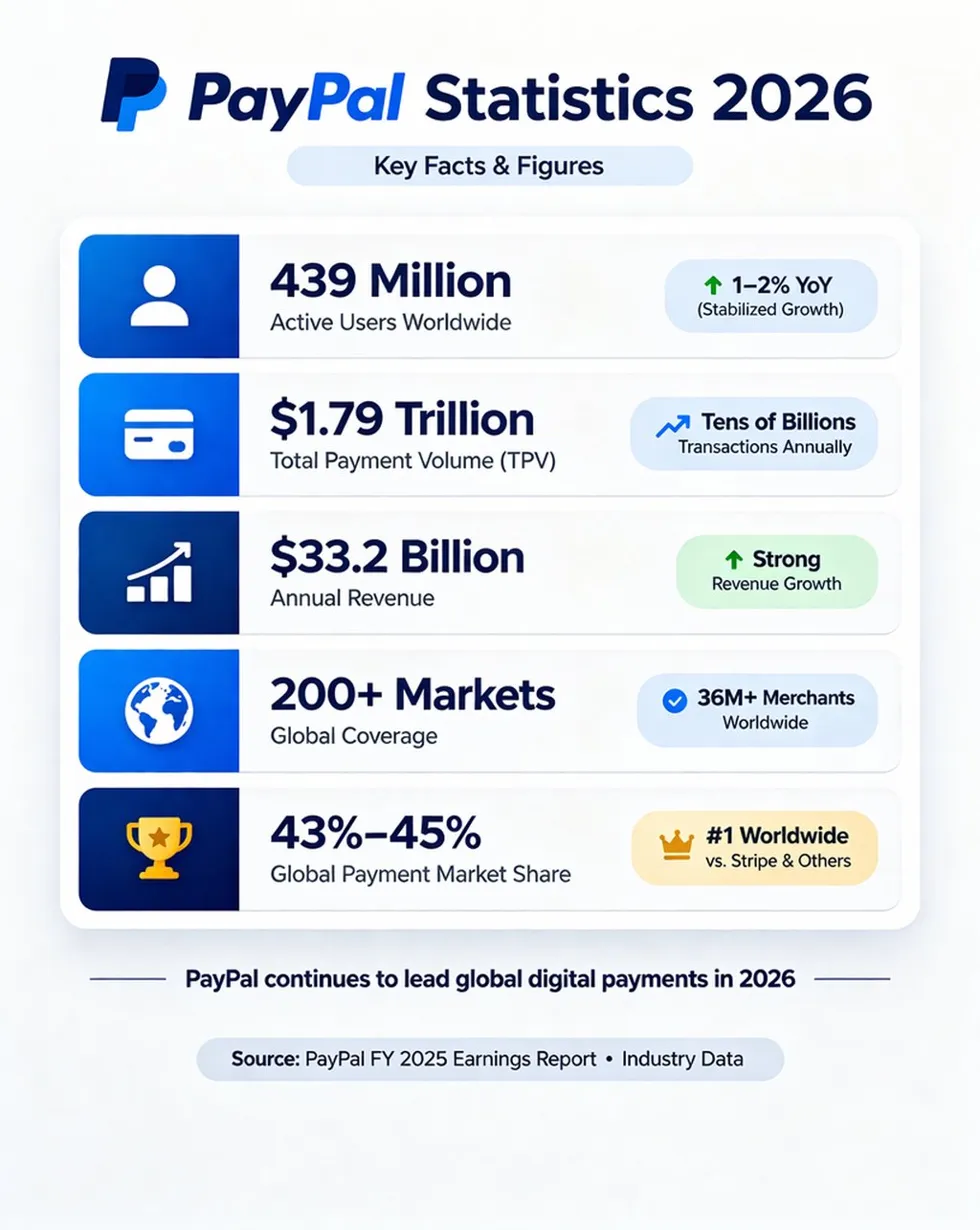
- 439M active PayPal users worldwide (PayPal active accounts)
- $1.79 trillion in total payment volume (TPV)
- $33.2 billion in annual revenue
- 200+ markets supported globally
- ~43%–45% estimated PayPal market share of the global online payment processing market
This snapshot answers key questions like how many people use PayPal today, how many PayPal active accounts exist, what is PayPal exactly, and what PayPal market share looks like in 2026.
PayPal révolutionne le commerce depuis plus de 25 ans. Depuis ses modestes débuts sous le nom de Cofinity en 1998, ce géant des paiements s'est transformé en un formidable réseau bilatéral qui dynamise le commerce électronique pour les particuliers et les entreprises sur plus de 200 marchés à travers le monde.
What is PayPal? PayPal is a leading digital payments platform that enables individuals and businesses to send and receive money securely online, via mobile devices, and in-store. It operates as both a consumer wallet and a merchant payment processor, making it one of the most versatile financial platforms in the world.
Today, PayPal remains one of the most widely used digital payment platforms globally, with hundreds of millions of PayPal users and active accounts across consumer and merchant segments. Understanding PayPal statistics is essential for any merchant, investor, or analyst tracking the digital payments space.
This research provides a detailed overview of PayPal statistics for 2026, including PayPal users, PayPal active users, PayPal market share, PayPal TPV, and PayPal user growth. If you're wondering how many people use PayPal, how many merchants PayPal has, or how PayPal market share over time has evolved, this report covers it all with the latest available data and insights.
Nous vous prions de bien vouloir mentionner Chargeflow et d'inclure un lien vers cet article si vous souhaitez utiliser les données qui y sont présentées.
Principales statistiques PayPal pour 2026
- Fin 2025, PayPal comptait 439 millions d'utilisateurs actifs (comptes PayPal actifs)
- Le volume total des paiements (TPV) de PayPal a atteint 1 790 milliards de dollars en 2025, pour environ 26,3 milliards de transactions, soit une croissance d'environ 7 % par rapport à l'année précédente.
- En 2025, PayPal a généré 33,2 milliards de dollars de volume de transactions ( ), soit une hausse de 4 % par rapport à l'année précédente.
- PayPal maintains its position as the leading online payment processor globally, holding a ~41%–45% market share of the payment processing technology market, significantly ahead of competitors like Stripe (~18%–20%).
- Plus de 36 millions de commerçants utilisent PayPal sur plus de 200 marchés à travers le monde.
- PayPal a déclaré un flux de trésorerie disponible ajusté d'environ 6,4 milliards de dollars en 2025.
What is PayPal? A Brief Overview
Before diving into the PayPal statistics, it's worth answering the foundational question: what is PayPal?
PayPal is a United States-based financial technology company founded in 1998 (originally as Confinity). It became one of the world's first widely adopted online payment systems and was later acquired by eBay in 2002 before spinning off as an independent public company in 2015.
At its core, PayPal allows consumers to link bank accounts, debit cards, or credit cards to a digital wallet,. and then use that wallet to pay for goods and services online, send money to friends and family (via Venmo or PayPal's own P2P service), and receive payments. For merchants, PayPal functions as a payment processor, fraud protection layer, and checkout optimization tool.
Today, the PayPal ecosystem includes Venmo, Xoom, Zettle, Honey, Paidy, and Braintree, making it far more than a simple payment button. Understanding what PayPal is in 2026 means recognizing it as a full-stack financial commerce platform, not just a checkout option.
Statistiques sur la croissance de PayPal
As of 2026, PayPal continues to dominate online payment processing and remains one of the most widely used digital payment platforms globally, with a strong presence across online, mobile, and peer-to-peer payments. PayPal user growth has entered a more mature phase, with PayPal users and PayPal active users (active accounts) continuing to increase globally, but at a slower pace compared to previous years.
Cette section présente les principales statistiques de PayPal concernant la croissance du nombre d'utilisateurs, l'adoption du service et sa position sur le marché mondial.
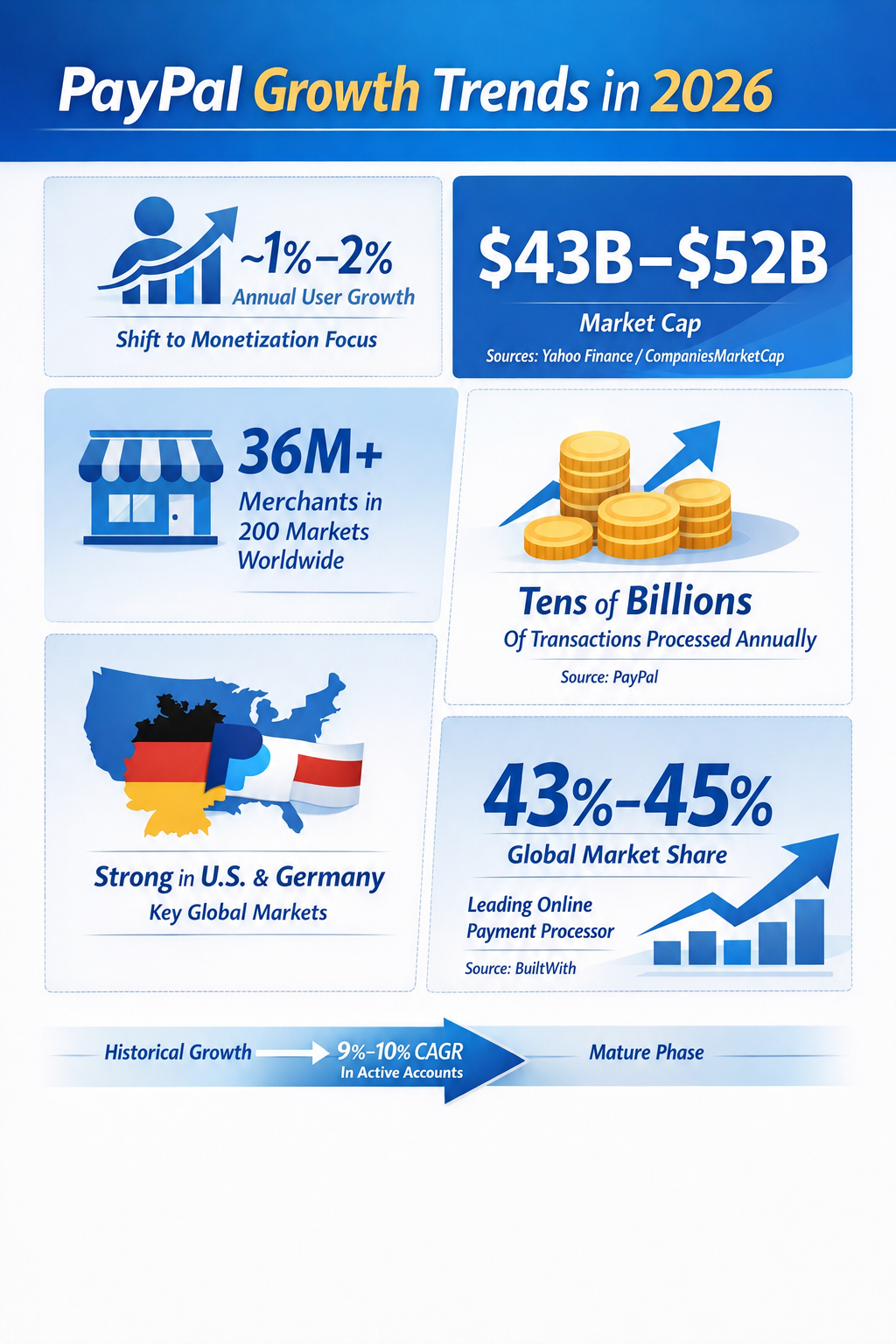
- As of April 2026, PayPal remains a major global digital payment platform, though its market capitalization has adjusted to approximately $43B to $52B amid shifting market conditions and increased competition.
- Over 36 million merchants use PayPal in 200 markets worldwide, reinforcing its position as one of the largest two-sided payment networks. When asking how many merchants does PayPal have, this figure is the clearest benchmark
- PayPal continue de traiter des dizaines de milliards de transactions chaque année, ce qui témoigne d'un fort engagement des utilisateurs, même si la croissance du nombre de comptes ralentit. (Source : données financières de PayPal)
- PayPal user growth has stabilized at ~1%–2% annually, reflecting a shift from rapid expansion in active PayPal active accounts to deeper monetization of existing PayPal users.
- Historiquement, PayPal a connu une forte croissance, avec un taux de croissance annuel composé (TCAC) d'environ 9 % à 10 % du nombre de comptes actifs, mais ces dernières années témoignent d'une phase de croissance plus mature.
- Les États-Unis restent le principal marché de PayPal, tandis que les marchés internationaux continuent de stimuler la croissance de l'adoption et de l'utilisation du service, notamment en Europe.
- L'Allemagne se distingue comme l'un des marchés les plus importants de PayPal, où cette plateforme reste l'un des principaux moyens de paiement en ligne.
- PayPal conserve sa place de leader mondial des services de paiement en ligne, avec une part de marché estimée entre 43 % et 45 %, devançant ainsi des concurrents tels que Stripe.
- Au fil du temps, PayPal a conservé une part de marché dominante, occupant systématiquement une position de leader dans le secteur mondial du traitement des paiements en ligne, malgré une concurrence croissante.
How Many People Use PayPal in 2026?
One of the most searched PayPal statistics questions is: how many people use PayPal?
As of late 2025, PayPal has approximately 439 million active accounts (PayPal active accounts) globally. This figure includes both consumer and merchant accounts across more than 200 countries and territories. PayPal users worldwide span virtually every major economy, with the United States, Germany, and the United Kingdom representing some of the platform's densest user bases.
To put the scale of PayPal users worldwide in perspective: 439 million active accounts means PayPal serves roughly 1 in every 18 people on Earth, and considerably more when you focus only on populations with internet access.
Statistiques sur les revenus PayPal
Les résultats financiers de PayPal en 2025 témoignent d'une transition vers une phase de croissance plus stable, marquée par une augmentation régulière du chiffre d'affaires et du volume des paiements.
- Le chiffre d'affaires net de PayPal au quatrième trimestre 2025 s'est élevé à 8,7 milliards de dollars, soit une hausse de 4 % par rapport à la même période de l'année précédente
- Le chiffre d'affaires net pour l'ensemble de l'année 2025 s'est élevé à 33,2 milliards de dollars, soit une hausse de 4 % par rapport à l'année précédente
- PayPal a clôturé le quatrième trimestre 2025 avec un volume total de paiements (TPV) de 475,1 milliards de dollars, soit une hausse de 9 % par rapport à l'année précédente.
- Le volume total des transactions (TPV) de PayPal pour l'ensemble de l'année 2025 s'est élevé à 1 790 milliards de dollars, soit une croissance annuelle d'environ 7 %.
- Le chiffre d'affaires lié aux transactions a augmenté d'environ 6 % en 2025, ce qui souligne la capacité constante de PayPal à générer de la valeur à partir de sa base d'utilisateurs existante.
- Le chiffre d'affaires des services à valeur ajoutée a atteint environ 3,4 milliards de dollars en 2025, porté par la croissance des services financiers destinés aux commerçants et aux consommateurs.
- En 2025, PayPal a généré environ 6,4 milliards de dollars de flux de trésorerie disponible ajusté, confirmant ainsi sa forte rentabilité et sa capacité à générer des rendements sur le capital.
- En 2025, l'entreprise a reversé environ 6 milliards de dollars à ses actionnaires par le biais de rachats d'actions, consolidant ainsi sa transition vers un modèle de croissance mature et plus efficace en termes de capital.
PayPal Market Share: 2026 Overview
PayPal market share is one of the most-researched topics in digital payments. Here's what the data shows.
PayPal holds an estimated 43%–45% share of the global online payment processing technology market as of 2026, according to data from Datanyze and PayPal's own investor disclosures. This makes PayPal the single largest player in online payment processing,. well ahead of Stripe (~18%–20%), Square, and Adyen.
PayPal market share over time tells an interesting story. Despite the explosion of competitors in the fintech space — from Apple Pay and Google Pay to BNPL providers and regional payment networks — PayPal has maintained its dominant position through:
- Brand trust: ~60% of consumers trust PayPal more than traditional banks for storing payment credentials (PYMNTS & FIS Research)
- Merchant penetration: Over 36 million merchants globally accept PayPal, creating powerful network effects
- Ecosystem depth: Products like Venmo, Honey, and Braintree give PayPal multiple touchpoints across the consumer journey
- Checkout optimization: PayPal Complete Payments drives up to 25% higher conversion rates for merchants
While PayPal market share has faced pressure in specific segments (mobile wallets, in-store payments), its grip on online checkout remains largely unmatched. For context, PayPal processes 26.3 billion transactions per year, a volume that would be nearly impossible to displace quickly.
PayPal Active Accounts: Key Statistics
Understanding PayPal active accounts is critical for sizing the platform's true reach. PayPal defines an active account as one that has completed at least one transaction in the prior 12 months.
Key PayPal active accounts stats for 2026:
- Total active accounts (consumers + merchants): ~439 million as of Q4 2025
- Active accounts growth rate: ~1%–2% annually — a significant slowdown from the 20%+ growth seen during the pandemic era
- Historical CAGR: ~9%–10% over the prior decade, reflecting PayPal's long-term compound growth
- Venmo active users: Over 90 million in the United States alone
The slowdown in PayPal active accounts growth is not unusual for a platform of this maturity. Rather than chasing new signups, PayPal is focused on increasing revenue per user through BNPL, debit cards, Venmo monetization, and merchant financial services.
How Many Merchants Does PayPal Have?
How many merchants does PayPal have? This is one of the most commercially important PayPal statistics for understanding the platform's two-sided network effect.
As of 2026, over 36 million merchants use PayPal across more than 200 markets. This merchant base spans everything from solo eCommerce sellers to global enterprise retailers and SaaS platforms.
Key context for the how many merchants does PayPal have question:
- PayPal Complete Payments handles approximately 45% of total SMB payment volume, reflecting deep penetration among small and medium-sized businesses
- Enterprise merchants using PayPal see 33% more completed checkouts compared to other processors
- The Braintree integration (PayPal's enterprise payments API) is used by major platforms including Uber, Airbnb, and GitHub
- PayPal's partnership with Verifone brings in-person and online payments together, expanding the addressable merchant base into brick-and-mortar retail
Statistiques sur la sécurité et la confiance de PayPal
PayPal s'est forgé une solide réputation en offrant à ses utilisateurs une surveillance anti-fraude 24 heures sur 24, 7 jours sur 7, un chiffrement de bout en bout et une protection des achats pour toutes leurs transactions. Une étude menée conjointement par PYMNTS et FIS révèle qu'environ 60 % des consommateurs font davantage confiance à PayPal qu'aux banques traditionnelles pour la conservation de leurs identifiants de paiement.
- Malgré les investissements continus dans la sécurité, la fraude en ligne et les abus en matière de paiement continuent de progresser parallèlement à la croissance du commerce numérique.
- Les pertes liées à la fraude dans le commerce électronique mondial ont atteint 48 milliards de dollars en 2025, soit une hausse de 16 % par rapport à l'année précédente, et les prévisions indiquent une poursuite de cette tendance à la hausse.
- En moyenne, les commerçants perdent environ 3 % de leur chiffre d'affaires total issu du commerce électronique à cause de la fraude, ces pertes pouvant atteindre 5 % voire plus dans les secteurs à haut risque.
- Les escroqueries les plus courantes auxquelles sont confrontés les utilisateurs de PayPal comprennent les e-mails et messages de phishing, les escroqueries par facture ou demande d'argent, les escroqueries aux frais payables d'avance, les escroqueries par trop-perçu, les faux gains de loterie, les escroqueries à l'investissement à haut rendement, les fausses associations caritatives, les escroqueries liées à l'expédition, les escroqueries aux étiquettes d'expédition prépayées, les escroqueries au réacheminement de colis, les fausses offres d'emploi, les escroqueries à la réexpédition et les escroqueries au travail à distance.
- Les commerçants qui utilisent PayPal doivent souvent traiter des centaines de litiges chaque mois, ce qui nécessite beaucoup de temps et de ressources opérationnelles pour mener les enquêtes et y répondre.
- Les réclamations pour « Article non reçu » (INR) et « Transaction non autorisée » restent les causes les plus fréquentes de litiges PayPal.
- PayPal propose des programmes de protection contre les rétrofacturations et la fraude, dont les coûts s'élèvent généralement à 0,4 % par transaction ou peuvent atteindre 0,6 % pour les options de couverture avancées, ce qui permet aux commerçants de transférer le risque au détriment de leur marge.
Polémiques et regard du public
- À l'instar de nombreuses grandes plateformes de fintech, PayPal a régulièrement fait l'objet d'un examen minutieux concernant certains aspects de ses pratiques commerciales et de la dynamique de son écosystème.
- En décembre 2024, une enquête largement relayée a soulevé des inquiétudes concernant le modèle d'attribution d'affiliation de Honey, filiale de PayPal, les détracteurs affirmant qu'il privait les créateurs de contenu d'une partie de leurs commissions.
- Plusieurs recours collectifs ont suivi, et bien qu'une première action ait été rejetée en 2025, de nouvelles plaintes ont été déposées en 2026, ce qui montre que le problème n'est toujours pas résolu.
- PayPal a nié toute faute, affirmant que Honey suit les pratiques standard d'« attribution au dernier clic ».
Commerce en ligne et PayPal
PayPal revolutionized the eCommerce business with its seamless online payment solution and digital products. The payments industry is experiencing tremendous upheavals due to industry regulations and fintech innovations. Mobile wallets are predicted to account for over 50% of all eCommerce transactions by 2026.
- PayPal passe d'un simple moyen de paiement à un écosystème complet de solutions pour les commerçants, comprenant notamment l'optimisation du processus de paiement, des outils de lutte contre la fraude et des services financiers.
- La croissance continue de PayPal, tant en termes de volume de transactions (TPV) que de nombre d'utilisateurs, est en partie due à l'expansion de son écosystème de solutions destinées aux commerçants et aux consommateurs.
- L'écosystème de paiement de PayPal comprend désormais des solutions telles que PayPal Everywhere et PayPal Complete, conçues pour améliorer les performances, l'évolutivité et les taux de conversion des commerçants.
- Ces solutions ont permis de réduire la latence de plus de 40 % et d'augmenter les taux de conversion de plus de 100 points de base.
- PayPal Complete Payments traite désormais environ 45 % du volume total des paiements des PME, ce qui témoigne de son adoption massive par les entreprises en pleine croissance.
Les entreprises qui utilisent PayPal bénéficient d'améliorations mesurables de leurs performances :
- Des taux de conversion pouvant atteindre 25 % de plus
- 33 % de transactions finalisées en plus pour les commerçants professionnels
- une augmentation de 12 % du montant moyen par transaction
- Une fréquence d'achat supérieure de 60 % par rapport aux autres modes de paiement
PayPal continue d'étendre son écosystème grâce à des produits tels que Venmo, Xoom, Paidy, Honey et Zettle, s'adaptant ainsi aux tendances telles que les paiements entre particuliers, le « BNPL » (achat maintenant, paiement plus tard) et le commerce omnicanal.
- Venmo remains a key growth driver, with over 90 million active users in the United States and continued expansion in monetization through debit cards and "Pay with Venmo"
- PayPal is also investing in infrastructure and partnerships to support enterprise and omnichannel commerce
- Its partnership with Verifone integrates in-person and online payments through Braintree, enabling more flexible and scalable payment systems
Le « Buy Now, Pay Later » (BNPL) est un autre secteur en forte croissance :
Le volume total des paiements « BNPL » (achat maintenant, paiement plus tard) de PayPal a atteint 33 milliards de dollars en 2024, soit une hausse de 21 % par rapport à l'année précédente, et a généré un volume d'achats plus de deux fois supérieur à celui des paiements classiques.
Parallèlement, PayPal développe son écosystème de développeurs et de partenaires grâce à des plateformes telles que PayPal Open, qui permettent aux commerçants d'intégrer des solutions de paiement, des services financiers et des outils de gestion des risques au sein d'un système unifié.
À mesure que PayPal poursuit son expansion dans les domaines du commerce électronique, des services mobiles et des services financiers, son rôle évolue, passant de simple prestataire de services de paiement à véritable infrastructure au sein de l'économie numérique mondiale.
Conclusion
PayPal continues to hold a dominant position in the global digital payments landscape, with 439 million active users, $1.79 trillion in annual payment volume, and a leading PayPal market share of approximately 43%–45% of the online payment processing market. As the company transitions into a more mature growth phase, its focus has shifted from rapid PayPal users acquisition to monetization, ecosystem expansion, and transaction quality.
At the same time, the broader payments environment is becoming more complex. Rising fraud levels, increasing chargebacks, and evolving consumer behavior are creating new challenges for merchants operating at scale. While PayPal's infrastructure, trust, and global reach remain key advantages, these same factors also contribute to higher transaction volumes and, with them, greater exposure to disputes and post-purchase risk.
As digital commerce continues to grow, PayPal's role is expanding beyond payments into a full commerce and financial ecosystem. For businesses, success will increasingly depend not just on accepting payments, but on managing what happens after the transaction — including fraud, disputes, and customer claims.
From PayPal users and PayPal active accounts to PayPal market share and PayPal TPV, the platform continues to define the global digital payments landscape.
FAQ sur les statistiques PayPal
How many people use PayPal?
PayPal has approximately 439 million active users (PayPal active accounts) worldwide as of late 2025, making it one of the largest digital payment platforms by PayPal users worldwide.
What is PayPal's market share?
PayPal holds an estimated 43%–45% market share of the global online payment processing market, making it the dominant player in online payments ahead of Stripe (~18%–20%).
How has PayPal market share changed over time?PayPal market share over time has remained remarkably resilient. Despite the rise of competitors like Stripe, Apple Pay, and Google Pay, PayPal has maintained its dominant position through strong merchant penetration (36M+ merchants), brand trust, and ecosystem depth. The platform's market share has hovered in the 41%–45% range for several years, even as competition intensifies.
What is PayPal?
PayPal is a digital payments platform that enables consumers and businesses to send, receive, and manage money online. Founded in 1998, PayPal has evolved from a simple online payment button into a full financial commerce ecosystem that includes Venmo, Braintree, Honey, Xoom, Zettle, and Paidy.
What is PayPal TPV?
PayPal's total payment volume (TPV) reached $1.79 trillion in 2025, reflecting approximately 7% year-over-year growth. In Q4 2025 alone, PayPal processed $475.1 billion in TPV.
How many merchants use PayPal?
Over 36 million merchants use PayPal globally across more than 200 markets. PayPal Complete Payments now handles approximately 45% of total SMB payment volume.
How many PayPal accounts are there?
PayPal has approximately 439 million active accounts worldwide as of late 2025, including both consumers and merchants. This figure counts only accounts with at least one transaction in the prior 12 months.
How many PayPal users are there worldwide?
There are approximately 439 million PayPal users worldwide (active accounts) as of Q4 2025. The United States represents the largest single market, followed by Germany and the United Kingdom.
Is PayPal still growing?
Yes, but PayPal user growth has slowed to ~1%–2% annually. The platform is shifting its strategic focus from growing its base of PayPal active accounts to deepening revenue per existing PayPal user through BNPL, Venmo monetization, and merchant financial services.
PayPal est-il le plus grand prestataire de services de paiement ?
PayPal is one of the largest online payment processors globally, with an estimated 43%–45% PayPal market share, making it the leading provider in digital payments online. In terms of total payment volume, PayPal processed $1.79 trillion in 2025 across 26.3 billion transactions.
How does PayPal's market share compare to Stripe?
PayPal holds approximately 43%–45% market share of the global online payment processing market, while Stripe holds approximately 18%–20%. While Stripe has grown rapidly among developers and SaaS businesses, PayPal's market share remains significantly larger when measured across all merchant types and geographies.
What are the most common fraud risks for PayPal users?
The most common scams PayPal users face include phishing emails, invoice scams, advance fee fraud, overpayment scams, shipping scams, and fake job offers. Merchants also face significant risk from "Item Not Received" (INR) and unauthorized transaction disputes.
Cette étude fournit des informations générales et factuelles valables à la date de rédaction. Chargeflow décline toute responsabilité quant à l'exhaustivité ou à l'exactitude des informations fournies. En raison de cycles de mise à jour variables, les statistiques peuvent présenter des données plus récentes que celles mentionnées dans le texte.
SOURCES:
- Relations avec les investisseurs PayPal – Rapport sur les résultats de l'exercice 2025
- Commission américaine des opérations boursières (SEC)
- Yahoo Finance (Données sur la capitalisation boursière)
- EntreprisesCapitalisation boursière
- Trading Economics
- Statista
- Étude PYMNTS & FIS
- Juniper Research (Données sur la fraude)
- Mastercard (Données sur l'impact de la fraude)
- EHI Retail Institute (Données sur les paiements en Allemagne)
- PR Newswire
- Investopedia
Recherches recommandées : Statistiques et faits concernant Shopify
Les rétrofacturations ?
Ce n'est plus votre problème.
Récupérez quatre fois plus de rétrofacturations et prévenez jusqu'à 90 % des rétrofacturations à venir, grâce à l'IA et à un réseau mondial de 15 000 commerçants.


.png)