%201.svg)


































Datos y estadísticas de PayPal para 2026


¿Devoluciones?
Ya no es tu problema.
Recupere cuatro veces más devoluciones y evite hasta el 90 % de las que se producen, gracias a la inteligencia artificial y a una red global de 15 000 comerciantes.


 Más de 600 opiniones
Este es un resumen detallado de las estadísticas, datos y cifras de PayPal para 2026, basado en los últimos datos disponibles de 2025 y en previsiones de futuro.
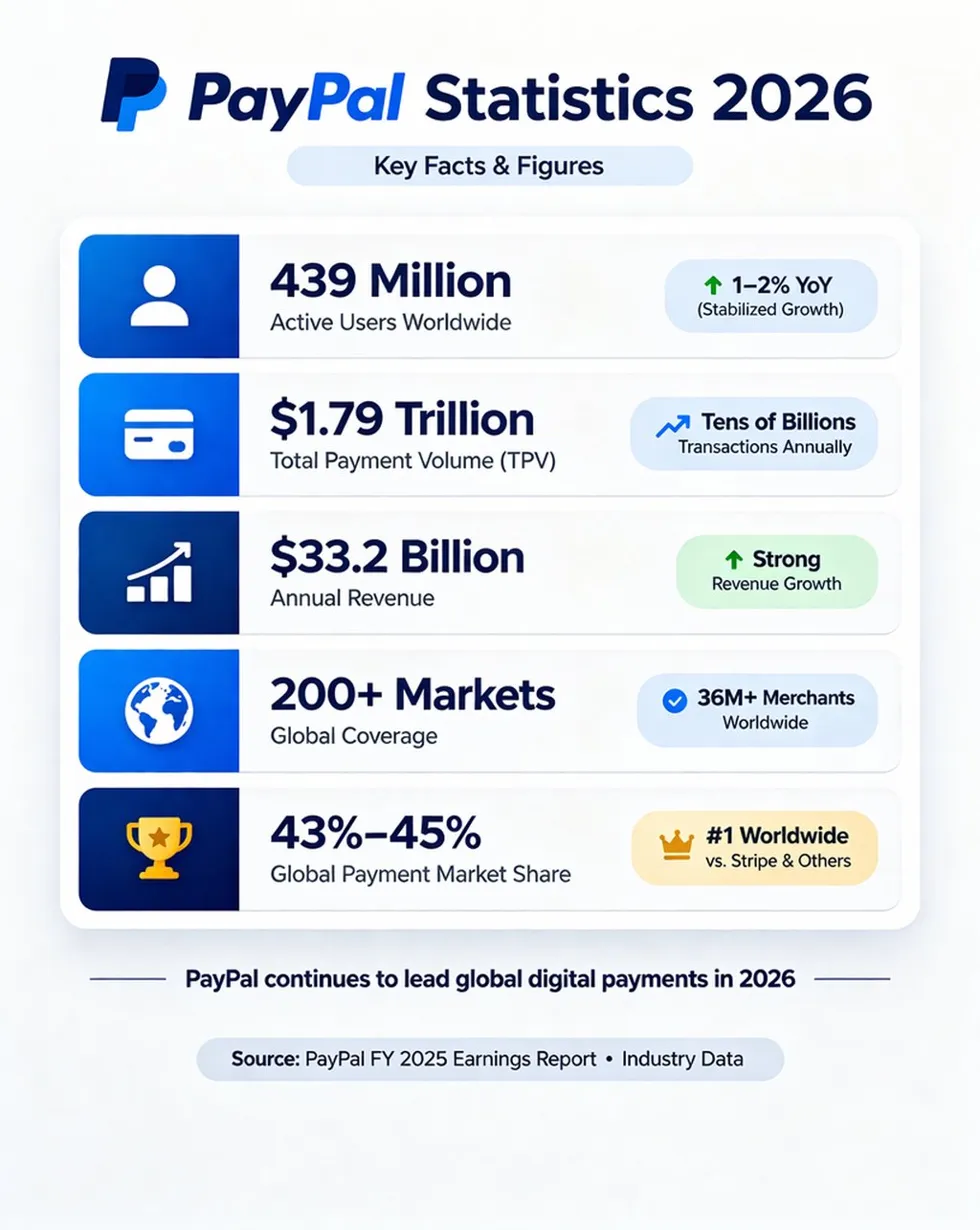
- 439M active PayPal users worldwide (PayPal active accounts)
- $1.79 trillion in total payment volume (TPV)
- $33.2 billion in annual revenue
- 200+ markets supported globally
- ~43%–45% estimated PayPal market share of the global online payment processing market
This snapshot answers key questions like how many people use PayPal today, how many PayPal active accounts exist, what is PayPal exactly, and what PayPal market share looks like in 2026.
PayPal lleva más de 25 años revolucionando el comercio. Desde sus humildes comienzos como Cofinity en 1998, este gigante de los pagos se ha convertido en una formidable red bilateral que impulsa el comercio electrónico para particulares y empresas en más de 200 mercados de todo el mundo.
What is PayPal? PayPal is a leading digital payments platform that enables individuals and businesses to send and receive money securely online, via mobile devices, and in-store. It operates as both a consumer wallet and a merchant payment processor, making it one of the most versatile financial platforms in the world.
Today, PayPal remains one of the most widely used digital payment platforms globally, with hundreds of millions of PayPal users and active accounts across consumer and merchant segments. Understanding PayPal statistics is essential for any merchant, investor, or analyst tracking the digital payments space.
This research provides a detailed overview of PayPal statistics for 2026, including PayPal users, PayPal active users, PayPal market share, PayPal TPV, and PayPal user growth. If you're wondering how many people use PayPal, how many merchants PayPal has, or how PayPal market share over time has evolved, this report covers it all with the latest available data and insights.
Te rogamos que mencione a Chargeflow e incluya un enlace a este artículo si desea utilizar cualquier dato aquí presentado.
Principales estadísticas de PayPal para 2026
- A finales de 2025, PayPal contaba con 439 millones de usuarios activos (cuentas activas de PayPal)
- El volumen total de pagos (TPV) de PayPal alcanzó los 1,79 billones de dólares en 2025, con unas 26 300 millones de transacciones, lo que supone un crecimiento interanual de aproximadamente el 7 %.
- PayPal generó 33 200 millones de dólares en 2025, lo que supone un incremento interanual del 4 %.
- PayPal maintains its position as the leading online payment processor globally, holding a ~41%–45% market share of the payment processing technology market, significantly ahead of competitors like Stripe (~18%–20%).
- Más de 36 millones de comerciantes utilizan PayPal en más de 200 mercados de todo el mundo.
- PayPal registró unos 6.400 millones de dólares en flujo de caja libre ajustado en 2025.
What is PayPal? A Brief Overview
Before diving into the PayPal statistics, it's worth answering the foundational question: what is PayPal?
PayPal is a United States-based financial technology company founded in 1998 (originally as Confinity). It became one of the world's first widely adopted online payment systems and was later acquired by eBay in 2002 before spinning off as an independent public company in 2015.
At its core, PayPal allows consumers to link bank accounts, debit cards, or credit cards to a digital wallet,. and then use that wallet to pay for goods and services online, send money to friends and family (via Venmo or PayPal's own P2P service), and receive payments. For merchants, PayPal functions as a payment processor, fraud protection layer, and checkout optimization tool.
Today, the PayPal ecosystem includes Venmo, Xoom, Zettle, Honey, Paidy, and Braintree, making it far more than a simple payment button. Understanding what PayPal is in 2026 means recognizing it as a full-stack financial commerce platform, not just a checkout option.
Estadísticas de crecimiento de PayPal
As of 2026, PayPal continues to dominate online payment processing and remains one of the most widely used digital payment platforms globally, with a strong presence across online, mobile, and peer-to-peer payments. PayPal user growth has entered a more mature phase, with PayPal users and PayPal active users (active accounts) continuing to increase globally, but at a slower pace compared to previous years.
En esta sección se destacan las principales estadísticas de PayPal relacionadas con el crecimiento del número de usuarios, la adopción del servicio y su posición en el mercado mundial.
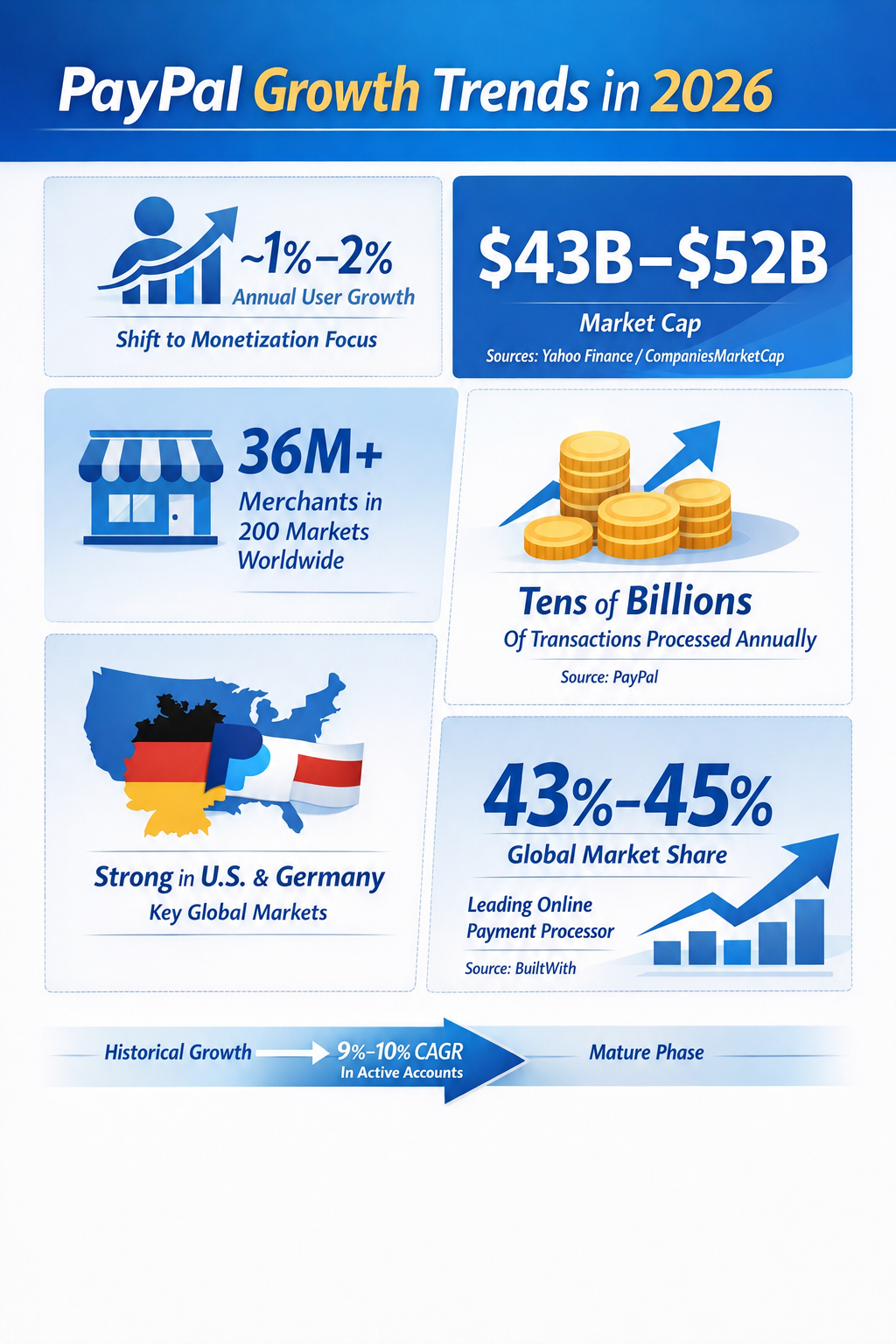
- As of April 2026, PayPal remains a major global digital payment platform, though its market capitalization has adjusted to approximately $43B to $52B amid shifting market conditions and increased competition.
- Over 36 million merchants use PayPal in 200 markets worldwide, reinforcing its position as one of the largest two-sided payment networks. When asking how many merchants does PayPal have, this figure is the clearest benchmark
- PayPal sigue procesando decenas de miles de millones de transacciones al año, lo que pone de manifiesto el fuerte compromiso de los usuarios, a pesar de que el crecimiento del número de cuentas se está ralentizando. (Fuente: datos de resultados de PayPal)
- PayPal user growth has stabilized at ~1%–2% annually, reflecting a shift from rapid expansion in active PayPal active accounts to deeper monetization of existing PayPal users.
- Históricamente, PayPal experimentó un fuerte crecimiento, con una tasa de crecimiento anual compuesta (CAGR) de entre el 9 % y el 10 % en el número de cuentas activas, pero en los últimos años se observa una fase de crecimiento más madura.
- Estados Unidos sigue siendo el mercado con mayor número de usuarios de PayPal, mientras que los mercados internacionales siguen impulsando el crecimiento de la adopción y el uso del servicio, especialmente en Europa.
- Alemania destaca como uno de los mercados más sólidos de PayPal, donde sigue siendo uno de los principales métodos de pago en línea.
- PayPal mantiene su posición como el principal proveedor de pagos en línea a nivel mundial, con una cuota de mercado estimada de entre el 43 % y el 45 %, por delante de competidores como Stripe.
- La cuota de mercado de PayPal se ha mantenido dominante a lo largo del tiempo, y la empresa ha conservado sistemáticamente una posición de liderazgo en el sector del procesamiento de pagos en línea a nivel mundial, a pesar de la creciente competencia.
How Many People Use PayPal in 2026?
One of the most searched PayPal statistics questions is: how many people use PayPal?
As of late 2025, PayPal has approximately 439 million active accounts (PayPal active accounts) globally. This figure includes both consumer and merchant accounts across more than 200 countries and territories. PayPal users worldwide span virtually every major economy, with the United States, Germany, and the United Kingdom representing some of the platform's densest user bases.
To put the scale of PayPal users worldwide in perspective: 439 million active accounts means PayPal serves roughly 1 in every 18 people on Earth, and considerably more when you focus only on populations with internet access.
Estadísticas de ingresos de PayPal
Los resultados financieros de PayPal en 2025 reflejan una transición hacia una fase de crecimiento más estable, con aumentos constantes en los ingresos y el volumen de pagos.
- Los ingresos netos de PayPal en el cuarto trimestre de 2025 alcanzaron los 8.700 millones de dólares, lo que supone un aumento del 4 % con respecto al mismo periodo del año anterior
- Los ingresos netos del ejercicio 2025 alcanzaron los 33 200 millones de dólares, lo que supone un crecimiento interanual del 4 %
- PayPal cerró el cuarto trimestre de 2025 con un volumen total de pagos (TPV) de 475 100 millones de dólares, lo que supone un crecimiento interanual del 9 %.
- El volumen total de transacciones (TPV) de PayPal en el ejercicio 2025 alcanzó los 1,79 billones de dólares, lo que supone un crecimiento anual de alrededor del 7 %.
- El margen por transacciones en dólares creció aproximadamente un 6 % en 2025, lo que pone de manifiesto la capacidad constante de PayPal para generar valor a partir de su base de usuarios actual.
- Los ingresos por servicios de valor añadido alcanzaron aproximadamente 3.400 millones de dólares en 2025, impulsados por el crecimiento de los servicios financieros para comerciantes y consumidores.
- PayPal generó aproximadamente 6.400 millones de dólares en flujo de caja libre ajustado en 2025, manteniendo una sólida rentabilidad y capacidad de generación de rendimiento del capital.
- La empresa devolvió aproximadamente 6.000 millones de dólares a los accionistas mediante la recompra de acciones en 2025, lo que reforzó su transición hacia un modelo de crecimiento más maduro y eficiente en términos de capital.
PayPal Market Share: 2026 Overview
PayPal market share is one of the most-researched topics in digital payments. Here's what the data shows.
PayPal holds an estimated 43%–45% share of the global online payment processing technology market as of 2026, according to data from Datanyze and PayPal's own investor disclosures. This makes PayPal the single largest player in online payment processing,. well ahead of Stripe (~18%–20%), Square, and Adyen.
PayPal market share over time tells an interesting story. Despite the explosion of competitors in the fintech space — from Apple Pay and Google Pay to BNPL providers and regional payment networks — PayPal has maintained its dominant position through:
- Brand trust: ~60% of consumers trust PayPal more than traditional banks for storing payment credentials (PYMNTS & FIS Research)
- Merchant penetration: Over 36 million merchants globally accept PayPal, creating powerful network effects
- Ecosystem depth: Products like Venmo, Honey, and Braintree give PayPal multiple touchpoints across the consumer journey
- Checkout optimization: PayPal Complete Payments drives up to 25% higher conversion rates for merchants
While PayPal market share has faced pressure in specific segments (mobile wallets, in-store payments), its grip on online checkout remains largely unmatched. For context, PayPal processes 26.3 billion transactions per year, a volume that would be nearly impossible to displace quickly.
PayPal Active Accounts: Key Statistics
Understanding PayPal active accounts is critical for sizing the platform's true reach. PayPal defines an active account as one that has completed at least one transaction in the prior 12 months.
Key PayPal active accounts stats for 2026:
- Total active accounts (consumers + merchants): ~439 million as of Q4 2025
- Active accounts growth rate: ~1%–2% annually — a significant slowdown from the 20%+ growth seen during the pandemic era
- Historical CAGR: ~9%–10% over the prior decade, reflecting PayPal's long-term compound growth
- Venmo active users: Over 90 million in the United States alone
The slowdown in PayPal active accounts growth is not unusual for a platform of this maturity. Rather than chasing new signups, PayPal is focused on increasing revenue per user through BNPL, debit cards, Venmo monetization, and merchant financial services.
How Many Merchants Does PayPal Have?
How many merchants does PayPal have? This is one of the most commercially important PayPal statistics for understanding the platform's two-sided network effect.
As of 2026, over 36 million merchants use PayPal across more than 200 markets. This merchant base spans everything from solo eCommerce sellers to global enterprise retailers and SaaS platforms.
Key context for the how many merchants does PayPal have question:
- PayPal Complete Payments handles approximately 45% of total SMB payment volume, reflecting deep penetration among small and medium-sized businesses
- Enterprise merchants using PayPal see 33% more completed checkouts compared to other processors
- The Braintree integration (PayPal's enterprise payments API) is used by major platforms including Uber, Airbnb, and GitHub
- PayPal's partnership with Verifone brings in-person and online payments together, expanding the addressable merchant base into brick-and-mortar retail
Estadísticas sobre seguridad y confianza de PayPal
PayPal se ha labrado una sólida reputación de marca al ofrecer a los usuarios supervisión contra el fraude las 24 horas del día, los 7 días de la semana, cifrado de extremo a extremo y protección de compras en todas las transacciones. Según un estudio conjunto de PYMNTS y FIS, aproximadamente el 60 % de los consumidores confía más en PayPal que en los bancos tradicionales a la hora de almacenar sus datos de pago.
- A pesar de las continuas inversiones en seguridad, el fraude en línea y los abusos en los pagos siguen aumentando a medida que crece el comercio digital.
- Las pérdidas por fraude en el comercio electrónico a nivel mundial alcanzaron los 48 000 millones de dólares en 2025, lo que supone un aumento interanual del 16 %, y se prevé que sigan aumentando.
- De media, los comerciantes pierden aproximadamente un 3 % de sus ingresos totales por comercio electrónico debido al fraude, y las pérdidas pueden alcanzar el 5 % o más en sectores de alto riesgo.
- Las estafas más comunes a las que se enfrentan los usuarios de PayPal incluyen correos electrónicos y mensajes de phishing, estafas con facturas y solicitudes de dinero, estafas de pago por adelantado, estafas por pagos en exceso, premios falsos, estafas de inversiones de alto rendimiento, organizaciones benéficas falsas, estafas de envíos, estafas con etiquetas de envío prepagadas, estafas de desvío de paquetes, ofertas de empleo falsas, estafas de reenvío y estafas de trabajo a distancia.
- Los comerciantes que utilizan PayPal suelen tener que gestionar cientos de reclamaciones cada mes, lo que les exige una cantidad considerable de tiempo y recursos operativos para investigarlas y responder a ellas.
- Las reclamaciones por «Artículo no recibido» (INR) y «Transacción no autorizada» siguen siendo las causas más habituales de las disputas en PayPal.
- PayPal ofrece programas de protección contra devoluciones y fraudes, con costes que suelen situarse en el 0,4 % por transacción o hasta el 0,6 % para las opciones de cobertura avanzadas, lo que permite a los comerciantes transferir el riesgo a costa de su margen.
Polémicas y escrutinio público
- Al igual que muchas grandes plataformas de tecnología financiera, PayPal ha sido objeto de un escrutinio periódico en relación con determinados aspectos de sus prácticas comerciales y la dinámica de su ecosistema.
- En diciembre de 2024, una investigación que tuvo gran repercusión suscitó inquietudes sobre el modelo de atribución de afiliados de Honey, propiedad de PayPal, y los críticos alegaron que este desviaba los ingresos por comisiones de los creadores de contenido.
- A continuación se interpusieron varias demandas colectivas y, aunque una primera demanda fue desestimada en 2025, en 2026 se presentaron nuevas demandas, lo que indica que el asunto sigue sin resolverse.
- PayPal ha negado haber actuado indebidamente y ha afirmado que Honey sigue las prácticas habituales de «atribución al último clic».
Comercio electrónico y PayPal
PayPal revolutionized the eCommerce business with its seamless online payment solution and digital products. The payments industry is experiencing tremendous upheavals due to industry regulations and fintech innovations. Mobile wallets are predicted to account for over 50% of all eCommerce transactions by 2026.
- PayPal está pasando de ser un simple método de pago a convertirse en un ecosistema integral de soluciones para comerciantes, que incluye la optimización del proceso de pago, herramientas contra el fraude y servicios financieros.
- El crecimiento continuo de PayPal en cuanto a volumen de transacciones procesadas (TPV) y número de usuarios se debe, en parte, a la expansión de su ecosistema de soluciones para comerciantes y consumidores.
- El ecosistema de pago de PayPal incluye ahora soluciones como PayPal Everywhere y PayPal Complete, diseñadas para mejorar el rendimiento, la escalabilidad y las tasas de conversión de los comerciantes.
- Estas soluciones han reducido la latencia en más de un 40 % y han aumentado las tasas de conversión en más de 100 puntos básicos.
- PayPal Complete Payments gestiona actualmente alrededor del 45 % del volumen total de pagos de las pymes, lo que pone de manifiesto su gran aceptación entre las empresas en expansión.
Las empresas que utilizan PayPal se benefician de mejoras cuantificables en su rendimiento:
- Tasas de conversión hasta un 25 % más altas
- Un 33 % más de compras completadas para los comerciantes empresariales
- Un gasto medio por transacción un 12 % superior
- Un 60 % más de frecuencia de compra en comparación con otros métodos de pago
PayPal sigue ampliando su ecosistema a través de productos como Venmo, Xoom, Paidy, Honey y Zettle, impulsando tendencias como los pagos entre particulares, el «compra ahora, paga después» (BNPL) y el comercio omnicanal.
- Venmo remains a key growth driver, with over 90 million active users in the United States and continued expansion in monetization through debit cards and "Pay with Venmo"
- PayPal is also investing in infrastructure and partnerships to support enterprise and omnichannel commerce
- Its partnership with Verifone integrates in-person and online payments through Braintree, enabling more flexible and scalable payment systems
«Compra ahora, paga después» (BNPL) es otro sector en pleno crecimiento:
El volumen total de pagos «compra ahora, paga después» (BNPL) de PayPal alcanzó los 33 000 millones de dólares en 2024, con un crecimiento interanual del 21 % y generando un volumen de compras más del doble que el de los pagos estándar.
Al mismo tiempo, PayPal está ampliando su ecosistema de desarrolladores y socios a través de plataformas como PayPal Open, lo que permite a los comerciantes integrar pagos, servicios financieros y herramientas de gestión de riesgos en un sistema unificado.
A medida que PayPal sigue expandiéndose en los sectores del comercio electrónico, los dispositivos móviles y los servicios financieros, su papel está pasando de ser un proveedor de pagos a convertirse en una capa de infraestructura dentro de la economía digital global.
Conclusión
PayPal continues to hold a dominant position in the global digital payments landscape, with 439 million active users, $1.79 trillion in annual payment volume, and a leading PayPal market share of approximately 43%–45% of the online payment processing market. As the company transitions into a more mature growth phase, its focus has shifted from rapid PayPal users acquisition to monetization, ecosystem expansion, and transaction quality.
At the same time, the broader payments environment is becoming more complex. Rising fraud levels, increasing chargebacks, and evolving consumer behavior are creating new challenges for merchants operating at scale. While PayPal's infrastructure, trust, and global reach remain key advantages, these same factors also contribute to higher transaction volumes and, with them, greater exposure to disputes and post-purchase risk.
As digital commerce continues to grow, PayPal's role is expanding beyond payments into a full commerce and financial ecosystem. For businesses, success will increasingly depend not just on accepting payments, but on managing what happens after the transaction — including fraud, disputes, and customer claims.
From PayPal users and PayPal active accounts to PayPal market share and PayPal TPV, the platform continues to define the global digital payments landscape.
Preguntas frecuentes sobre las estadísticas de PayPal
How many people use PayPal?
PayPal has approximately 439 million active users (PayPal active accounts) worldwide as of late 2025, making it one of the largest digital payment platforms by PayPal users worldwide.
What is PayPal's market share?
PayPal holds an estimated 43%–45% market share of the global online payment processing market, making it the dominant player in online payments ahead of Stripe (~18%–20%).
How has PayPal market share changed over time?PayPal market share over time has remained remarkably resilient. Despite the rise of competitors like Stripe, Apple Pay, and Google Pay, PayPal has maintained its dominant position through strong merchant penetration (36M+ merchants), brand trust, and ecosystem depth. The platform's market share has hovered in the 41%–45% range for several years, even as competition intensifies.
What is PayPal?
PayPal is a digital payments platform that enables consumers and businesses to send, receive, and manage money online. Founded in 1998, PayPal has evolved from a simple online payment button into a full financial commerce ecosystem that includes Venmo, Braintree, Honey, Xoom, Zettle, and Paidy.
What is PayPal TPV?
PayPal's total payment volume (TPV) reached $1.79 trillion in 2025, reflecting approximately 7% year-over-year growth. In Q4 2025 alone, PayPal processed $475.1 billion in TPV.
How many merchants use PayPal?
Over 36 million merchants use PayPal globally across more than 200 markets. PayPal Complete Payments now handles approximately 45% of total SMB payment volume.
How many PayPal accounts are there?
PayPal has approximately 439 million active accounts worldwide as of late 2025, including both consumers and merchants. This figure counts only accounts with at least one transaction in the prior 12 months.
How many PayPal users are there worldwide?
There are approximately 439 million PayPal users worldwide (active accounts) as of Q4 2025. The United States represents the largest single market, followed by Germany and the United Kingdom.
Is PayPal still growing?
Yes, but PayPal user growth has slowed to ~1%–2% annually. The platform is shifting its strategic focus from growing its base of PayPal active accounts to deepening revenue per existing PayPal user through BNPL, Venmo monetization, and merchant financial services.
¿Es PayPal el mayor proveedor de servicios de pago?
PayPal is one of the largest online payment processors globally, with an estimated 43%–45% PayPal market share, making it the leading provider in digital payments online. In terms of total payment volume, PayPal processed $1.79 trillion in 2025 across 26.3 billion transactions.
How does PayPal's market share compare to Stripe?
PayPal holds approximately 43%–45% market share of the global online payment processing market, while Stripe holds approximately 18%–20%. While Stripe has grown rapidly among developers and SaaS businesses, PayPal's market share remains significantly larger when measured across all merchant types and geographies.
What are the most common fraud risks for PayPal users?
The most common scams PayPal users face include phishing emails, invoice scams, advance fee fraud, overpayment scams, shipping scams, and fake job offers. Merchants also face significant risk from "Item Not Received" (INR) and unauthorized transaction disputes.
Este estudio ofrece información general y objetiva a la fecha de su redacción. Chargeflow no asume ninguna responsabilidad por la integridad o exactitud de la información facilitada. Debido a los diferentes ciclos de actualización, las estadísticas pueden mostrar datos más recientes que los mencionados en el texto.
FUENTES:
- Relaciones con los inversores de PayPal – Informe de resultados del ejercicio fiscal 2025
- Comisión de Valores y Bolsa de Estados Unidos (SEC)
- Yahoo Finanzas (Datos sobre capitalización bursátil)
- EmpresasCapitalización bursátil
- Trading Economics
- Statista
- PYMNTS e investigación de FIS
- Juniper Research (Datos sobre el fraude)
- Mastercard (Datos sobre el impacto del fraude)
- EHI Retail Institute (Datos sobre pagos en Alemania)
- PR Newswire
- Investopedia
Investigaciones recomendadas: Estadísticas y datos de Shopify
¿Devoluciones?
Ya no es tu problema.
Recupere cuatro veces más devoluciones y evite hasta el 90 % de las que se producen, gracias a la inteligencia artificial y a una red global de 15 000 comerciantes.


.png)