What Is a Payment Dispute? Meaning, Types and Timelines by Method


Chargebacks?
Dat is niet langer jouw probleem.
Haal 4x meer chargebacks terug en voorkom tot 90% van de inkomende betalingen, dankzij AI en een wereldwijd netwerk van 20.000 handelaren.


 Meer dan 600 beoordelingen


TL;DR:
- A payment dispute covers any challenged charge, while a chargeback is only the card-network version.
- Issuers rule on card cases, banks on ACH returns and debit errors, and PayPal or BNPL providers on their own cases.
- Customers usually get 60 days from the statement under Regulation Z and Regulation E, while merchants often get 5 to 21 days to answer a card dispute.
- Authorized Zelle transfers and wires carry few dispute rights compared with cards and PayPal purchases.
- Refund early when a claim is valid or small, and fight only with proof that answers the exact claim.
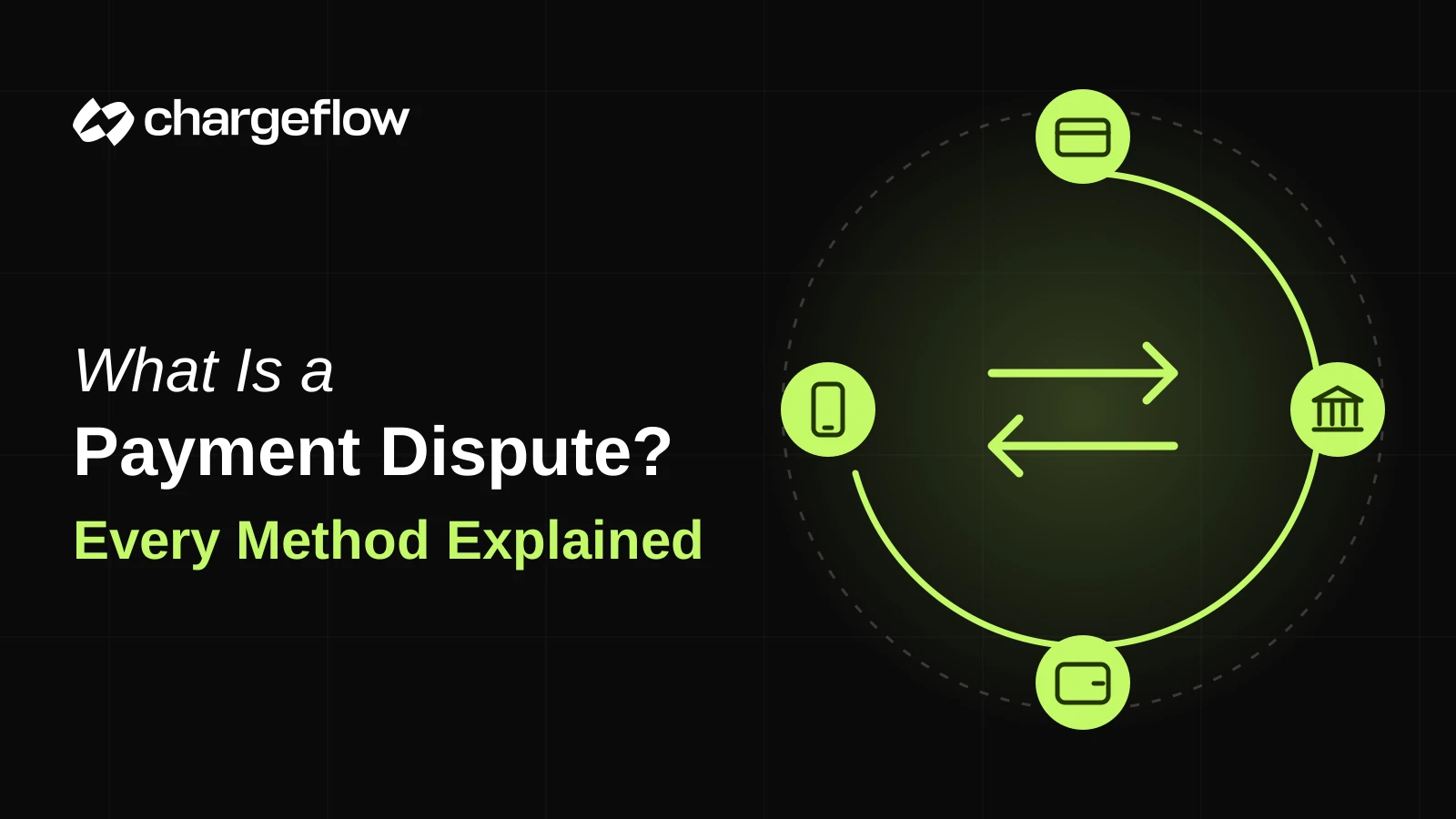
A payment dispute is a formal challenge a customer files with their card issuer, bank or payment provider, saying a transaction was unauthorized, wrong or not delivered as promised. It can end in a refund, a chargeback, an ACH return or a ruling by the provider itself, depending on how the customer paid.
For merchants, the payment method decides almost everything: who rules on the case, how long you have to answer and what it costs. This guide maps those rules across cards, debit, ACH, PayPal, buy now, pay later (BNPL), wallets and peer-to-peer apps.
{{cta}}
What Does Payment Dispute Mean?
A payment dispute means a customer has asked a third party to step in on a charge. That third party is the issuer for cards, the bank for debit and ACH, or the platform for PayPal, BNPL and some apps. The customer no longer needs your consent to get money back.
Every payment dispute has the same core parts:
- A claim: fraud, item not received, not as described, canceled service, duplicate charge or a missing refund.
- A decision maker: the issuer, the bank or the provider, never the merchant.
- A clock: a filing window for the customer and a shorter response window for you.
- A money movement: funds are often held or pulled from your balance while the case is open.
A chargeback is one possible outcome, not a synonym. If you want the card terms side by side, read chargeback vs dispute vs refund vs representment. For the card process itself, start with what is a chargeback.
Is a Payment Dispute the Same as a Chargeback?
No. A payment dispute is the umbrella term for any challenged payment. A chargeback is the card-network version, where the issuer pulls funds back from the merchant. A PayPal claim, a BNPL dispute or an ACH return can all happen with no chargeback at all.
| Term | Wat het Zijn | Who starts it | What happens to your money |
|---|---|---|---|
| Payment dispute | Any formal challenge to a charge, on any payment method | Customer, through issuer, bank or provider | Often held or debited until a decision |
| Terugboeking | Card-network reversal ordered by the issuer | Cardholder, through the card issuer | Debited from your balance, plus a fee |
| Inquiry or pre-dispute | Request for information or an alert before a chargeback posts | Issuer, network or provider | Usually not debited yet |
| ACH return | Bank sends a debit back under Nacha rules, for example as unauthorized | Account holder, through their bank | Debited from your account |
| Terugbetaling | You return money on your own | Handelaar | You control the amount and timing |
The fastest way to keep a dispute from turning into a chargeback is to catch it early. Chargeback alerts give you a short window to refund before the issuer files, so the case does not count as a chargeback.
Who Decides a Payment Dispute, by Payment Method?
The decision maker changes with the payment rail. On cards, the issuer rules under network rules. On PayPal and BNPL, the provider rules under its own terms. On ACH, the customer's bank can return the debit and the dispute moves outside the network. Use this table to see where your case actually sits.
| Betaalwijze | Customer files with | Wie beslist? | Typical merchant cost |
|---|---|---|---|
| Creditcard | Card issuer | Issuer, under Visa, Mastercard or Amex rules | Processor dispute fee, for example Stripe US: $15 per dispute, plus $15 to counter (counter fee returned on a win) |
| Debit card | Bank that issued the card | Bank, under network rules and Regulation E | Same processor fees as credit cards |
| Apple Pay and Google Pay | The bank behind the stored card | Card issuer, under card network rules | Same as the underlying card |
| ACH debit | De bank van de klant | Bank returns the debit under Nacha rules; you then collect directly | Return fees set by your processor or bank |
| PayPal | PayPal Resolution Center (or the card issuer) | PayPal for disputes and claims; the issuer for card chargebacks | $15 standard or $30 high-volume dispute fee per PayPal dispute fee policy |
| BNPL (Klarna, Affirm, Afterpay) | The BNPL provider | The BNPL provider, under its merchant terms | Varies; Affirm charges a $15 dispute fee on a lost case |
| P2P apps (Venmo, Zelle, Cash App) | The app or the linked bank | App for eligible purchase claims; bank for unauthorized transfers | Depends on the product; personal transfers often have no merchant process |
| Bankoverschrijving | Sending bank | Receiving bank, by recall request | No formal dispute right for an authorized wire |
Two patterns stand out. First, the more a payment looks like a card, the more it follows card rules: wallets and most debit transactions do. Second, push payments like Zelle and wires give customers far fewer rights once they approved the transfer. That cuts both ways: less dispute risk for you, but also less trust from buyers.
For method-specific playbooks, see PayPal dispute vs claim vs chargeback, BNPL dispute evidence, ACH payment disputes and Stripe dispute fees.
How Long Does a Payment Dispute Take?
Most card disputes take two to three months from filing to final decision, according to Stripe. Regulated debit and credit investigations run on fixed legal clocks. Provider-run disputes, like PayPal and BNPL, move faster but give you less time to reply.
60 days Customer window under Reg Z and Reg E, from the statement date | 10 days Business days for a bank to investigate a debit error | 5 to 21 Days a merchant usually has to respond to a card dispute | 180 dagen PayPal window for item-not-received claims |
Sources: CFPB Regulation Z, 1026.13, CFPB Regulation E, 1005.11, Stripe guide to payment disputes, PayPal US dispute filing timeframes.
| Betaalwijze | Customer filing window | Decision or response clock |
|---|---|---|
| Credit card (Reg Z) | Billing-error notice within 60 days of the first statement showing the charge | Issuer acknowledges within 30 days and resolves within 2 billing cycles, never more than 90 days |
| Debit card and bank EFT (Reg E) | Error notice within 60 days of the statement | 10 business days, or up to 45 days with provisional credit; 90 days for point-of-sale debit, foreign and new-account transfers |
| Terugvordering door een kaartnetwerk | Set by network and reason code, often 120 days | Merchant usually has 5 to 21 days to respond through the processor |
| ACH debit (Nacha) | Unauthorized consumer debits can be returned up to 60 days after settlement | Business-account unauthorized returns generally within 2 banking days |
| PayPal | Item not received: up to 180 days from payment; not as described: earlier of 30 days from delivery or 180 days | Dispute closes after 20 days unless escalated to a claim |
| Klarna | Customer opens a dispute in the Klarna app | Merchant responds within 21 days for most reasons, 7 days for unauthorized |
| Afterpay | Customer raises a dispute with Afterpay | 13 days from notification to respond |
| Cash App Pay | Customer disputes in Cash App | A case with evidence is challenged automatically on day 13 |
On debit disputes, the bank may post provisional credit to the customer while it investigates. That does not mean you lost. It means the bank met its legal clock. If you are fighting a debit case, use our guide to win a debit card chargeback dispute.
Why Do Customers Dispute Payments?
Most payment disputes fall into six claim types. The claim decides what evidence wins.
- Unauthorized or fraud: the customer says they never made the purchase. Some are true fraud. Many are friendly fraud by real buyers.
- Item not received: the order never arrived, or arrived late.
- Not as described: the product or service did not match the listing.
- Canceled subscription: the customer says they canceled before a renewal.
- Credit not processed: a promised refund never showed up.
- Processing errors: a duplicate charge, wrong amount or unclear billing descriptor.
Scale matters here. Mastercard projects 286 million chargebacks worldwide in 2026, costing $36.9 billion, rising to $46.1 billion by 2029 (Mastercard, updated June 2026, research by Datos Insights). Outside cards, the CFPB found that more than 13% of BNPL transactions involved a return or dispute (CFPB).
How Should a Merchant Handle a Payment Dispute?
Handle every payment dispute the same way, whatever the rail. The steps below work for cards, PayPal, BNPL and ACH. Only the deadlines and the upload screen change.
When Should You Refund Instead of Fighting?
- Refund when the claim is correct, the order is small, or your evidence cannot prove delivery or authorization.
- Refund before escalation on PayPal inquiries and BNPL inquiries, where an early refund can avoid a dispute fee.
- Fight when you can prove delivery, usage, cancellation terms or a prior undisputed purchase by the same customer.
- Never do both. A refund after a chargeback posts can mean you pay the customer twice.
If you lose, the money usually stays with the customer and the case counts toward your dispute ratio. Learn how money moves back in payment reversals and how each route ends.
What Does a Disputed Transaction Mean on a Statement or Dashboard?
A disputed transaction on a customer's statement means the bank is reviewing the charge. The customer may see a temporary credit. On your processor dashboard, the same case shows as a dispute, inquiry or chargeback, and the funds plus a fee are often held.
The labels differ by provider. Stripe shows "Needs response." PayPal shows an open case in the Resolution Center. Some BNPL providers pause the payout for that order. In every case, the status means a deadline is running.
How Do You Dispute a Payment as a Customer?
To dispute a payment, contact the seller first, then file with whoever moved the money: your card issuer, your bank, PayPal or the BNPL app. File within the window, usually 60 days from the statement for cards and bank accounts. Keep receipts, messages and tracking numbers.
P2P apps work differently. Venmo covers eligible goods and services payments under Purchase Protection. For Zelle, banks handle unauthorized transfers, and Zelle says some impostor scams can qualify for reimbursement. Read how to dispute a Zelle payment, the Venmo chargeback routes and Cash App Pay disputes.
How Can Merchants Prevent Payment Disputes Across Every Method?
Most disputes start as confusion, not fraud. Fix the causes that apply to every rail:
- Use a billing descriptor customers recognize, and match it on receipts.
- Send shipping and delivery updates with tracking links.
- Make cancellation and refund steps easy to find.
- Refund fast when you promise a refund.
- Answer support tickets before customers go to their bank.
- Screen risky orders before you ship, not after the dispute.
Prevention matters more than recovery for your account health. On cards, a won chargeback still counts toward network ratios. On PayPal, a high dispute rate moves you to the $30 high-volume fee once you pass 1.5% with more than 100 sales in three months, per PayPal's dispute fee FAQ.
Veelgestelde vragen
What is a payment dispute?
A payment dispute is a formal challenge a customer files with their card issuer, bank or payment provider, claiming a charge was unauthorized, incorrect or not delivered as promised. The provider, not the merchant, decides the outcome, and the dispute can end in a refund, a chargeback or a ruling for the merchant.
What happens when I dispute a payment?
When you dispute a payment, your card issuer, bank or payment provider opens a case and contacts the merchant for evidence. You may get a temporary credit during the review. The provider then decides who keeps the money, which usually takes a few weeks to three months.
Betekent een geschil dat ik mijn geld terugkrijg?
No, a dispute does not mean refund. A refund is money the merchant returns voluntarily. A payment dispute is a claim decided by a third party, and the customer gets money back only if the issuer, bank or provider rules in their favor or the merchant accepts the claim.
Can I dispute a transaction and get my money back?
Yes, you can often get your money back by disputing a transaction if the charge was unauthorized, wrong or not delivered and you file within the window. Card and bank customers usually have 60 days from the statement. Authorized P2P transfers and wires are much harder to recover.
Can a merchant win a payment dispute?
Yes, a merchant can win a payment dispute by sending evidence that answers the exact claim, such as delivery proof, usage logs or cancellation terms, before the deadline. A win returns the disputed funds, though on cards the case still counts toward the merchant's dispute ratio.
How long does a payment dispute take?
A payment dispute usually takes a few weeks to three months. Card disputes often run two to three months in total. Credit card billing errors must be resolved within 90 days under Regulation Z, and debit errors within 45 days, or 90 days for some transfers, under Regulation E.
One Workflow for Payment Disputes on Every Processor
A payment dispute is one problem with many rule books. Cards, PayPal, BNPL and ACH each set their own clock, fee and evidence screen. Teams that track each rail in a separate tool miss deadlines and refund cases they could have won.
Chargeflow pulls disputes from 100+ integrations, including Shopify, Stripe and PayPal, into one queue. It builds evidence automatically, handles inquiries on supported BNPL platforms and charges only for chargebacks it recovers.
{{cta}}
Resolve Payment Disputes Across Every Processor
Chargeflow Automation pulls disputes from cards, PayPal and BNPL into one queue and builds the evidence for each case.
Chargebacks?
Dat is niet langer jouw probleem.
Haal 4x meer chargebacks terug en voorkom tot 90% van de inkomende betalingen, dankzij AI en een wereldwijd netwerk van 20.000 handelaren.