How to Run a 30-Day Shopify Chargeback-Prevention Pilot


Chargebacks?
Dat is niet langer jouw probleem.
Haal 4x meer chargebacks terug en voorkom tot 90% van de inkomende betalingen, dankzij AI en een wereldwijd netwerk van 20.000 handelaren.


 Meer dan 600 beoordelingen


TL;DR:
- A 30-day Shopify chargeback-prevention pilot can prove operational feasibility before every dispute outcome has matured.
- Progress through instrumentation, an observation setup, controlled enforcement and stabilization; confirm which controls the account supports.
- Leading measures include coverage, latency, action mix, verification, support load and missed fulfillment cutoffs.
- Lagging measures include mature disputes, false-positive indicators and net economic impact.
- Stop conditions for integration failure, excessive cancellation, customer harm and privacy concerns must be set before enforcement.
- Chargeflow’s product claims should be treated as scoped pilot hypotheses rather than guaranteed merchant outcomes.
A 30-day pilot should validate integration, coverage, latency, workflow, verification and early decision quality while preserving a valid baseline. Because disputes mature later, set a follow-up window for financial outcomes and do not declare ROI from canceled orders alone. Begin with observation and enable limited enforcement only when the available setup supports the agreed controls.
Thirty days can establish operational readiness if the sample and supported setup are adequate. It may not capture mature chargeback outcomes. The pilot must distinguish leading evidence available now from mature outcomes available later.
Write the go/no-go criteria before seeing results. That keeps one dramatic prevented order or one angry customer from replacing the agreed business case.
Prevent workflow documentation, checked November 1, 2026 lists Proceed, On Hold and Cancel; automated Verify is marked coming soon. Confirm account availability and test that the hold reaches your fulfillment system. Other automations can override it.
Explore Chargeflow Prevent for ecommerce fraud and friendly-fraud prevention.
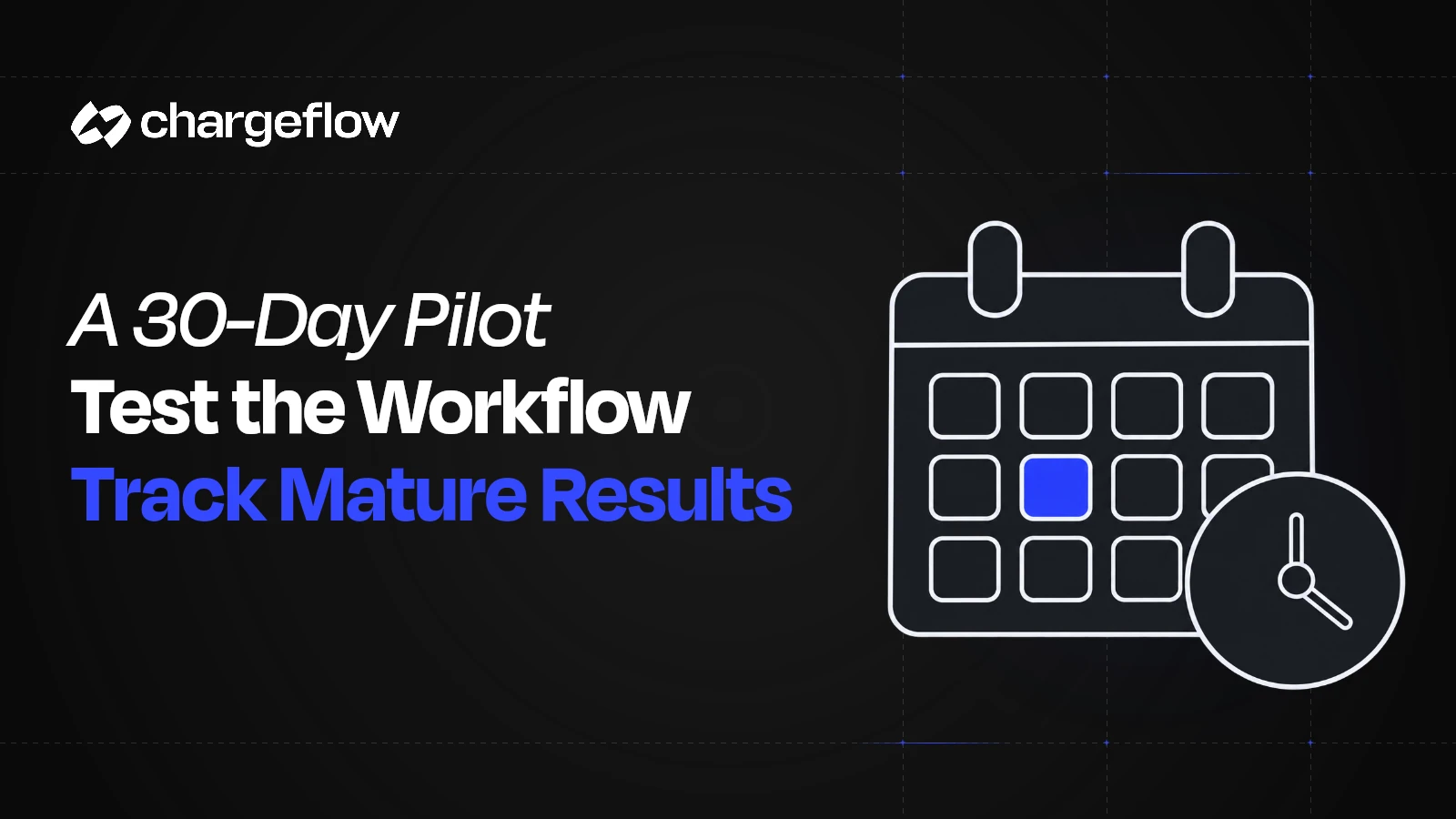
Days 1–5: instrument
Confirm scope, events, identifiers, holds, monitoring and baseline
Proves data and workflow readiness.Days 6–10: observe
Score without enforcing and compare recommendations
Reveals volume, conflicts and capacity.Days 11–20: controlled action
Enable selected holds or verification with daily review
Tests customer and operational behavior.Days 21–30: stabilize
Ramp only if guardrails hold; document issues
Produces a launch recommendation.Post-pilot: mature
Follow refunds, disputes and false positives to the agreed window
Produces defensible financial evaluation.
Freeze the baseline and population
Define eligible shops, payment routes, order types, value bands and exclusions. Record current fraud analysis, rules, manual review, dispute rate, fulfillment latency and costs.
Avoid changing unrelated fraud or returns policies during the test. If change is unavoidable, document it so results are not falsely attributed.
Use the pre-fulfillment prevention framework to document the payment-to-fulfillment window and which team owns each action before selecting the test cohort.
Set leading and lagging acceptance criteria
Leading criteria include coverage, event completeness, decision latency, action distribution, hold enforcement, verification completion, support load and critical incidents. Lagging criteria include mature disputes, good-order harm and net economic impact.
Set stop conditions for excessive cancellations, missed fulfillment, integration failures, privacy concerns or customer escalation.
Ramp enforcement deliberately
Design a merchant-controlled observation period that records recommendations while existing approved controls remain responsible for fulfillment. “Shadow” here describes the test design; it is not a claim that Prevent has a native shadow-mode switch or configurable cohort feature. Confirm a supported setup with the vendor before running it.
If observation or cohort separation cannot be implemented safely, use available test or replay cases and keep enforcement disabled until the team approves a supported design. Do not invent an integration around an unavailable API.
For controlled action, specify the eligible population, review capacity and daily exposure cap. Widen only after the named owners approve the evidence. Version policy changes and retain overrides; a changed threshold creates a new cohort.
Make the decision in two stages
At day 30, decide whether the system is operationally safe and whether evidence supports continued controlled use. Do not claim final financial success before disputes and returns mature.
At the follow-up review, compare the original decision cohorts with outcomes and refresh the ROI model. Scale, modify or stop according to the preregistered criteria.
Worked example: day-30 operating scorecard
The following thresholds are invented acceptance examples for a hypothetical 5,000-order pilot. They are not product guarantees or recommended defaults. Agree your own thresholds, sample requirements and stop authority before enabling action.
Scroll horizontally to see every column.
| Measure / owner | Hypothetical acceptance test | Evidence to retain |
|---|---|---|
| Coverage / Engineering | At least 98% of eligible orders assessed before the fulfillment cutoff. | Eligible, assessed, missing and late counts by order type. |
| Latency / Engineering + Operations | 95% of automated decisions enforced within 45 seconds. | Order event to actual fulfillment-system state; not only score arrival. |
| Reliability / Engineering | No unresolved duplicate actions or critical incident beyond the agreed response window. | Retries, refunds, state reconciliation and incident timeline. |
| Workload / Risk | Fewer than 2% of eligible orders require manual review. | Review count, duration, backlog and complexity. |
| Customer handling / CX | If verification is available and used, at least 70% of delivered requests complete. | Sent, delivered, completed, nonresponse and appeals as separate counts. |
| Fulfillment / Operations | Zero missed warehouse cutoffs caused by a risk hold. | Hold start, expiry, actual release and carrier cutoff. |
Automated Verify remains marked coming soon in the workflow guide. Use an approved manual process if needed, and measure it separately. Nonresponse alone is not proof of fraud.
Day 30: proceed cautiously
Sponsor and operating owners approve continued controlled use only if mandatory guardrails pass and observed workload is sustainable.
Day 30: hold or stop
Hold expansion when evidence is incomplete. Stop enforcement under the predefined rollback if an essential control fails; route orders to the approved baseline.
Later: decide financial scale
Finance and Risk compare cohorts of equal maturity, actual cost and customer harm after the agreed outcome window.
Keep the decision provisional
Few or zero disputes in a small recent cohort do not prove elimination. Report sample size and uncertainty, and extend observation when needed.
Test decisions, transitions and failure states
A pilot should not test only whether the dashboard receives an order. The evidence needs to show that each recommendation produces the intended Shopify and warehouse state, that buyer communication is sent once and that retries cannot duplicate a cancellation, refund or release.
Shopify’s fraud-analysis documentation describes simulated risk recommendations for supported test configurations. Those tests exercise Shopify’s recommendation path; they do not validate Prevent’s model or network signals. Add vendor-specific and merchant-created cases for repeat disputers, network or identity signals, missing recommendations, delayed events and rule conflicts.
- Happy paths: low-risk release, verify-and-release and approved cancellation.
- Conflict paths: Shopify and add-on scores disagree or more than one rule matches.
- Failure paths: no score, late score, duplicate event, provider outage and warehouse cutoff.
- Outcome path: every test case retains policy version, action, approver and later result.
Turn each published result into a pilot hypothesis
Write merchant-specific questions before enforcement: Does the added assessment change useful decisions beyond the current baseline? Do those actions reach fulfillment in time? Do later losses improve after accounting for delayed or lost good orders?
Vendor comparisons can suggest categories to investigate, but they are not pilot acceptance thresholds. Pre-register eligibility, policy versions, baseline, cost definitions and the later outcome-read date. Use comparable order ages and record differences in season, order value, payment route and customer tenure.
Implementation sequence
- Name sponsor and owners: Assign Risk, Operations, Engineering, CX, Finance and Security responsibilities.
- Lock scope and baseline: Define eligibility, current controls and comparison design.
- Instrument end to end: Connect events, decisions, fulfillment, communication and outcomes.
- Run the supported observation setup: Validate recommendations, conflicts and queue volume.
- Enable bounded action: Start with a small cohort and explicit stop conditions.
- Review daily: Track latency, errors, customer impact and overrides.
- Close at day 30: Make an operational decision and schedule mature-outcome review.
- Complete financial follow-up: Use disputes, false positives and actual cost to decide scale.
Failure modes and controls
Scroll horizontally to see every column.
| Failure mode | Business consequence | Control |
|---|---|---|
| Pilot measures only canceled value | ROI is declared from an unobserved counterfactual. | Use mature follow-up and probability-weighted estimates. |
| No baseline freeze | Other changes contaminate results. | Document and preserve the comparison stack. |
| Full enforcement on day one | Unknown rules create customer and warehouse risk. | Observe using a supported setup, then ramp. |
| No stop conditions | Teams continue despite operational harm. | Predefine thresholds and authority. |
| Day 30 treated as final dispute maturity | Recent orders look artificially clean. | Schedule a later outcome read. |
How Chargeflow Prevent fits
Budget eligible scans using the current published pricing and the per-order ROI model. Include implementation, review and customer-support cost. Confirm the supported actions and account rollout before building the pilot around automated verification or external data access.
Use the vendor evaluation scorecard to settle mandatory requirements and the prevention KPI guide to define each metric.
Frequently asked questions
Can a pilot prove ROI in 30 days?
It can prove operational feasibility and early decision quality; final dispute and customer outcomes often require later follow-up.
What is shadow mode?
It is an observation test that records recommendations without changing the current fulfillment policy. This guide uses the term for a merchant-designed setup, not a documented native Prevent mode; confirm feasibility before planning around it.
How large should the pilot be?
Large enough to observe representative risk and workflow volume while small enough to cap customer and operational exposure.
What are good stop conditions?
Critical integration failure, excessive good-order cancellation, missed fulfillment SLAs, material customer escalation or a privacy/security issue.
Who makes the go/no-go decision?
A named sponsor should decide using input from Risk, Operations, CX, Engineering, Security and Finance against preregistered criteria.
How do I test a Shopify fraud workflow?
Use test or replay cases that exercise low, medium and high risk, missing data, conflicting scores, timeouts, duplicate events and outages. Shopify currently documents test email addresses for simulated risk levels in supported test configurations. Confirm the final Shopify and warehouse state for every case.
What can a 30-day fraud-prevention pilot prove?
It can prove event coverage, decision latency, rule behavior, queue volume, customer handling, fulfillment control and early action quality. It usually cannot fully prove mature dispute reduction for recent orders. Schedule a later read after the relevant delivery, return and dispute windows close.
Bronnen
Validate Prevent in Your Shopify Workflow
Start with supported controls, measurable operating criteria and a later outcome review.
Chargebacks?
Dat is niet langer jouw probleem.
Haal 4x meer chargebacks terug en voorkom tot 90% van de inkomende betalingen, dankzij AI en een wereldwijd netwerk van 20.000 handelaren.