%201.svg)


































PayPal-statistieken en feiten 2026


Terugboekingen?
Dat is niet langer uw probleem.
Vorder 4 keer meer terugboekingen terug en voorkom tot 90% van de inkomende terugboekingen, dankzij AI en een wereldwijd netwerk van 15.000 handelaren.


 Meer dan 600 beoordelingen
Dit is een gedetailleerd overzicht van de statistieken, feiten en cijfers van PayPal voor 2026, gebaseerd op de meest recente beschikbare gegevens uit 2025 en toekomstgerichte inzichten.
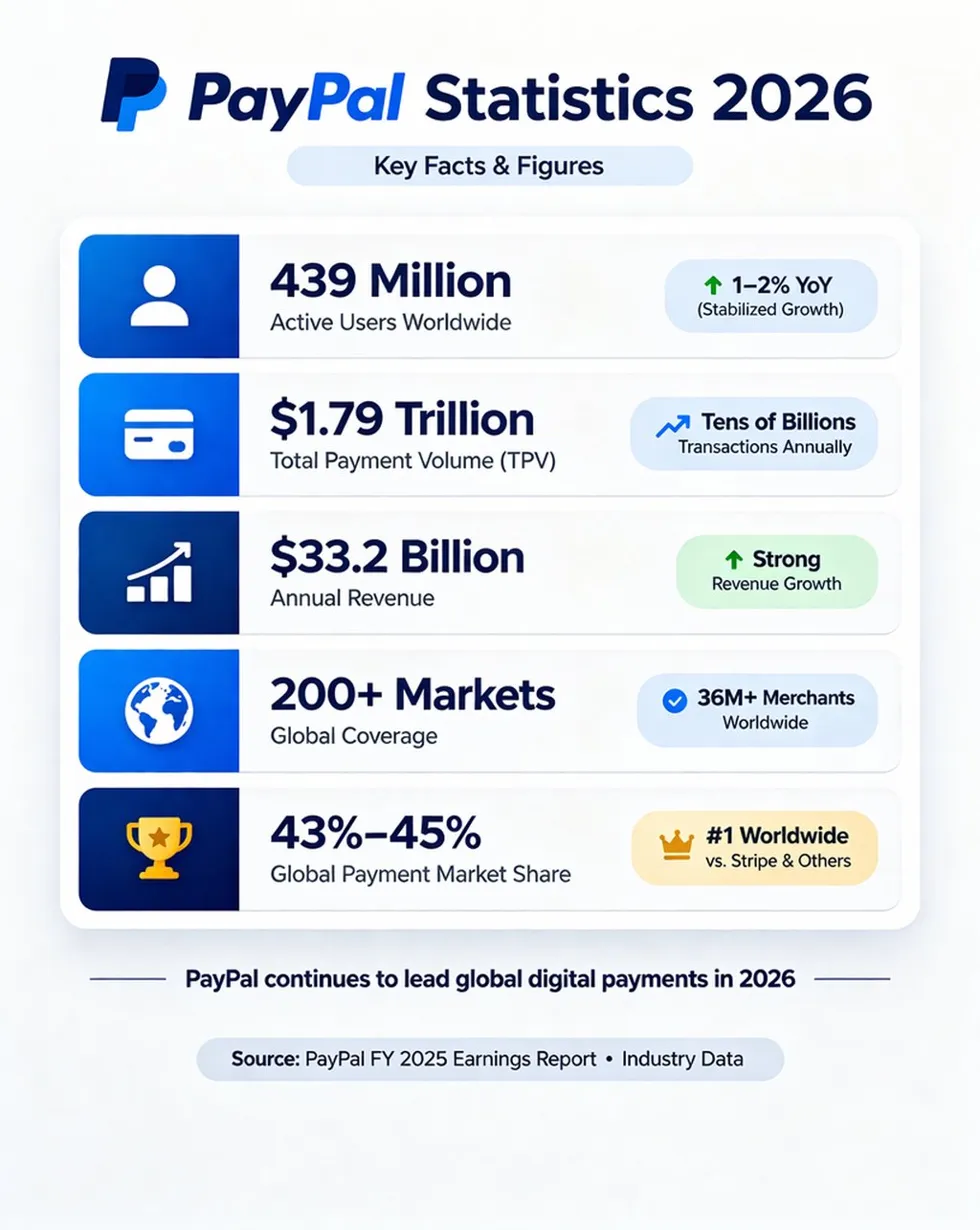
- 439M active PayPal users worldwide (PayPal active accounts)
- $1.79 trillion in total payment volume (TPV)
- $33.2 billion in annual revenue
- 200+ markets supported globally
- ~43%–45% estimated PayPal market share of the global online payment processing market
This snapshot answers key questions like how many people use PayPal today, how many PayPal active accounts exist, what is PayPal exactly, and what PayPal market share looks like in 2026.
PayPal zorgt al meer dan 25 jaar voor een revolutie in de handel. Sinds de bescheiden start als Cofinity in 1998 is de betalingsgigant uitgegroeid tot een indrukwekkend tweezijdig netwerk dat e-commerce mogelijk maakt voor particulieren en bedrijven in meer dan 200 markten wereldwijd.
What is PayPal? PayPal is a leading digital payments platform that enables individuals and businesses to send and receive money securely online, via mobile devices, and in-store. It operates as both a consumer wallet and a merchant payment processor, making it one of the most versatile financial platforms in the world.
Today, PayPal remains one of the most widely used digital payment platforms globally, with hundreds of millions of PayPal users and active accounts across consumer and merchant segments. Understanding PayPal statistics is essential for any merchant, investor, or analyst tracking the digital payments space.
This research provides a detailed overview of PayPal statistics for 2026, including PayPal users, PayPal active users, PayPal market share, PayPal TPV, and PayPal user growth. If you're wondering how many people use PayPal, how many merchants PayPal has, or how PayPal market share over time has evolved, this report covers it all with the latest available data and insights.
Wij verzoeken u vriendelijk Chargeflow te vermelden en een link naar dit artikel op te nemen als u de hier gepresenteerde gegevens wilt gebruiken.
Belangrijkste PayPal-statistieken voor 2026
- PayPal heeft eind 2025 439 miljoen actieve gebruikers (actieve PayPal-accounts)
- Het totale betalingsvolume (TPV) van PayPal bedroeg in 2025 1,79 biljoen dollar, verdeeld over ongeveer 26,3 miljard transacties, wat neerkomt op een groei van ongeveer 7% ten opzichte van het voorgaande jaar.
- PayPal genereerde in 2025 een omzet van 33,2 miljard dollar , wat neerkomt op een stijging van 4% ten opzichte van het voorgaande jaar.
- PayPal maintains its position as the leading online payment processor globally, holding a ~41%–45% market share of the payment processing technology market, significantly ahead of competitors like Stripe (~18%–20%).
- Meer dan 36 miljoen verkopers maken wereldwijd in meer dan 200 markten gebruik van PayPal.
- PayPal rapporteerde in 2025 een gecorrigeerde vrije kasstroom van ongeveer 6,4 miljard dollar.
What is PayPal? A Brief Overview
Before diving into the PayPal statistics, it's worth answering the foundational question: what is PayPal?
PayPal is a United States-based financial technology company founded in 1998 (originally as Confinity). It became one of the world's first widely adopted online payment systems and was later acquired by eBay in 2002 before spinning off as an independent public company in 2015.
At its core, PayPal allows consumers to link bank accounts, debit cards, or credit cards to a digital wallet,. and then use that wallet to pay for goods and services online, send money to friends and family (via Venmo or PayPal's own P2P service), and receive payments. For merchants, PayPal functions as a payment processor, fraud protection layer, and checkout optimization tool.
Today, the PayPal ecosystem includes Venmo, Xoom, Zettle, Honey, Paidy, and Braintree, making it far more than a simple payment button. Understanding what PayPal is in 2026 means recognizing it as a full-stack financial commerce platform, not just a checkout option.
Groei-statistieken van PayPal
As of 2026, PayPal continues to dominate online payment processing and remains one of the most widely used digital payment platforms globally, with a strong presence across online, mobile, and peer-to-peer payments. PayPal user growth has entered a more mature phase, with PayPal users and PayPal active users (active accounts) continuing to increase globally, but at a slower pace compared to previous years.
In dit gedeelte worden de belangrijkste statistieken van PayPal belicht met betrekking tot gebruikersgroei, acceptatie en wereldwijde marktpositie.
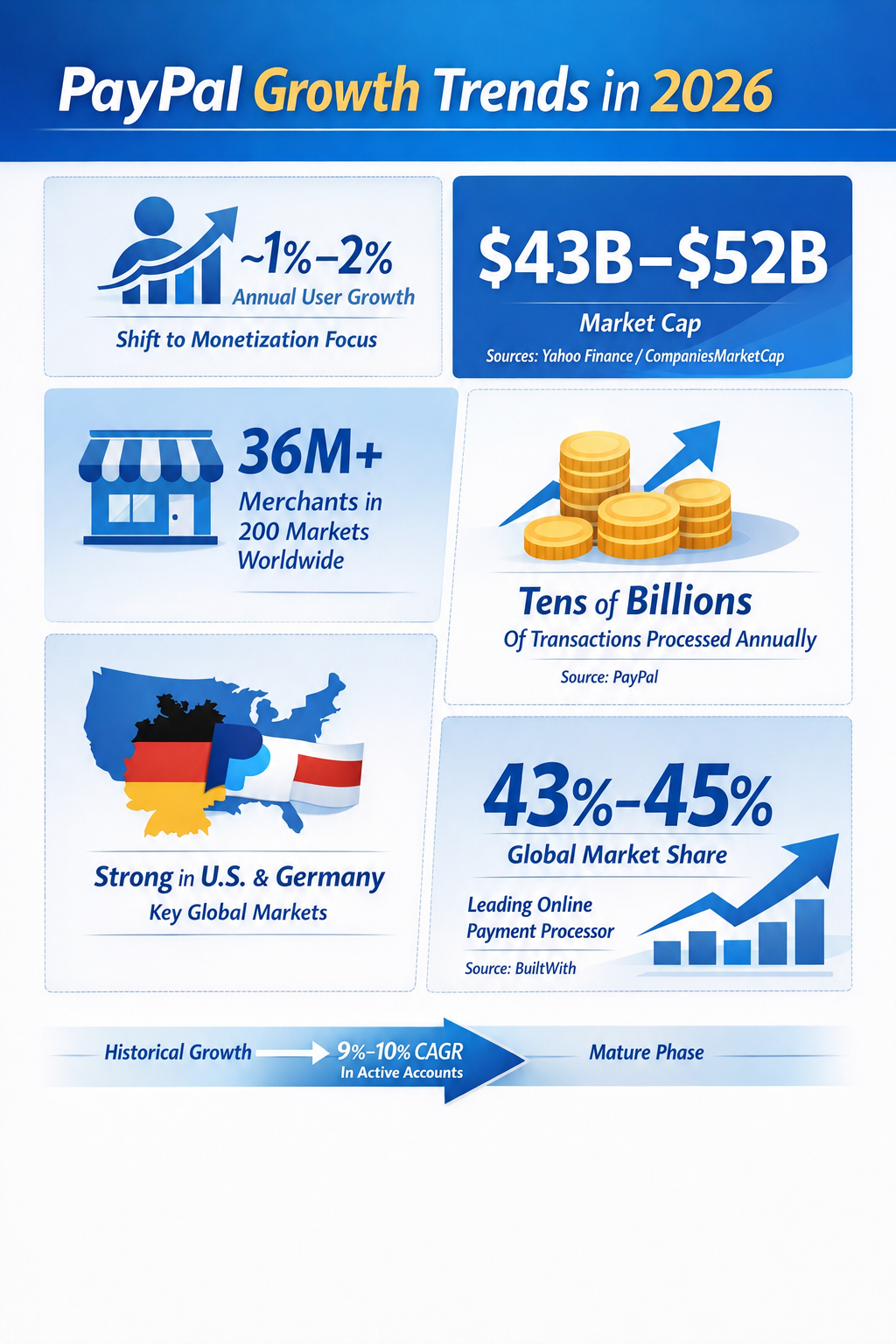
- As of April 2026, PayPal remains a major global digital payment platform, though its market capitalization has adjusted to approximately $43B to $52B amid shifting market conditions and increased competition.
- Over 36 million merchants use PayPal in 200 markets worldwide, reinforcing its position as one of the largest two-sided payment networks. When asking how many merchants does PayPal have, this figure is the clearest benchmark
- PayPal verwerkt nog steeds tientallen miljarden transacties per jaar, wat wijst op een sterke gebruikersbetrokkenheid, ook al vertraagt de groei van het aantal accounts. (Bron: financiële resultaten van PayPal)
- PayPal user growth has stabilized at ~1%–2% annually, reflecting a shift from rapid expansion in active PayPal active accounts to deeper monetization of existing PayPal users.
- In het verleden kende PayPal een sterke groei met een samengesteld jaarlijks groeipercentage (CAGR) van ongeveer 9% tot 10% in het aantal actieve accounts, maar de afgelopen jaren is er sprake van een meer volwassen groeifase.
- De Verenigde Staten blijven het grootste gebruikersbestand van PayPal, terwijl internationale markten de groei van het aantal gebruikers en het gebruik blijven stimuleren, met name in Europa.
- Duitsland is een van de sterkste markten van PayPal, waar het nog steeds een toonaangevende online betaalmethode is.
- PayPal behoudt zijn positie als wereldwijd toonaangevende aanbieder van online betalingsdiensten, met een geschat marktaandeel van 43% tot 45%, waarmee het concurrenten zoals Stripe achter zich laat.
- Het marktaandeel van PayPal is in de loop der tijd dominant gebleven; ondanks de toenemende concurrentie behoudt PayPal consequent een leidende positie op het gebied van wereldwijde online betalingsverwerking.
How Many People Use PayPal in 2026?
One of the most searched PayPal statistics questions is: how many people use PayPal?
As of late 2025, PayPal has approximately 439 million active accounts (PayPal active accounts) globally. This figure includes both consumer and merchant accounts across more than 200 countries and territories. PayPal users worldwide span virtually every major economy, with the United States, Germany, and the United Kingdom representing some of the platform's densest user bases.
To put the scale of PayPal users worldwide in perspective: 439 million active accounts means PayPal serves roughly 1 in every 18 people on Earth, and considerably more when you focus only on populations with internet access.
Statistieken over PayPal-inkomsten
De financiële resultaten van PayPal in 2025 wijzen op een overgang naar een stabielere groeifase, met een gestage stijging van zowel de omzet als het betalingsvolume.
- De netto-omzet van PayPal bedroeg in het vierde kwartaal van 2025 8,7 miljard dollar, een stijging van 4% ten opzichte van dezelfde periode vorig jaar
- De netto-omzet over het volledige jaar 2025 bedroeg 33,2 miljard dollar, wat neerkomt op een groei van 4% ten opzichte van vorig jaar
- PayPal sloot het vierde kwartaal van 2025 af met een totaal betalingsvolume (TPV) van 475,1 miljard dollar, wat neerkomt op een groei van 9% ten opzichte van dezelfde periode vorig jaar.
- De totale transactiewaarde (TPV) van PayPal bedroeg in het volledige jaar 2025 1,79 biljoen dollar, wat neerkomt op een jaarlijkse groei van ongeveer 7%.
- De transactiemarge in dollars steeg in 2025 met ongeveer 6% , wat aantoont dat PayPal er nog steeds in slaagt waarde te genereren uit zijn bestaande gebruikersbestand.
- De omzet uit diensten met toegevoegde waarde bedroeg in 2025 ongeveer 3,4 miljard dollar, dankzij de groei in financiële diensten voor bedrijven en consumenten.
- PayPal genereerde in 2025 ongeveer 6,4 miljard dollar aan gecorrigeerde vrije kasstroom en behield daarmee een sterke winstgevendheid en het vermogen om kapitaal terug te betalen.
- Het bedrijf keerde in 2025 ongeveer 6 miljard dollar uit aan aandeelhouders via de inkoop van eigen aandelen, waarmee het zijn verschuiving naar een kapitaalefficiënter, volwassen groeimodel versterkte.
PayPal Market Share: 2026 Overview
PayPal market share is one of the most-researched topics in digital payments. Here's what the data shows.
PayPal holds an estimated 43%–45% share of the global online payment processing technology market as of 2026, according to data from Datanyze and PayPal's own investor disclosures. This makes PayPal the single largest player in online payment processing,. well ahead of Stripe (~18%–20%), Square, and Adyen.
PayPal market share over time tells an interesting story. Despite the explosion of competitors in the fintech space — from Apple Pay and Google Pay to BNPL providers and regional payment networks — PayPal has maintained its dominant position through:
- Brand trust: ~60% of consumers trust PayPal more than traditional banks for storing payment credentials (PYMNTS & FIS Research)
- Merchant penetration: Over 36 million merchants globally accept PayPal, creating powerful network effects
- Ecosystem depth: Products like Venmo, Honey, and Braintree give PayPal multiple touchpoints across the consumer journey
- Checkout optimization: PayPal Complete Payments drives up to 25% higher conversion rates for merchants
While PayPal market share has faced pressure in specific segments (mobile wallets, in-store payments), its grip on online checkout remains largely unmatched. For context, PayPal processes 26.3 billion transactions per year, a volume that would be nearly impossible to displace quickly.
PayPal Active Accounts: Key Statistics
Understanding PayPal active accounts is critical for sizing the platform's true reach. PayPal defines an active account as one that has completed at least one transaction in the prior 12 months.
Key PayPal active accounts stats for 2026:
- Total active accounts (consumers + merchants): ~439 million as of Q4 2025
- Active accounts growth rate: ~1%–2% annually — a significant slowdown from the 20%+ growth seen during the pandemic era
- Historical CAGR: ~9%–10% over the prior decade, reflecting PayPal's long-term compound growth
- Venmo active users: Over 90 million in the United States alone
The slowdown in PayPal active accounts growth is not unusual for a platform of this maturity. Rather than chasing new signups, PayPal is focused on increasing revenue per user through BNPL, debit cards, Venmo monetization, and merchant financial services.
How Many Merchants Does PayPal Have?
How many merchants does PayPal have? This is one of the most commercially important PayPal statistics for understanding the platform's two-sided network effect.
As of 2026, over 36 million merchants use PayPal across more than 200 markets. This merchant base spans everything from solo eCommerce sellers to global enterprise retailers and SaaS platforms.
Key context for the how many merchants does PayPal have question:
- PayPal Complete Payments handles approximately 45% of total SMB payment volume, reflecting deep penetration among small and medium-sized businesses
- Enterprise merchants using PayPal see 33% more completed checkouts compared to other processors
- The Braintree integration (PayPal's enterprise payments API) is used by major platforms including Uber, Airbnb, and GitHub
- PayPal's partnership with Verifone brings in-person and online payments together, expanding the addressable merchant base into brick-and-mortar retail
Statistieken over veiligheid en vertrouwen bij PayPal
PayPal heeft een sterke merkreputatie opgebouwd door gebruikers 24/7 fraudebewaking, end-to-end-versleuteling en aankoopbescherming bij alle transacties te bieden. Uit gezamenlijk onderzoek van PYMNTS en FIS blijkt dat ongeveer 60% van de consumenten PayPal meer vertrouwt dan traditionele banken voor het opslaan van betaalgegevens.
- Ondanks voortdurende investeringen in beveiliging blijven online fraude en misbruik bij betalingen toenemen, parallel aan de groei van de digitale handel.
- De wereldwijde verliezen als gevolg van e-commercefraude bedroegen in 2025 48 miljard dollar, wat neerkomt op een stijging van 16% ten opzichte van het voorgaande jaar, en de prognoses wijzen op een verdere stijging.
- Gemiddeld lopen webwinkeliers ongeveer 3% van hun totale e-commerce-omzet mis door fraude, waarbij de verliezen in risicovolle sectoren oplopen tot 5% of meer.
- De meest voorkomende vormen van oplichting waarmee PayPal-gebruikers te maken krijgen, zijn onder meer phishing-e-mails en -berichten, oplichting met facturen en betalingsverzoeken, oplichting waarbij vooraf kosten moeten worden betaald, oplichting met te hoge betalingen, valse prijswinsten, beleggingsfraude met hoog rendement, valse goede doelen, verzendoplichting, oplichting met vooraf betaalde verzendlabels, oplichting met het omleiden van pakketten, valse vacatures, oplichting met doorverzending en oplichting met thuiswerk.
- Handelaren die PayPal gebruiken, krijgen vaak te maken met honderden geschillen per maand, wat veel tijd en operationele middelen vergt om deze te onderzoeken en erop te reageren.
- Claims wegens „Artikel niet ontvangen“ (INR) en „Ongeautoriseerde transactie“ blijven de meest voorkomende oorzaken van geschillen via PayPal.
- PayPal biedt programma’s voor bescherming tegen terugboekingen en fraude, waarbij de kosten doorgaans 0,4% per transactie bedragen of tot 0,6% voor uitgebreide dekkingsopties, waardoor verkopers het risico kunnen afwentelen ten koste van hun marge.
Controverses en publieke kritiek
- Net als veel andere grote fintech-platforms heeft PayPal regelmatig te maken gehad met kritische vragen over bepaalde aspecten van zijn bedrijfsvoering en de dynamiek binnen zijn ecosysteem.
- In december 2024 leidde een veelbesproken onderzoek tot bezorgdheid over het affiliate-attributiemodel van Honey, een dochteronderneming van PayPal, waarbij critici beweerden dat het commissie-inkomsten van contentmakers zou onttrekken.
- Er volgden meerdere collectieve rechtszaken, en hoewel een eerste zaak in 2025 werd afgewezen, werden er in 2026 nieuwe vorderingen ingediend, waaruit blijkt dat de kwestie nog steeds niet is opgelost.
- PayPal heeft elk verwijt van wangedrag van de hand gewezen en verklaard dat Honey de gangbare praktijken op het gebied van „last-click-attributie“ volgt.
E-commerce en PayPal
PayPal revolutionized the eCommerce business with its seamless online payment solution and digital products. The payments industry is experiencing tremendous upheavals due to industry regulations and fintech innovations. Mobile wallets are predicted to account for over 50% of all eCommerce transactions by 2026.
- PayPal evolueert van een op zichzelf staande betaalmethode naar een uitgebreid ecosysteem van oplossingen voor verkopers, waaronder optimalisatie van het afrekenproces, tools voor fraudebestrijding en financiële diensten.
- De aanhoudende groei van PayPal op het gebied van PayPal TPV en het aantal PayPal-gebruikers wordt deels aangedreven door het groeiende ecosysteem van oplossingen voor handelaren en consumenten.
- Het betalingsecosysteem van PayPal omvat nu oplossingen zoals PayPal Everywhere en PayPal Complete, die zijn ontworpen om de prestaties, schaalbaarheid en conversiepercentages van verkopers te verbeteren.
- Deze oplossingen hebben de vertraging met meer dan 40% verminderd en de conversiepercentages met meer dan 100 basispunten verhoogd.
- PayPal Complete Payments verwerkt momenteel ongeveer 45% van het totale betalingsvolume van kleine en middelgrote ondernemingen, wat wijst op een sterke acceptatie onder groeiende bedrijven.
Bedrijven die PayPal gebruiken, profiteren van meetbare prestatieverbeteringen:
- Conversiepercentages tot 25% hoger
- 33% meer voltooide aankoopprocessen voor zakelijke verkopers
- 12% hogere gemiddelde besteding per transactie
- 60% hogere aankoopfrequentie in vergelijking met andere betaalmethoden
PayPal blijft zijn ecosysteem uitbreiden met producten als Venmo, Xoom, Paidy, Honey en Zettle, waarmee het trends als peer-to-peer-betalingen, BNPL en omnichannel-handel ondersteunt.
- Venmo remains a key growth driver, with over 90 million active users in the United States and continued expansion in monetization through debit cards and "Pay with Venmo"
- PayPal is also investing in infrastructure and partnerships to support enterprise and omnichannel commerce
- Its partnership with Verifone integrates in-person and online payments through Braintree, enabling more flexible and scalable payment systems
'Nu kopen, later betalen' (BNPL) is een ander belangrijk groeigebied:
Het totale betalingsvolume van PayPal’s BNPL-dienst bedroeg in 2024 33 miljard dollar, een stijging van 21% ten opzichte van het voorgaande jaar, en zorgde voor een meer dan verdubbeling van het aankoopvolume in vergelijking met de standaard betaalprocedure.
Tegelijkertijd breidt PayPal zijn ecosysteem van ontwikkelaars en partners uit via platforms zoals PayPal Open, waardoor handelaren betalingen, financiële diensten en risicobeheerinstrumenten in één geïntegreerd systeem kunnen integreren.
Naarmate PayPal zich steeds verder uitbreidt op het gebied van e-commerce, mobiele diensten en financiële diensten, verschuift zijn rol van betalingsprovider naar die van infrastructuurlaag binnen de wereldwijde digitale economie.
Conclusie
PayPal continues to hold a dominant position in the global digital payments landscape, with 439 million active users, $1.79 trillion in annual payment volume, and a leading PayPal market share of approximately 43%–45% of the online payment processing market. As the company transitions into a more mature growth phase, its focus has shifted from rapid PayPal users acquisition to monetization, ecosystem expansion, and transaction quality.
At the same time, the broader payments environment is becoming more complex. Rising fraud levels, increasing chargebacks, and evolving consumer behavior are creating new challenges for merchants operating at scale. While PayPal's infrastructure, trust, and global reach remain key advantages, these same factors also contribute to higher transaction volumes and, with them, greater exposure to disputes and post-purchase risk.
As digital commerce continues to grow, PayPal's role is expanding beyond payments into a full commerce and financial ecosystem. For businesses, success will increasingly depend not just on accepting payments, but on managing what happens after the transaction — including fraud, disputes, and customer claims.
From PayPal users and PayPal active accounts to PayPal market share and PayPal TPV, the platform continues to define the global digital payments landscape.
Veelgestelde vragen over PayPal-statistieken
How many people use PayPal?
PayPal has approximately 439 million active users (PayPal active accounts) worldwide as of late 2025, making it one of the largest digital payment platforms by PayPal users worldwide.
What is PayPal's market share?
PayPal holds an estimated 43%–45% market share of the global online payment processing market, making it the dominant player in online payments ahead of Stripe (~18%–20%).
How has PayPal market share changed over time?PayPal market share over time has remained remarkably resilient. Despite the rise of competitors like Stripe, Apple Pay, and Google Pay, PayPal has maintained its dominant position through strong merchant penetration (36M+ merchants), brand trust, and ecosystem depth. The platform's market share has hovered in the 41%–45% range for several years, even as competition intensifies.
What is PayPal?
PayPal is a digital payments platform that enables consumers and businesses to send, receive, and manage money online. Founded in 1998, PayPal has evolved from a simple online payment button into a full financial commerce ecosystem that includes Venmo, Braintree, Honey, Xoom, Zettle, and Paidy.
What is PayPal TPV?
PayPal's total payment volume (TPV) reached $1.79 trillion in 2025, reflecting approximately 7% year-over-year growth. In Q4 2025 alone, PayPal processed $475.1 billion in TPV.
How many merchants use PayPal?
Over 36 million merchants use PayPal globally across more than 200 markets. PayPal Complete Payments now handles approximately 45% of total SMB payment volume.
How many PayPal accounts are there?
PayPal has approximately 439 million active accounts worldwide as of late 2025, including both consumers and merchants. This figure counts only accounts with at least one transaction in the prior 12 months.
How many PayPal users are there worldwide?
There are approximately 439 million PayPal users worldwide (active accounts) as of Q4 2025. The United States represents the largest single market, followed by Germany and the United Kingdom.
Is PayPal still growing?
Yes, but PayPal user growth has slowed to ~1%–2% annually. The platform is shifting its strategic focus from growing its base of PayPal active accounts to deepening revenue per existing PayPal user through BNPL, Venmo monetization, and merchant financial services.
Is PayPal de grootste betalingsverwerker?
PayPal is one of the largest online payment processors globally, with an estimated 43%–45% PayPal market share, making it the leading provider in digital payments online. In terms of total payment volume, PayPal processed $1.79 trillion in 2025 across 26.3 billion transactions.
How does PayPal's market share compare to Stripe?
PayPal holds approximately 43%–45% market share of the global online payment processing market, while Stripe holds approximately 18%–20%. While Stripe has grown rapidly among developers and SaaS businesses, PayPal's market share remains significantly larger when measured across all merchant types and geographies.
What are the most common fraud risks for PayPal users?
The most common scams PayPal users face include phishing emails, invoice scams, advance fee fraud, overpayment scams, shipping scams, and fake job offers. Merchants also face significant risk from "Item Not Received" (INR) and unauthorized transaction disputes.
Dit onderzoek bevat algemene en feitelijke informatie zoals die op het moment van schrijven bekend was. Chargeflow aanvaardt geen aansprakelijkheid voor de volledigheid of juistheid van de verstrekte informatie. Vanwege uiteenlopende updatecycli kunnen de statistieken recentere gegevens weergeven dan waarnaar in de tekst wordt verwezen.
BRONNEN:
- PayPal Investor Relations – Resultatenverslag boekjaar 2025
- Amerikaanse Securities and Exchange Commission (SEC)
- Yahoo Finance (gegevens over marktkapitalisatie)
- BedrijvenMarktkapitalisatie
- Trading Economics
- Statista
- Onderzoek door PYMNTS & FIS
- Juniper Research (fraudecijfers)
- Mastercard (gegevens over de gevolgen van fraude)
- EHI Retail Institute (betalingsgegevens uit Duitsland)
- PR Newswire
- Investopedia
Aanbevolen onderzoek: Statistieken en feiten over Shopify
Terugboekingen?
Dat is niet langer uw probleem.
Vorder 4 keer meer terugboekingen terug en voorkom tot 90% van de inkomende terugboekingen, dankzij AI en een wereldwijd netwerk van 15.000 handelaren.


.png)