%201.svg)


































Chargeback Arbitration Explained: Everything a Merchant Should Know to Prevent Losses

Rétrofacturations ?
Ce n'est plus votre problème.
Récupérez 4 fois plus de rétrofacturations et prévenez jusqu’à 90 % de celles à venir, grâce à l’IA et à un réseau mondial de 20 000 commerçants.


 Plus de 600 avis
Chargeback arbitration is the final stage of a payment dispute, where the card network issues a binding ruling after issuer and acquirer cannot agree. Fewer than 2% of chargebacks reach arbitration for obvious reasons. The losing party pays hefty network fee after the ruling. Visa and Mastercard handle the process differently. An issuer that files for arbitration has already reviewed the merchant's evidence and found enough of a gap to back a $575–$600 fee. Prevention means closing that gap before the issuer reaches that conclusion.
Dispute management is moving from a back-office function to a strategic priority. That quote comes directly from a recent Visa product press release. If the stakes around payment disputes have climbed that high, then your chargeback management playbook is incomplete until you understand how chargeback arbitration works. That's why we've put together this guide.
If you’ve read our previous installment on pre-arbitration chargeback, then you’re aware that winning a dispute response does not always mean case closed. A case won at representment can be reopened and funneled to arbitration.
Chargeback arbitration is demanding enough that some payment providers won't take cases this far at all.
The deck is stacked against you as a merchant. The procedural rules are strict and unforgiving. There are tight limits on the evidence you can submit, and the network can charge technical fees for every rule you break. Few disputes ever reach arbitration, and fewer still are won there.
So how do you know when a case is worth taking that far, and how do you give yourself the best possible shot if it is? Below we break down how chargeback arbitration works, when a case qualifies, how Visa and Mastercard handle it differently, what it costs, the deadlines you can't afford to miss, and how to prevent losses.
What is Arbitration in Chargeback Disputes?
Chargeback arbitration is the last stop in a payment dispute, where your acquirer and the cardholder’s bank have argued the case as far as they can and still can’t agree on who should absorb the loss. When that happens, the card network steps in to make a legally binding determination.
Filing for arbitration triggers network fees that typically run well into the hundreds, and the losing side usually pays. That finality is expensive by design and the expense is the whole point. Because escalating hurts, both parties have a strong reason to settle earlier or walk away from a fight that isn't worth it.
Thus, few disputes ever get to arbitration. Most are resolved in the earlier rounds.
The Chargeback Arbitration Process
Whether you’re new to chargebacks or experienced with early rounds, arbitration is the exceptional case. It’s where most merchants never want to go because it’s the most punishing part of the chargeback cycle, and where most playbooks fail.
The card issuer or your acquirer can initiate chargeback arbitration (sometimes referred to as an arbitration chargeback). But for the purpose of this guide, we’ll focus specifically on what happens when the issuer initiates the process.
Here’s the generic 5-step chargeback arbitration workflow (and what happens at each stage):
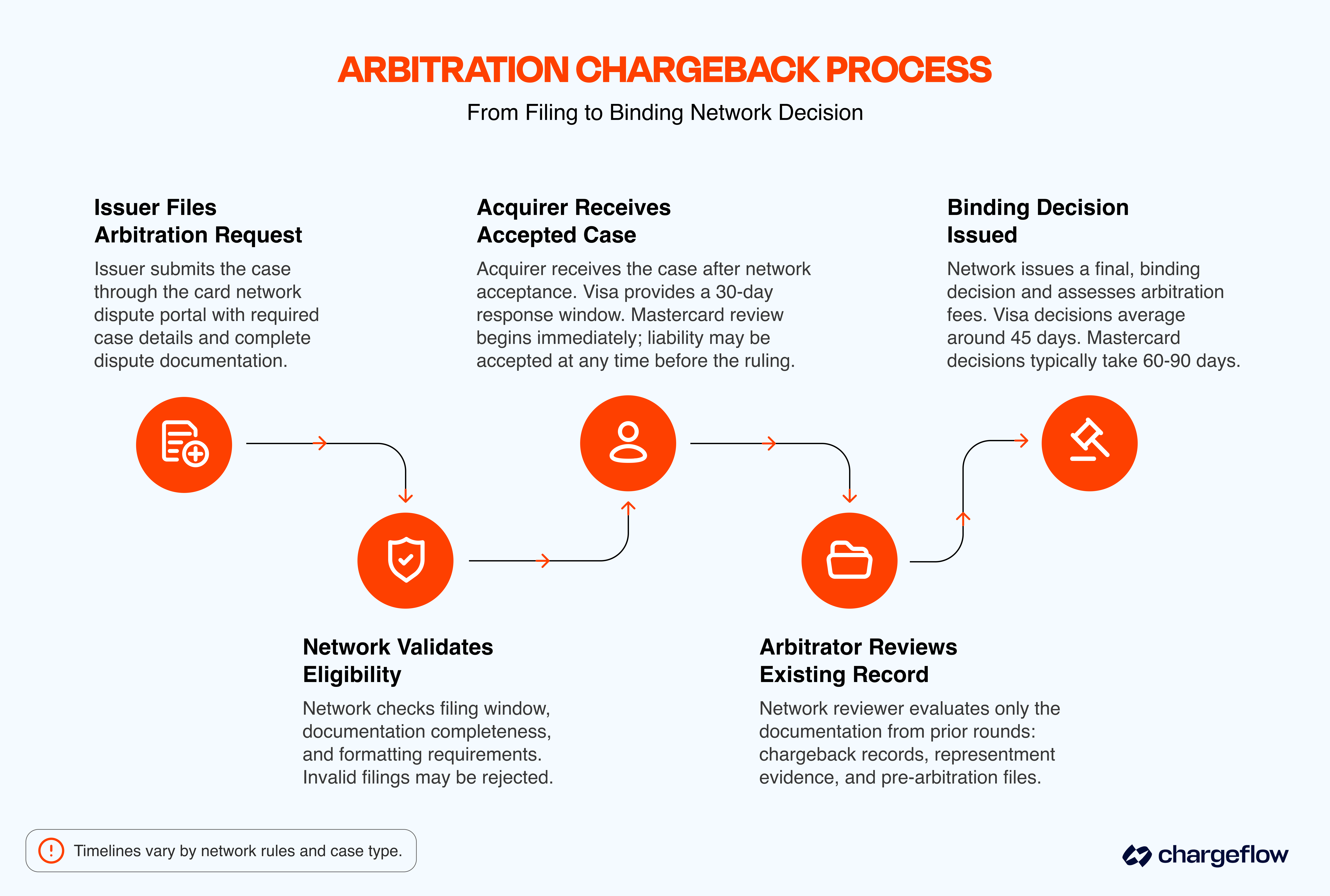
Step 1: Issuer Files Arbitration Request
The card issuer submits an arbitration filing to the card network using the network’s electronic dispute portal (Visa Claims Resolution portal or Mastercard Mastercom system) with:
- Required form data: Case ID, original chargeback reference number, transaction amount, transaction date, applicable reason code.
- Complete dispute record: Some necessary pieces of information required include original chargeback reason code documentation, the merchant's representment letter with supporting evidence, pre-arbitration communication logs from both parties, transaction records, and shipping/delivery confirmation (if applicable).
Step 2: Network Validates Eligibility
The card network reviews the submission to ensure:
- Filing is within the required window (Visa: 20 days from pre-arbitration; Mastercard: 30–45 days)
- All required documentation is complete.
- Case RBA ID and formatting requirements are met.
If the network rejects the filing for any reason (expired window, missing documentation, wrong format), the case dies immediately for Visa. Mastercard allows a 5-day repair window for technical errors only.
Step 3: Acquirer Receives Case and Counter-Response Window
Once the network accepts the arbitration, the merchant's acquirer receives the case file and must respond within:
- Visa: 30 days after network acceptance.
- Mastercard: As of October 2024, the 10-day acquirer response window has been eliminated. Mastercard's Dispute Resolution Management team begins its review immediately upon case acceptance. The acquirer may accept liability at any point before Mastercard issues its ruling, but there is no formal response window and no default period.
The acquirer can submit counter-evidence, but only documentation already in the case file is allowed.
Step 4: Arbitrator Reviews Existing Documentation
A network reviewer (Visa Claims Resolution Team or Mastercard Dispute Resolution Management team) evaluates only the documentation from prior rounds:
- Original chargeback records
- Representment documentation
- Pre-arbitration files
Step 5: Binding Decision Issued and Fees Charged
The network issues a final, binding decision within:
- Visa: 45 days average
- Mastercard: 60–90 days
The losing party pays the dispute fees. We’ll cover the complete fee schedule in a subsequent section. The network's ruling is binding on both parties. Any further controversy must be taken to a court of law, although conditional appeal processes may exist within both networks under specific conditions.
Visa vs Mastercard Arbitration: Key Differences
Generally speaking, the principle of chargeback arbitration is the same across the card networks. But the steps, terminology, and decision-makers vary. The differences matter when you're deciding whether or not to fight. The table below examines the key differences between Visa and Mastercard chargeback arbitration.
Industry analysis indicates that arbitration tends to favor issuers more than merchants. There are several reasons for that. Besides the technicality and procedural requirements highlighted earlier, chargeback arbitration is still one of the core stages of the dispute cycle. Both Visa and Mastercard’s arbitration documentation emphasize consumer protection as a guiding principle. So card networks generally prioritize cardholder trust, which can influence arbitration decisions.
Chargeback Arbitration Fees and Costs
When the issuer files an arbitration chargeback, you don't pay the arbitration fee upfront. The network assigns it later to the losing party. So if the case goes against you, you risk losing the full transaction amount and the arbitration fee (as detailed earlier in our discussion of chargeback costs).
Here’s a verifiable breakdown of all chargeback arbitration fees and costs:
Visa Arbitration Fees and Costs
Mastercard Arbitration Fees and Costs
Mastercard Dispute Administration Fee (EU/EEA/MEA Only)
Administration fees applies to intra- and inter-European transactions. They are auto-generated per dispute cycle through the Mastercard Consolidated Billing System, and flows between issuer and acquirer at each stage.
A Note on Arbitration Appeal
Arbitration rulings are widely described as final. But "final" is not the same as "unappealable." Both Visa (Core Rules, Section 11.13.4: Conditions for an Appeal to the Arbitration and Compliance Committee) and Mastercard (Chargeback Guide, May 2025, "Appeals" and "Appeal Review Process," pp. 679–680) maintain formal appeal processes in select circumstances.
Visa allows 60 days to appeal at 5% of the dispute value (max $1,000), with a $5,000 minimum threshold. Mastercard allows 45 days at $500, reviewed by the Chief Franchise Officer; no new facts are accepted unless requested.
Both appeal decisions are genuinely final; no further recourse exists.
The misconception persists because conditions (high thresholds, tight timelines, strict evidence rules) make appeals impractical for most disputes. They exist for high-value cases where a specific ruling error can be demonstrated.
When Payment Disputes Escalate to Arbitration
An arbitration chargeback is a product of a sequence of deliberate choices. By the time an arbitration case is filed, the dispute has typically been active for 60 to 120 days. It has equally passed through at least one pre-arbitration round, where settlement was available but declined.
What Happens When Visa Disputes Go To Arbitration
When you successfully challenge a pre-arbitration case, the issuer can accept or reject it. If it rejects the merchant’s remedy, it files directly for arbitration. And the dispute status in Visa’s system moves to “arbitration.” At that point, Visa owns the case.
What happens next depends on which Visa workflow the dispute was in. In Visa Allocation disputes, the network automatically assigns liability upon chargeback. If assigned to you, you can challenge it by filing a pre-arbitration (which is their first response opportunity). The issuer then has 10 calendar days to accept or reject the challenge. Rejection automatically escalates the case to arbitration for Visa’s final ruling. For Collaboration disputes, the sequence ran through representment and pre-arbitration before reaching this point.
What Happens When Mastercard Disputes Go to Arbitration
For most Mastercard reason codes, pre-arbitration is mandatory before an issuer can file for arbitration. When a merchant wins second presentment and the issuer files pre-arb, the merchant’s response to that pre-arb is their final submission.
If the issuer still disagrees, it files through Mastercom. The case is then with Mastercard’s Dispute Resolution Management team. And as of October 2024, the 10-day acquirer response window that previously existed after filing has been eliminated, removing what had functioned as a last-chance withdrawal point.
The issuer can bypass pre-arbitration entirely and file for arbitration directly after second presentment for reason codes 4808 (Authorization Not Obtained), 4870, and 4871 (Chip Liability Shift). If you won representment on these codes, you may find the case already at the network level with no pre-arb exchange.
Strategies to Prevent Chargeback Arbitration
The most effective strategy for preventing chargeback arbitration is resolving before it’s even an option. Issuers don’t file for an arbitration chargeback they expect to lose. By the time they do, they’ve reviewed your representment and pre-arb submissions and found enough of a gap in the evidence, the reason code alignment, or the documentation. Preventing arbitration means closing that gap before the issuer can assess it.
Voici comment faire :
1) Eliminate Disputes Before They Exist
These interventions operate at the transaction and fulfilment level, before any network is involved.
Apply Friendly Fraud Filters
Most arbitration cases originate in fraud disputes and consumer disputes. Both are identifiable through post-purchase signals before fulfillment. Chargeflow Prevent analyzes transactions against a global merchant network, identifies digital shoplifters, serial refund abusers, and stolen-card patterns, then automatically cancels, verifies, or approves orders pre-shipment.
A cancelled order generates no chargeback, no pre-arb, and no arbitration filing. Where orders are verified rather than cancelled, the verification creates dispute-ready evidence if the customer files regardless.
At the Transaction Level
3DS2 authentication shifts fraud liability to the issuer. But it only covers fraud reason codes: Visa 10.x and Mastercard 4837, 4840, 4849, and 4871. Consumer disputes such as "item not received," "not as described," and "cancelled recurring" proceed through the dispute cycle regardless of authentication. If your chargebacks are dominated by consumer dispute codes, you will see no ratio benefit from 3DS2.
Within fraud reason codes, the protection depends on full authentication. Low-value, recurring, and Transaction Risk Analysis (TRA)-exempted transactions skip the authentication step. Without authentication, the liability shift does not apply. Merchants applying exemptions at scale to reduce checkout friction are accepting fraud liability on that volume without realising it.
Visa-specific Rules
For Visa 10.4 disputes, CE 3.0 provides foundational defence. Two prior undisputed transactions sharing the same device, IP address, and shipping address as the disputed transaction can shift liability to the issuer. That data must be queryable at the moment of dispute notification, not assembled after. Chargeflow Automation retrieves and compiles CE 3.0 qualifying evidence automatically. This matters because CE 3.0 carries a one-attempt rule. An incomplete or incorrect submission is permanently declined with no opportunity to correct it.
2) Intercept Between Chargeback Filing and Dispute Cycle
When a dispute is initiated but not yet a formal chargeback, a refund window still exists. Ethoca Alerts and Verifi CDRN notify merchants inside that window. A refund issued at this stage avoids the chargeback record entirely. Chargeflow Alerts integrates with both networks and automates that interception.
3) Win At Representment To Close The Arbitration Path
In April 2026, Visa reported that 106 million disputes were processed in 2025, a 35% increase since 2019. The rising volume forced Visa to develop a suite of AI-driven dispute tools to keep up. Andrew Torre, Visa's President of Value-Added Services, stated it plainly: “when outdated technology cannot keep pace, fraud goes undetected.”
Each of those 106 million disputes required specific evidence to resolve them. When representment and pre-arbitration could not convincingly close the loop, cases escalated to arbitration.
Winning at representment is how most arbitration cases are prevented. It happens when the issuer reviews the merchant's response and concludes that escalating is not worth the card network penalty for losing.
That determination comes down to two things. Whether the evidence directly addresses the specific reason code being disputed. And whether the pre-arbitration response makes escalating look like a bad bet.
The pre-arbitration response has one job: make the cost of proceeding to arbitration outweigh the expected return. A response that directly dismantles the issuer's claim and cites the specific transaction data that undermines it closes more cases than one that simply adds more evidence.
Both require precision that fragmented, manual processes cannot consistently deliver. Sam Abadir of IDC Financial Insights, cited in Visa's April 2026 release, put it directly: institutions managing disputes through fragmented, manual processes are leaving recoverable revenue on the table. Chargeflow Automation maps each dispute to its network-required evidence type, compiles documentation, and submits within the earliest available response window. At the pre-arb stage, it produces responses built to the standard that changes the issuer's escalation decision.
In closing this guide, I leave you with this thought: At a time when card networks are moving dispute management into AI-driven workflows, merchants who still rely on manual processes are the most exposed to arbitration. Don't be that merchant.
Rétrofacturations ?
Ce n'est plus votre problème.
Récupérez 4 fois plus de rétrofacturations et prévenez jusqu’à 90 % de celles à venir, grâce à l’IA et à un réseau mondial de 20 000 commerçants.


.png)