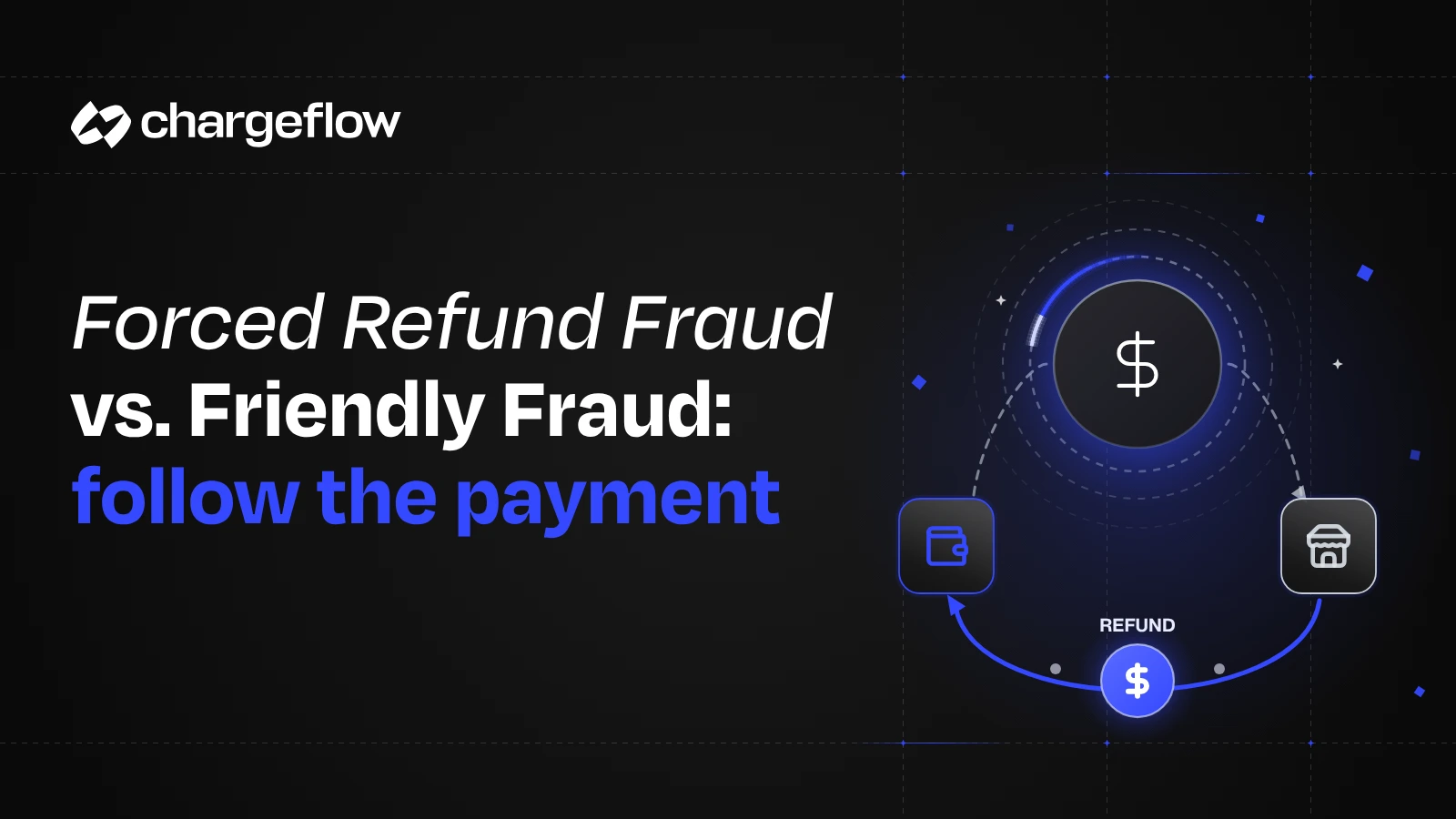
Forced Refund Fraud vs. Friendly Fraud: Follow the Payment

Chargebacks?
Não é mais problema seu.
Recover 4x more chargebacks and prevent up to 90% of incoming ones, powered by AI and a global network of 20,000+ merchants.


 Mais de 600 avaliações


Resumo:
- Trace the actual payment event before labeling it refund fraud or friendly fraud.
- Investigate merchant refund authorization separately from an issuer dispute.
- Match every credit to the original payment or a documented exception.
- Coordinate open disputes and refunds to prevent duplicate reimbursement.
Forced refund fraud is abuse of a merchant’s own refund process, while friendly fraud is a cardholder dispute over a real purchase. The fastest way to tell them apart is to trace how the money left the business.
Forced refund fraud is one form of digital shoplifting. Confirm the actual refund or dispute event before you choose a response. For the wider definition of refund fraud, its common types and prevention controls, see the merchant guide.
{{cta}}
Identify the Money Movement Before Applying a Label
The phrase forced refund can mean different things. A customer may use it for a bank reversal, while an operations team may use it for a wrong credit sent by the merchant. The phrase alone does not tell you the payment flow, the intent or who is liable.
Record the provider’s event type, transaction reference, amount, currency and status. Then decide which event it is: a merchant refund, a payment reversal, a formal dispute debit or an accounting adjustment. The payment-reversal guide helps separate events that people often describe with the same words.
Trace the money before you label the case
1 | Find the event. Note the provider event type, reference, amount and status. |
2 | Name the route. Merchant refund, payment reversal, dispute debit or accounting adjustment. |
3 | Link it to the sale. Match the credit to the original payment or a documented exception. |
4 | Check for overlap. Look for earlier refunds and open disputes on the same payment. |
5 | Choose the control. Fix refund access for forced refund fraud; answer the case for friendly fraud. |
Forced refund fraud vs friendly fraud at a glance
| Question | Refund-Process Abuse | Friendly-Fraud Dispute |
|---|---|---|
| Where does the action occur? | Merchant refund workflow or an improperly used account or terminal | Issuer dispute process concerning an otherwise legitimate purchase |
| What must be investigated? | Refund authorization, original payment, beneficiary, and processing history | Customer allegation, reason code, purchase facts, and response deadline |
| What records matter? | Staff or account activity, approval, refund reference, and settlement | Claim-specific evidence such as delivery, cancellation, and payment records |
| What is the immediate control? | Prevent further unauthorized credits and reconcile existing ones | Meet the case requirements and submit a supported response |
| What cannot be assumed? | Every unusual refund is deliberate fraud | Every mistaken dispute is intentional abuse |
A fair refund request is not fraud just because it costs you money. In the same way, a real cardholder reporting stolen-card use is not the same as someone disputing their own valid purchase. Review friendly fraud without treating every bank complaint as misuse.
The comparison of friendly fraud vs. chargeback fraud separates those two labels, and the guide to friendly fraud prevention tools maps controls to each stage.
Trace the Refund to Its Original Payment
Find the original sale, the approved refund amount, the request, who asked, who approved and the final status. Check whether the same payment was already credited or disputed another way. A repeat request is not the same as a repeat credit that actually went through.
A referenced refund and an unreferenced refund need different checks. The official unreferenced-refund documentation for Adyen’s point-of-sale system explains that these refunds are not linked to the original payment. It recommends reconciliation controls to reduce duplicate or misdirected refunds. A supported unreferenced refund is not fraud by itself.
If you cannot find the original payment or the normal refund route is blocked, use your provider’s supported process. Do not send money to an unrelated account because someone asks for an urgent exception.
The double-refund workflow helps support, finance and dispute teams act together instead of alone. One owner should confirm the total already paid back before anyone approves another credit.
Investigate Refund Requests Without Assuming Intent
An angry message or a threatened chargeback does not prove fraud. Check the product complaint, return record, delivery event and any refund promise. The customer may be upset because a fair refund is late or has not shown up yet.
For Stripe, the refund-status documentation separates pending, successful and failed refunds. Your support notes should show the real status and reference, not just say refunded when a request was sent.
Keep the reply factual: name the order, explain its status and state the next step you control. Keep internal suspicions out of the message. The support and payments handoff stops repeat promises from turning into conflicting refunds.
Treat an Issuer Dispute as a Separate Case
If the bank has opened a dispute, record its ID, claim, amount, currency, deadline and response options. A refund review does not pause the formal case. Check the chargeback intake workflow before you submit evidence or send another credit.
Match the evidence to the claim. A completed refund can answer a missing-credit claim. A delivery scan can answer non-receipt. Neither one proves every part of an unauthorized-payment claim. Use the evidence-by-reason-code guide to build the right response.
If your records back the customer, accept or resolve the case the right way. If they contradict the claim, explain the facts without overstating them. Winning the case does not prove the customer meant harm.
Control Access and Review Exceptions
Give refund rights only to staff who need them, require personal logins and define which exceptions need extra approval. Keep an audit trail of the request, approver, action and result. Review access when staff roles change.
- Require a traceable original payment or a documented exception.
- Check past credits and open disputes before you approve a refund.
- Review any change to the refund destination through your provider’s controls.
- Where you can, split the right to request an exception from the right to approve it.
If you suspect an account was compromised, use your incident plan to lock it down and save the logs. The account-takeover guide helps you review activity that does not match the real user.
Keep honest explanations in mind when you see odd patterns. Repeat credits may come from a broken integration or an ongoing shipping problem. Chargeflow Prevent supports post-purchase fraud and abuse prevention using relevant signals; your team still needs accurate payment and customer records.
Reconcile the Loss and Fix the Cause
Track completed refunds, disputed amounts, returned funds, fees and recoveries in separate lines. Do not count a pending credit as done, or count one payment twice because it shows in two systems. Send unmatched entries to the provider with the right references.
Measure causes you can act on: duplicate processing, unauthorized access, unsupported exceptions, missed cancellations or claims your evidence disproves. Fix the workflow behind the loss instead of stopping at a broad fraud label.
Perguntas frequentes
Is forced refund fraud the same as a chargeback?
Not always. A forced refund label does not tell you which payment event happened. Confirm whether the money moved through a merchant refund or a bank dispute, because the controls and responses differ.
Does an unreferenced refund prove fraud?
No. Some payment systems support unreferenced refunds. They need proper approval and reconciliation, but a missing link to the original payment does not prove abuse.
Can a refund and a chargeback affect the same purchase?
Yes. A refund and a chargeback can overlap on the same purchase. Match the amounts, statuses and references before you send another refund or submit evidence.
Explore Chargeflow’s automated chargeback recovery to organize evidence and manage supported responses.
Chargebacks?
Não é mais problema seu.
Recupere 4 vezes mais chargebacks e PREVENÇÃO — até 90% dos e-mails recebidos —, com tecnologia de IA e uma rede global Rede de 20.000 Lojistas.