



























%201.svg)


































How Do I Audit My Internal Dispute Workflow?
¿Devoluciones?
Ya no es tu problema.
Recover 4x more chargebacks and prevent up to 90% of incoming ones, powered by AI and a global network of 20,000 merchants.


 Más de 600 opiniones
Audit your dispute workflow by tracking how disputes move from intake to submission. Most merchants discover losses are caused by process gaps, inconsistent decisions, or slow response times rather than weak evidence.
Respuesta breve
An internal dispute workflow audit helps uncover where valid disputes are being lost before they ever reach the issuer. Most large merchants discover problems in ownership, evidence collection, escalation paths, and response timing, not in the strength of the evidence itself. Without a formal audit, small process failures compound across thousands of disputes and quietly reduce win rates. Many merchants assume dispute losses come from weak evidence, but operational gaps are often the bigger issue. This is explored in Chargeflow's State of Chargebacks Report, which highlights common causes of dispute losses at scale.
Pasos para resolver el problema
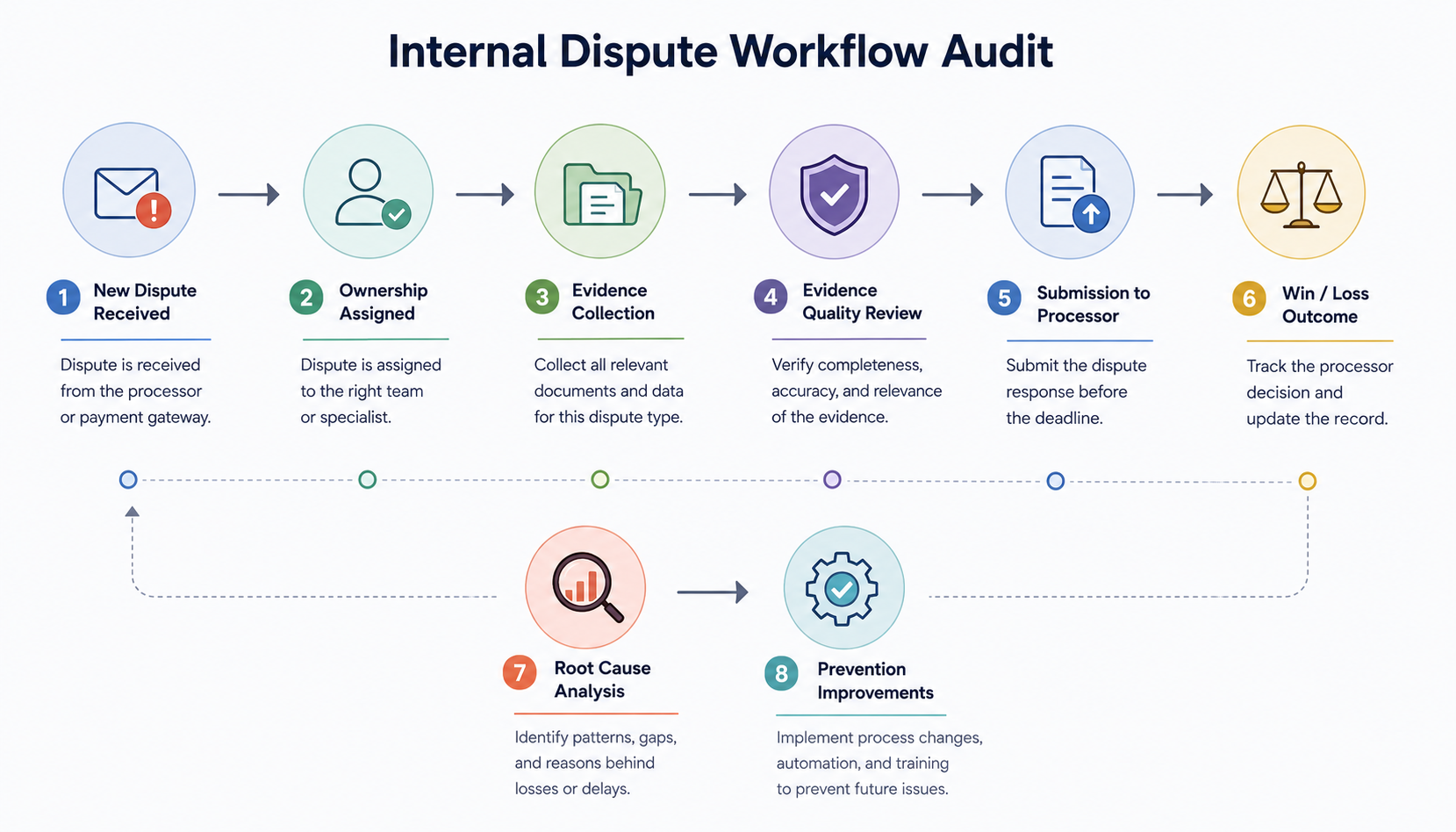
Map your current workflow
Document every step from dispute notification to final submission.
Include:
- who receives disputes
- who gathers evidence
- who decides whether to fight
- who submits responses
Many teams discover disputes pass through multiple owners with no clear accountability.
Audit response times at each stage
Measure how long disputes spend in each step:
- dispute received → assigned
- assigned → evidence collected
- evidence collected → submitted
Even strong cases lose when one stage consistently slows down the process.
Review evidence consistency
Compare disputes of the same type.
Check whether teams submit:
- the same evidence
- the same structure
- the same supporting documents
Inconsistent submissions often produce inconsistent outcomes.
Analyze win rates by dispute type
Break performance down by:
- reason code
- processor
- product line
- region
Some categories may perform well while others quietly reduce overall performance.
Identify recurring failure points
Look for patterns such as:
- missing delivery proof
- incomplete customer communication
- weak fraud evidence
- disputes submitted after deadlines
Chargeflow Insights helps uncover recurring operational issues across large dispute volumes.
Standardize and automate
Create clear workflows and evidence requirements for each dispute type.
Chargeflow Automation helps ensure disputes are handled consistently and submitted on time.
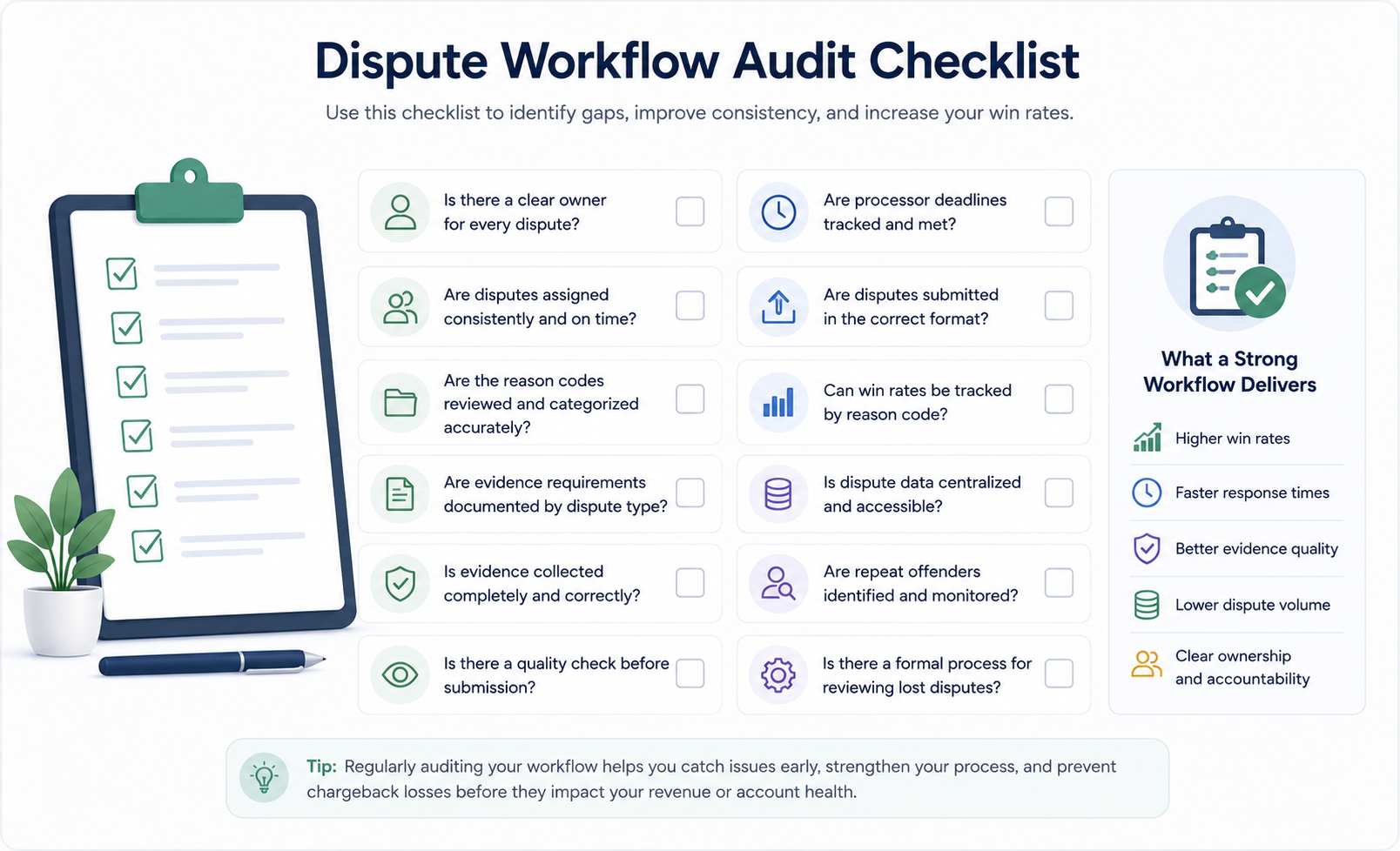
Audit Checklist
Review the following:
- Is there a clear owner for every dispute?
- Are disputes assigned consistently?
- Are evidence requirements documented by dispute type?
- Are processor deadlines ever missed?
- Can win rates be tracked by reason code?
- Is dispute data centralized across teams?
- Are repeat offenders identified and monitored?
- Is there a formal process for reviewing lost disputes?
If multiple answers are "no," the workflow likely contains preventable gaps.
Variaciones de la plataforma o de los casos de uso
Enterprise merchants
Review workflows across multiple teams, processors, and business units. Inconsistency often increases as operations scale.
Subscription businesses
Focus on cancellation records, renewal notices, and customer communication.
Productos digitales
Review how access logs, usage data, and customer activity are captured and stored.
Se necesitan pruebas
When auditing your workflow, review whether you consistently collect:
- transaction details
- authorization data
- delivery confirmation
- registros de comunicación con los clientes
- refund records
- IP and device data
- cancellation or renewal records where applicable
Por qué ocurre esto
As merchants scale, dispute workflows become fragmented across support, fraud, finance, operations, and payments teams. Small inconsistencies compound over thousands of disputes and create losses that are difficult to detect without a structured audit process. Many merchants believe they have an evidence problem when they actually have a workflow problem.
Preguntas frecuentes
What is a dispute workflow audit?
A dispute workflow audit reviews how chargebacks are handled internally, from intake through evidence collection and submission, to identify operational weaknesses.
Why do merchants lose disputes even with valid evidence?
Many disputes are lost because evidence is submitted late, incomplete, inconsistent, or not properly aligned with the dispute reason.
How often should merchants audit their dispute process?
Most merchants should review their dispute workflow quarterly, while high-volume merchants may benefit from monthly audits.
What should enterprise merchants track during a workflow audit?
Enterprise merchants should track response times, evidence quality, ownership, win rates by dispute type, and recurring operational failures.
What are the most common dispute workflow failures?
The most common failures are unclear ownership, inconsistent evidence collection, missed deadlines, fragmented data, and a lack of visibility into why disputes are won or lost.
The merchants with the highest win rates are usually the ones with the most disciplined workflows, and Chargeflow helps uncover and eliminate the operational gaps that silently reduce dispute performance.
¿Devoluciones?
Ya no es tu problema.
Recover 4x more chargebacks and prevent up to 90% of incoming ones, powered by AI and a global network of 20,000 merchants.


.png)
Más artículos.
How Do I Align Customer Support and Payments to Reduce Disputes?
The strongest dispute reduction strategy is catching customer frustration inside support before it reaches the issuing bank. A shared workflow between customer support and payments prevents many disputes before they become chargebacks.
¿Tienes alguna pregunta?
: tenemos las respuestas.
Chargeflow recopila datos de decenas de fuentes externas, no solo datos de transacciones como hace Stripe Dispute. Esto permite una cobertura mucho mayor y unas tasas de éxito mucho mejores, ya que las pruebas presentadas son mucho más completas y convincentes.
Chargeflow recopila datos como la información de los pedidos, los mensajes de los clientes y los detalles de pago. Se encarga de preparar todo el expediente de reclamación por ti, para que no tengas que mover un dedo.
¡Sí! Chargeflow es compatible con muchos procesadores de pagos, no solo con Stripe. Esto significa que dispones de una única herramienta para gestionar todas tus devoluciones, independientemente de cómo proceses los pagos.
Solo pagas un porcentaje de los ingresos que te ayudamos a recuperar. Sin cuotas iniciales, sin suscripciones: solo una tarifa basada en los resultados.
Sí. Chargeflow cuenta con las certificaciones SOC 2, RGPD e ISO. Aplicamos los más altos estándares de seguridad para proteger tus datos.
¿Necesitas más ayuda?
¿Tienes alguna pregunta? Estamos aquí para ayudarte. Solo tienes que pulsar el botón de chat para iniciar una conversación con el servicio de asistencia.