%201.svg)


































PayPal Statistics and Facts 2026


Chargebacks?
No longer your problem.
Recover 4x more chargebacks and prevent up to 90% of incoming ones, powered by AI and a global network of 15,000 merchants.


 600+ reviews
This is a detailed overview of PayPal statistics, facts, and figures for 2026, based on the latest available 2025 data and forward-looking insights.
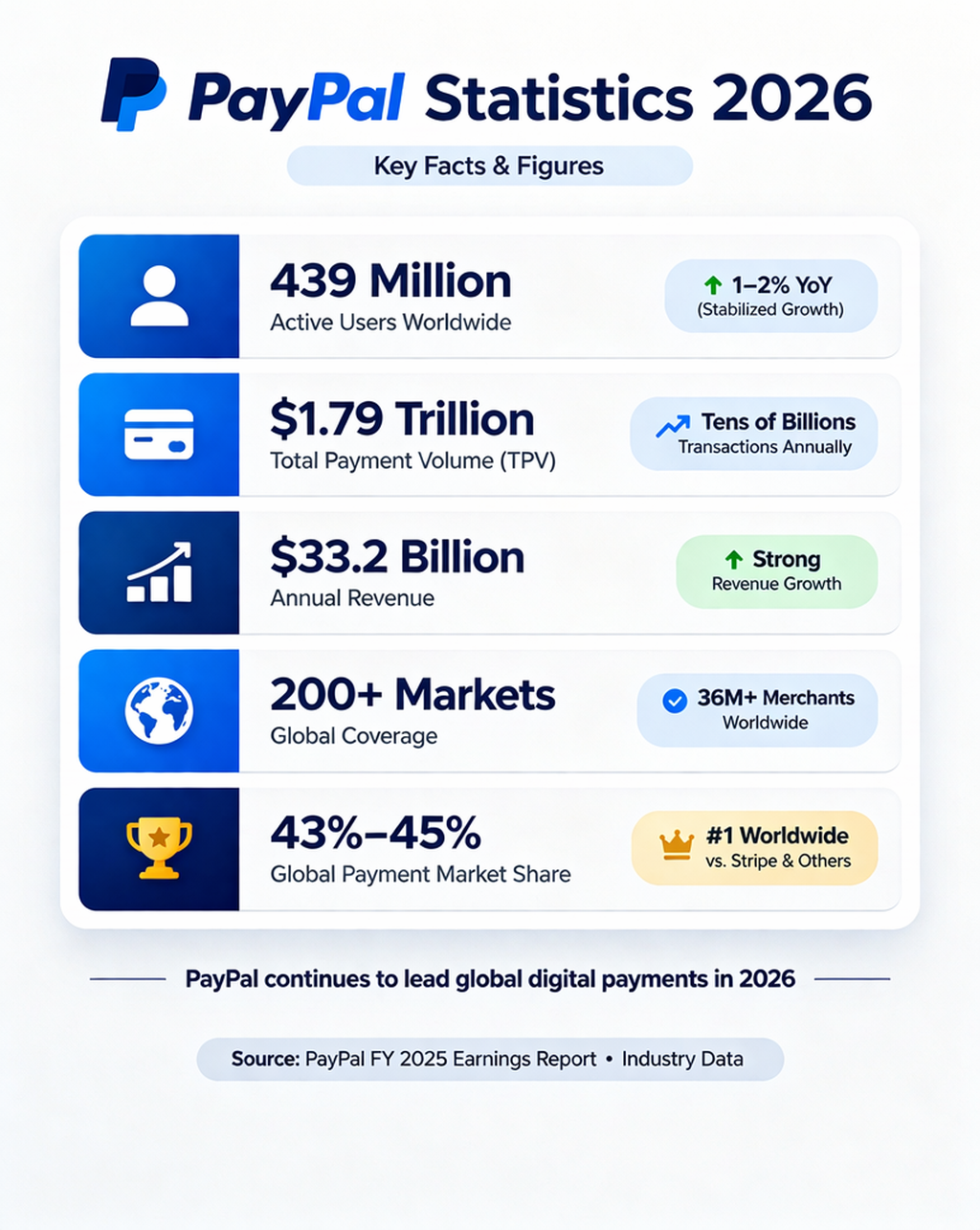
- 439M active PayPal users worldwide (PayPal active accounts)
- $1.79 trillion in total payment volume (TPV)
- $33.2 billion in annual revenue
- 200+ markets supported globally
- ~43%–45% estimated share of the global online payment processing market
This snapshot answers key questions like how many people use PayPal today, PayPal active accounts, and PayPal market share in 2026.
PayPal has been revolutionizing commerce for over 25 years now. Since its humble beginning as Cofinity in 1998, the payment giant has grown into a formidable two-sided network powering eCommerce for individuals and companies in over 200 markets worldwide.
Today, PayPal remains one of the most widely used digital payment platforms globally, with hundreds of millions of PayPal users and active accounts across consumer and merchant segments.
This research provides a detailed overview of PayPal statistics for 2026, including PayPal users, PayPal active users, PayPal market share, PayPal TPV, and PayPal user growth. If you're wondering how many people use PayPal, how many merchants PayPal has, or how PayPal market share has evolved over time, this report covers it all with the latest available data and insights.
We kindly ask that you credit Chargeflow and include a link to this article if you wish to use any data presented here.
Top Line PayPal Statistics for 2026
- PayPal has 439 million active users (PayPal active accounts) as of late 2025
- PayPal's total payment volume (TPV) reached $1.79 trillion in 2025 across ~26.3 billion transactions, representing approximately 7% year-over-year growth.
- PayPal generated $33.2 billion in 2025, with a 4% YoY increment.
- PayPal holds an estimated 43-45% share of the global online payment processing market (based on third-party data).
- Over 36 million merchants use PayPal across 200+ markets worldwide.
- PayPal reported ~$6.4 billion in adjusted free cash flow in 2025.
PayPal Growth Statistics
As of 2026, PayPal continues to dominate online payment processing and remains one of the most widely used digital payment platforms globally, with a strong presence across online, mobile, and peer-to-peer payments.
PayPal user growth has entered a more mature phase, with PayPal users and PayPal active users (active accounts) continuing to increase globally, but at a slower pace compared to previous years.
This section highlights key PayPal statistics related to user growth, adoption, and global market position.
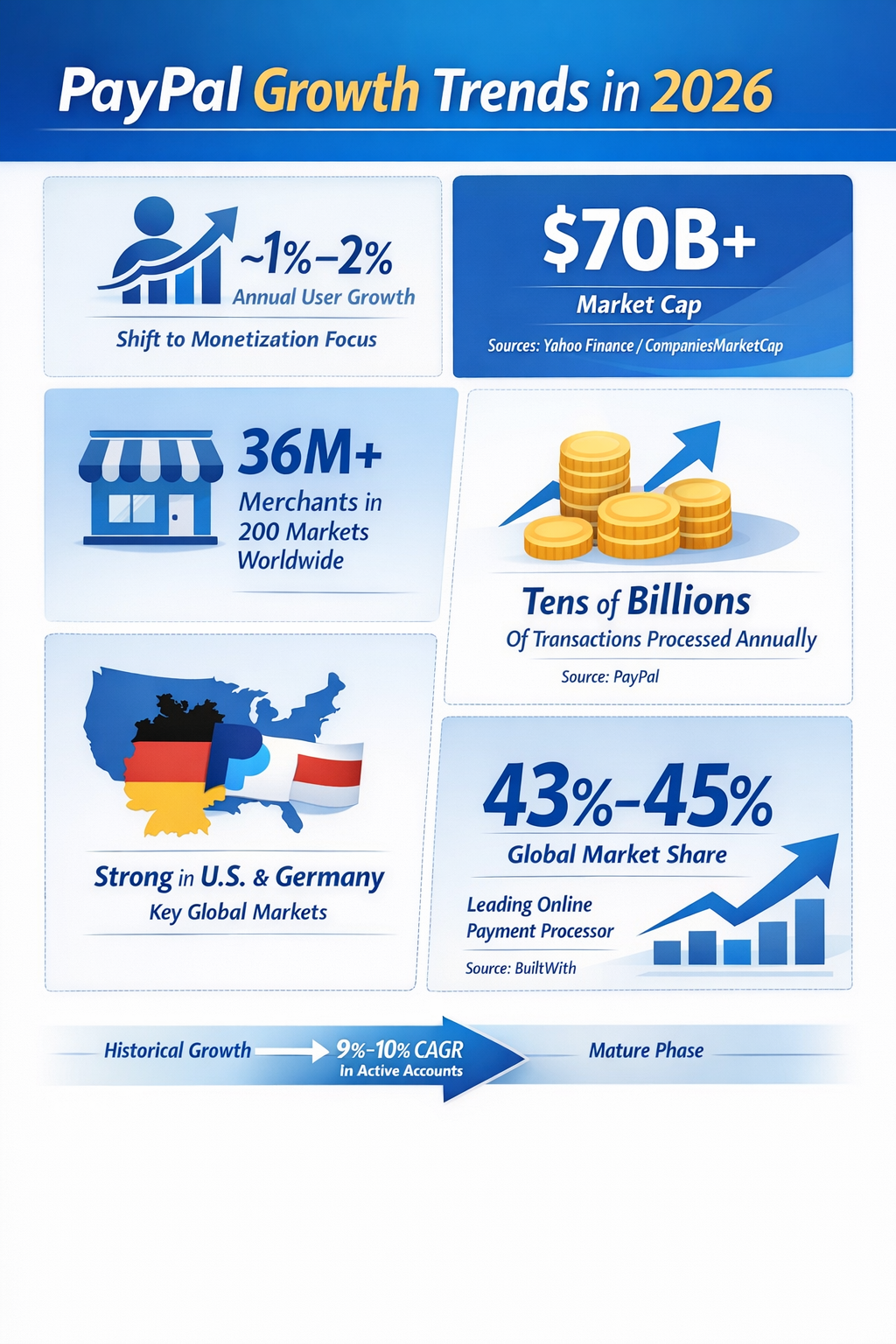
- As of early 2026, PayPal remains one of the most widely used digital payment platforms globally, with a market capitalization of approximately $70B+, depending on market conditions.
- Over 36 million merchants use PayPal in 200 markets worldwide, reinforcing its position as one of the largest two-sided payment networks.
- PayPal continues to process tens of billions of transactions annually, highlighting strong user engagement even as account growth slows. (Source: PayPal earnings data)
- PayPal user growth has stabilized at ~1%–2% annually, reflecting a shift from rapid expansion in active PayPal accounts to deeper monetization of existing PayPal users.
- Historically, PayPal experienced strong growth with a ~9%–10% CAGR in active accounts, but recent years reflect a more mature growth phase.
- The United States remains PayPal’s largest user base, while international markets continue to drive adoption and usage growth, particularly in Europe.
- Germany stands out as one of PayPal's strongest markets, where it remains a leading online payment method.
- PayPal maintains its position as the leading online payment processor globally, with an estimated 43%–45% PayPal market share, ahead of competitors like Stripe.
- PayPal's market share over time has remained dominant, with PayPal consistently holding a leading position in the global online payment processing despite increasing competition.
PayPal Revenue Statistics
PayPal’s financial performance in 2025 reflects a transition into a more stable growth phase, with consistent increases in revenue and payment volume.
- PayPal’s Q4 2025 net revenue reached $8.7 billion, up 4% year-over-year
- Full-year 2025 net revenue reached $33.2 billion, representing 4% YoY growth
- PayPal ended Q4 2025 with $475.1 billion in total payment volume (TPV), reflecting 9% year-over-year growth.
- PayPal’s full-year 2025 TPV reached $1.79 trillion, representing ~7% annual growth.
- Transaction margin dollars grew approximately 6% in 2025, highlighting PayPal’s continued ability to generate value from its existing user base.
- Value-added services revenue reached approximately $3.4 billion in 2025, driven by growth in merchant and consumer financial services.
- PayPal generated approximately $6.4 billion in adjusted free cash flow in 2025, maintaining strong profitability and capital return capacity.
- The company returned approximately $6 billion to shareholders through share repurchases in 2025, reinforcing its shift toward a more capital-efficient, mature growth model.
PayPal Security and Trust Statistics
PayPal has established a strong brand reputation by providing users with 24/7 fraud monitoring, end-to-end encryption, and purchase protection across transactions. Collaborative research by PYMNTS and FIS reports that approximately 60% of consumers trust PayPal more than traditional banks for storing payment credentials.
- Despite ongoing investment in security, online fraud and payment abuse continue to scale alongside digital commerce growth.
- Global eCommerce fraud losses reached $48 billion in 2025, representing a 16% year-over-year increase, with projections continuing to rise.
- On average, merchants lose roughly 3% of total eCommerce revenue to fraud, with losses climbing to 5% or more in high-risk industries.
- The most common scams PayPal users face include phishing emails and messages, invoice and money request scams, advance fee fraud, overpayment scams, fake prize winnings, high-return investment scams, fake charities, shipping scams, prepaid shipping label scams, package rerouting scams, fake job opportunities, reshipping scams, and remote work scams.
- Merchants using PayPal often deal with hundreds of disputes each month, requiring significant time and operational resources to investigate and respond.
- “Item Not Received” (INR) and “Unauthorized Transaction” claims remain the most common causes of PayPal disputes.
- PayPal offers chargeback and fraud protection programs, with costs typically set at 0.4% per transaction or up to 0.6% for advanced coverage options, allowing merchants to transfer risk at the expense of margin.
Controversies and Public Scrutiny
- Like many large fintech platforms, PayPal has faced periodic scrutiny over aspects of its business practices and ecosystem dynamics.
- In December 2024, a widely circulated investigation raised concerns about PayPal-owned Honey’s affiliate attribution model, with critics alleging it diverted commission revenue from content creators.
- Multiple class-action lawsuits followed, and while an initial case was dismissed in 2025, updated claims were filed in 2026, indicating the issue remains unresolved.
- PayPal has denied wrongdoing, stating that Honey follows standard “last-click attribution” practices.
eCommerce and PayPal
PayPal revolutionized the eCommerce business with its seamless online payment solution and digital products.
The payments industry is experiencing tremendous upheavals due to industry regulations and fintech innovations. Mobile wallets are predicted to account for over 50% of all eCommerce transactions by 2026.
PayPal stands to benefit from these developments through its focus on fast, scalable payment systems across eCommerce, mobile, and peer-to-peer transactions.
- PayPal is shifting from a standalone payment method to a comprehensive ecosystem of merchant solutions, including checkout optimization, fraud tools, and financial services.
- PayPal’s continued growth in PayPal TPV and PayPal users is driven in part by its expanding ecosystem of merchant and consumer solutions.
- PayPal’s checkout ecosystem now includes solutions like PayPal Everywhere and PayPal Complete, designed to improve performance, scalability, and merchant conversion rates.
- These solutions have reduced latency by over 40% and increased conversion rates by more than 100 basis points.
- PayPal Complete Payments now handles approximately 45% of total SMB payment volume, highlighting strong adoption among growing businesses.
Businesses using PayPal benefit from measurable performance improvements:
- Up to 25% higher conversion rates
- 33% more completed checkouts for enterprise merchants
- 12% higher average spend per transaction
- 60% higher purchase frequency compared to other payment methods
- PayPal continues to expand its ecosystem through products such as Venmo, Xoom, Paidy, Honey, and Zettle, supporting trends like peer-to-peer payments, BNPL, and omnichannel commerce.
- Venmo remains a key growth driver, with over 90 million active users in the United States and continued expansion in monetization through debit cards and “Pay with Venmo.”
- PayPal is also investing in infrastructure and partnerships to support enterprise and omnichannel commerce.
- Its partnership with Verifone integrates in-person and online payments through Braintree, enabling more flexible and scalable payment systems.
- Buy Now, Pay Later (BNPL) is another major growth area:
PayPal’s BNPL total payment volume reached $33 billion in 2024, growing 21% year-over-year and driving more than 2x purchase volume compared to standard checkout.
At the same time, PayPal is expanding its developer and partner ecosystem through platforms like PayPal Open, allowing merchants to integrate payments, financial services, and risk tools into a unified system.
As PayPal continues to scale across eCommerce, mobile, and financial services, its role is shifting from payment provider to infrastructure layer within the global digital economy.
Conclusion
PayPal continues to hold a dominant position in the global digital payments landscape, with 439 million active users, $1.79 trillion in annual payment volume, and a leading share of the online payment processing market. As the company transitions into a more mature growth phase, its focus has shifted from rapid user acquisition to monetization, ecosystem expansion, and transaction quality.
At the same time, the broader payments environment is becoming more complex. Rising fraud levels, increasing chargebacks, and evolving consumer behavior are creating new challenges for merchants operating at scale. While PayPal’s infrastructure, trust, and global reach remain key advantages, these same factors also contribute to higher transaction volumes and, with them, greater exposure to disputes and post-purchase risk.
As digital commerce continues to grow, PayPal’s role is expanding beyond payments into a full commerce and financial ecosystem. For businesses, success will increasingly depend not just on accepting payments, but on managing what happens after the transaction — including fraud, disputes, and customer claims.
From PayPal users and PayPal active accounts to PayPal market share and PayPal TPV, the platform continues to define the global digital payments landscape.
PayPal Statistics FAQs
How many people use PayPal?
PayPal has approximately 439 million active users (PayPal active accounts) worldwide as of late 2025.
What is PayPal's market share?
PayPal holds an estimated 43%–45% share of the global online payment processing market.
What is PayPal TPV?
PayPal’s TPV reached $1.79 trillion in 2025.
How many merchants use PayPal?
Over 36 million merchants use PayPal globally.
How many PayPal accounts are there?
PayPal has approximately 439 million active accounts worldwide as of late 2025, including both consumers and merchants.
Is PayPal still growing?
Yes, but PayPal user growth has slowed to ~1%–2% annually.
Is PayPal the largest payment processor?
PayPal is one of the largest online payment processors globally, with an estimated 43%–45% market share, making it a leading provider in digital payments.
This research provides general and factual information as of the time of writing. Chargeflow assumes no liability for the information given being complete or correct. Due to varying update cycles, statistics can display more up-to-date data than referenced in the text.
SOURCES:
- PayPal Investor Relations – FY 2025 Earnings Report
- U.S. Securities and Exchange Commission (SEC)
- Yahoo Finance (Market Cap Data)
- CompaniesMarketCap
- Statista
- PYMNTS & FIS Research
- Juniper Research (Fraud Data)
- Mastercard (Fraud Impact Data)
- EHI Retail Institute (Germany Payments Data)
- PR Newswire
- Investopedia
Recommended Research: Shopify Statistics and Facts
Chargebacks?
No longer your problem.
Recover 4x more chargebacks and prevent up to 90% of incoming ones, powered by AI and a global network of 15,000 merchants.


.png)