How Identity Intelligence Links Risk Across Devices, IPs, Emails and Payment Methods


Chargebacks?
Dat is niet langer jouw probleem.
Haal 4x meer chargebacks terug en voorkom tot 90% van de inkomende betalingen, dankzij AI en een wereldwijd netwerk van 20.000 handelaren.


 Meer dan 600 beoordelingen


TL;DR:
- Identity intelligence models relationships among accounts, devices, networks, destinations and payment instruments over time.
- Risk comes from the strength and history of an identity path; not from the presence of one shared attribute.
- Devices can be persistent, IP addresses are often shared, and payment methods can be replaced or legitimately shared.
- A false merge blocks different people as one identity; a false split lets the same abusive buyer appear unrelated.
- Operators need confidence and reason categories rather than unrestricted access to sensitive raw identity data.
- Data minimization, retention, access, correction and vendor controls belong in the buying decision.
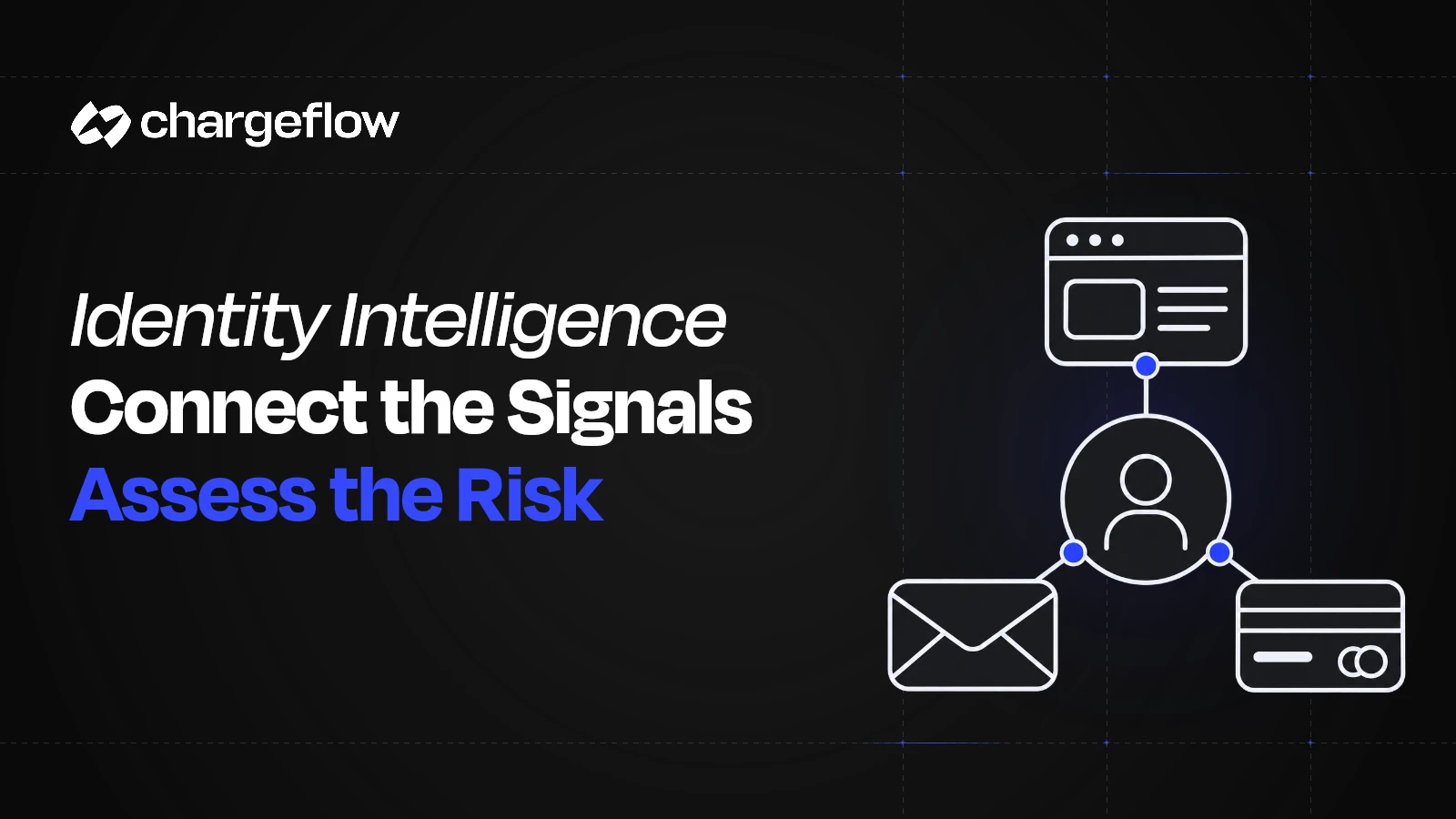
Identity intelligence links order attributes into a graph of people, accounts, devices, networks, destinations and payment instruments. Risk comes from the strength and history of the paths; not from any single shared attribute. Merchants should use confidence tiers, reason codes, data minimization and correction controls before the graph drives fulfillment action.
A repeat buyer can change one identifier while retaining others. At the same time, a legitimate family can share an IP, address, device or card. Identity intelligence is the discipline of resolving those overlaps without pretending the graph is certain.
A useful system returns an interpretable relationship: which nodes connect, how stable they are, when they were observed and which confirmed outcomes sit on the linked history.
Device
Often persistent but can be reset or shared
Strong only with recency, ownership context and corroboration.
IP or network
Easy to observe and frequently shared or changed
Use as context, velocity or supporting evidence.
Email/phone/account
Direct customer identifiers but easy to create or recycle
Normalize and combine with behavioral history.
Payment method/token
Closer to transaction identity but may be shared or replaced
Use provider-safe references, never exposed raw credentials.
Address/recipient
Relevant to delivery and households
Separate normalized location from named recipient and unit.
Model entities, relationships and outcomes
Nodes represent entities such as account, device, payment token and address. Edges represent an observed relationship at a time: used by, shipped to, logged in from or paid with. Outcomes such as confirmed dispute, successful verification and good delivery should remain attributed to the original event.
The graph should not collapse all connected nodes into one person. It can indicate shared or related identity while preserving ambiguity and the evidence path.
Device Identification Example: What a Visitor ID Establishes
Fingerprint Identification is a concrete example of an upstream device-identification component. Its visitor ID refers to a device or browser, rather than a verified person. This distinction matters when several people share a household, office network or device.
Observed signal: a hypothetical browser_demo_01 identifier appears in an upstream event at 10:00 UTC. Store the actual vendor event reference, observation time and meaning of the signal. These placeholder labels are not a promised API schema.
Merchant linkage: the merchant’s backend joins the event to order_demo_01 and pay_demo_01. If that mapping is ambiguous, hold it for review rather than attaching the signal to a different buyer’s transaction.
Decision boundary: recurring device context can support continuity, but it does not prove cardholder consent, delivery or fraudulent intent. Evaluate corroborating transaction facts and counter-signals before merging people or applying an order action.
Evidence handoff: send only relevant, permitted facts with source and event time. Keep a review and correction path for false merges. No native Fingerprint-to-Chargeflow integration or measured recovery improvement is asserted.
Sources checked October 27, 2026: Fingerprint Identification documentation and Fingerprint’s device-versus-person explanation. The record above is a hypothetical mapping example, not a real customer event.
Grade signals without double-counting the same evidence
Swipe or scroll horizontally to view every column.
| Signal | Persistence and sharing | Safe decision use |
|---|---|---|
| Device or browser ID | Can persist across visits; devices can be shared, reset or replaced. | Support continuity with event time and transaction context. |
| IP or network | Often shared and may change with a carrier, office, travel or VPN. | Use as supporting network and velocity context. |
| Email, phone or account | Values can be created, recycled or controlled by more than one person. | Check recency, ownership context and outcome history. |
| Payment reference | Provider-scoped tokens may rotate or represent a shared instrument. | Confirm meaning and scope with the processor; avoid raw card credentials. |
| Address and recipient | One building or household may contain several legitimate buyers. | Keep unit and recipient context; do not equate location with a person. |
Do not multiply these attributes as if they were independent probabilities. Device location and IP-derived location, for example, may reflect the same underlying observation.
Score the path, not the presence of a match
Confidence can rise when corroborating, stable signals agree over time and connect to a relevant outcome. Check their dependence before counting several fields as several independent facts. It falls when the signal is widely shared, stale, easily changed or contradicted by strong good history.
A path that joins a current device and payment token to multiple prior disputed orders is different from one shared office IP. The result should expose that difference as a tier or reason.
Control false merges and evasive splits
A false merge combines different people and can block an innocent customer. A false split treats the same abusive identity as several unrelated buyers. Sample both errors, review appeals and look for patterns in shared households, VPN use, travel and recycled phone numbers.
Use step-up verification when the graph is informative but not decisive. Verification creates new evidence without requiring the merchant to resolve identity from passive signals alone.
Use a reviewable identity-link record
Observation
Store a permitted source/event reference, observation time, identifier type and scope. A missing signal remains unknown.
Relationship
Describe which order or account the evidence connects and why. Preserve the path rather than merging every connected node into one person.
Outcome and counterevidence
Separate a dispute allegation from a confirmed outcome. Record good deliveries, shared-household explanations and disputed matches.
Action and correction
Record the decision, owner, policy version and review date. A correction should affect future decisions without rewriting the original event history.
Field names and examples describe an internal review ledger, not a Chargeflow or Fingerprint API schema. Use only information permitted for the reviewed purpose.
Apply privacy and security by design
Collect only fields needed for defined fraud and abuse purposes, restrict access, set retention and correction processes, and document vendor responsibilities. Hashing or tokenization can reduce exposure but does not automatically remove privacy obligations.
Operators usually need reason categories and confidence, not raw device fingerprints or card data. Design interfaces to reveal the minimum evidence required for the decision.
Worked example: weak, moderate and strong identity links
Hypothetical examples; the correct action depends on merchant policy and full order context.
- Weak link: the current order shares only an office IP with a previously disputed order; do not block automatically.
- Moderate link: a new account reuses the same recipient and phone number but has a new device and payment token; hold or verify when exposure is material.
- Strong link: the same device, payment token and recipient connect to two confirmed prior disputes; escalate to the merchant’s strongest approved verify or cancel rule.
- Counter-signal: the account has three years of successful orders and the shared address belongs to a large apartment building; reduce confidence and review before intervention.
- Correction signal: a prior dispute was reversed or the identity was falsely merged; remove or reduce its negative weight.
Implementation sequence
- Inventory identifiers: List each signal, source, permitted purpose and retention period.
- Normalize safely: Standardize values and use provider-safe tokens where possible.
- Build time-aware links: Keep first seen, last seen and observation count.
- Assign reliability: Score uniqueness, persistence, shareability and evasion cost.
- Return explainable reasons: Show the path and confidence needed for the action.
- Audit merges and splits: Use appeals and outcomes to find identity-resolution errors.
Failure modes and controls
Swipe or scroll horizontally to view every column.
| Failure mode | Business consequence | Control |
|---|---|---|
| One shared IP becomes identity proof | Families and workplaces are merged. | Treat network as supporting context. |
| Opaque aggregate score | Operators cannot calibrate action. | Return reason categories and confidence. |
| Raw sensitive data overexposed | Security and privacy risk increases. | Tokenize, minimize and restrict operator views. |
| No correction path | False links persist across future orders. | Support reviewed correction and decay. |
These operating principles apply across ecommerce platforms: the merchant needs reliable order, payment, fulfillment and dispute records. Prevent currently deploys through Shopify; other platform support is on the roadmap, and the public Prevent API is not yet available. General ecommerce guidance does not imply a live integration for every platform.
Apply the repeat-chargeback abuse playbook only after deciding how reliable the link is. The fraud and abuse diagnostic guide helps distinguish the relevant outcome, while the order-rule guide sets the permitted action.
This guide builds on Shopify chargeback prevention before fulfillment. Chargeflow Prevent acts after checkout; it does not replace payment authorization or resolve every post-delivery service issue.
Availability checked October 27, 2026: the workflow Help Center documents Proceed, On Hold and Cancel; automated Verify is marked coming soon. A merchant can define a manual verification policy, but should not promise an unavailable automated flow.
How Chargeflow Prevent fits
Chargeflow Prevent describes identity intelligence across device, IP, email and payment-related signals, with models trained on a broad merchant network.
The buying group should not confuse that model context with the merchant-visible Repeat Disputers list, which Chargeflow currently documents as store-specific. Evaluate how confidence is explained, how policy uses the result and which governance controls apply.
{{cta}}
Frequently asked questions
Is an IP address personal identity?
It is a network signal, not proof of a person. Its privacy treatment depends on context and jurisdiction.
Why use several identifiers?
Independent signals make evasion harder and reduce reliance on a collision-prone field.
What is an identity graph?
A time-aware model of entities and observed relationships linked to outcomes.
Can identity intelligence automatically cancel orders?
It can inform a rule, but high-impact actions should require calibrated confidence, economics and policy.
What should vendors explain?
Signal categories, confidence, relevant history, permitted use, retention, security and correction behavior.
Can an IP address alone prove ecommerce fraud?
No. An IP address can be shared by households, offices, carriers, hotels or privacy tools. Treat it as network context, not proof of a person. Stronger decisions use several independent, time-aware links plus confirmed outcomes and an appropriate correction path.
What should Privacy review in an identity-intelligence tool?
Review purpose, data fields, tokenization, access, retention, subprocessors, cross-border handling, correction and deletion behavior. Also ask what operators actually see and how the vendor prevents weak household or network links from producing an irreversible decision without proportionate confidence.
Do several matching fields always make a strong identity link?
No. Several fields may come from one shared device, household or underlying network observation. Evaluate independence, recency, identifier scope and evidence in the buyer’s favor. A reasoned review is more useful than adding arbitrary points for every match.
Bronnen
Connect Identity Signals to Order Decisions
Explore Prevent for ecommerce fraud and friendly-fraud prevention, with deployment through Shopify today.
Chargebacks?
Dat is niet langer jouw probleem.
Haal 4x meer chargebacks terug en voorkom tot 90% van de inkomende betalingen, dankzij AI en een wereldwijd netwerk van 20.000 handelaren.