How to Automate Shopify Fraud Review Without Slowing Fulfillment


rétrofacturation?
Ce n'est plus votre problème.
Récupérez 4 fois plus d'rétrofacturation s et PRÉVENTION jusqu'à 90 % des messages entrants, grâce à l'IA et à un réseau mondial de 20 000 commerçants.


 Plus de 600 avis


En bref :
- Automated Shopify fraud review should release low-risk orders immediately and reserve humans for resolvable ambiguity.
- Decision latency must be measured from the paid-order event to an enforceable fulfillment state; not only model response time.
- The review queue should be prioritized by fulfillment deadline, net exposure and the value of additional information.
- An outage policy can fail open for low exposure and fail closed for extreme exposure when documented in advance.
- One case identifier and idempotent events prevent duplicate holds, releases, refunds and customer messages.
- Tail latency, stale holds and missed warehouse cutoffs reveal operational failures that average response time can hide.
Automate Shopify fraud review by releasing low-risk orders immediately, routing only ambiguous orders to a bounded exception queue, and reserving buyer verification or cancellation for defined cohorts. Measure end-to-end decision latency against the warehouse cutoff, not just model response time.
Most orders should never enter a manual queue. Automation succeeds when it removes repetitive review while making the few true exceptions more structured.
The performance constraint is the last safe moment before fulfillment. Work backward from label creation, pick/pack or digital delivery and assign a latency budget to every system and human step.
Straight-through release
Low risk and no hard policy conflict
Protects fulfillment speed for the majority.
Automatic intervention
High-confidence risk with approved action
Prevents avoidable loss without waiting for an analyst.
Exception queue
Ambiguous, valuable and resolvable cases
Concentrates expert time where it can change outcome.
Fallback
Timeout or dependency failure
Produces a known release, verify or cancel decision.
Work backward from the fulfillment cutoff
Measure when each warehouse, 3PL, dropshipper or digital system makes fulfillment irreversible. Same-day and express services may have different cutoffs. The risk workflow must complete before the earliest applicable point.
Budget time for event delivery, enrichment, scoring, rules, manual review, verification and state synchronization. A fast score cannot compensate for a queue that is checked twice per day.
Set a deadline budget that includes the warehouse
Swipe or scroll horizontally to view every column.
| Elapsed time | Work and owner | Exit requirement |
|---|---|---|
| 0:00 to 0:15 | Receive and record the order event; integration owner. | The order enters the correct eligible population. |
| 0:15 to 1:00 | Obtain available assessment and evaluate policy; risk system. | A decision or explicit missing-data state is recorded. |
| 1:00 to 10:00 | Resolve selected exceptions; reviewer and, where appropriate, buyer. | A named reviewer decides before the queue deadline. |
| 10:00 to 12:00 | Apply and confirm the intended action; integration and fulfillment. | Shopify and the actual shipping system acknowledge the state. |
| 12:00 to 15:00 | Recovery buffer; operations owner. | Handle failures before the earliest irreversible fulfillment step. |
Illustrative allocation only, not a Prevent response-time claim. Replace every stage with measured limits for each warehouse, service level and digital-delivery path.
Keep the exception queue narrow
Auto-release orders with sufficient evidence and low estimated loss. Auto-apply approved actions to the clearest high-risk cases. Send only cases where a human can obtain or interpret information that changes the decision.
Prioritize the queue by deadline, exposure and information value. Show reasons, linked history, permitted actions and the exact time remaining.
Queue capacity must also survive bursts. Estimate required review minutes as incoming orders × exception share × minutes per case, then compare that workload with staffed minutes before the cutoff. Include break cover and variability; average daily volume can conceal an unmanageable ten-minute spike.
Make state changes event-driven and idempotent
The same case should update Shopify, warehouse and communication systems. Retries must produce the same result without duplicate holds, releases, messages or refunds.
Monitor late decisions, stale holds, missing events and integration failures. Alert an operational owner before orders cross the cutoff.
Test missing events, retries and stale decisions
For a custom Shopify event consumer, Shopify distinguishes delivery and event identifiers. Verify delivery authenticity and deduplicate retries before taking action. Use a durable order/action record as well: two distinct deliveries should not create the same refund twice.
Use periodic reconciliation to detect eligible orders that never reached the decision workflow. Before a delayed release or cancellation, reread the current order and fulfillment state. Treat an action request, an accepted platform change and a warehouse acknowledgement as separate events.
Swipe or scroll horizontally to view every column.
| Scénario | Expected control | Operational owner |
|---|---|---|
| A paid order has no assessment by its deadline | Record missing coverage; apply the preapproved exposure-based fallback. | Risk and operations |
| A duplicate or stale release arrives | Deduplicate; reject an action incompatible with the current state. | Integration team |
| Shopify accepts a hold; the 3PL still queues shipment | Escalate the acknowledgement gap before the irreversible step. | Fulfillment owner |
| The queue has more work than remaining capacity | Route to the escalation owner and stop widening the rollout. | Review lead |
These are implementation acceptance tests, not claims about native Prevent APIs or automatic synchronization with every 3PL.
Measure both speed and decision quality
Track median and tail latency, percent auto-released, percent manually reviewed, verification completion, late decisions and fulfillment delay. Pair those with dispute, cancellation and false-positive indicators.
If automation increases review volume, the rules are not automation. Tighten the definition of exceptions or improve the evidence shown so the team can decide faster.
For Shopify-native fraud assessments, the Order risk analyzed trigger runs after Shopify finishes its analysis and does not fire for a third-party assessment. Do not wait on that trigger for a Prevent decision. Confirm the actual app workflow and test its effect on each fulfillment path.
Confirm the current rollout boundary
Chargeflow’s current deployment path centers on the Shopify app and workflow automation. Teams that require direct access to order scores, recommendations or webhook events should confirm public API availability for their intended implementation rather than infer it from the product workflow.
- Automated buyer verification is still marked coming soon in the workflow Help Center. Confirm the exact in-product flow before promising it operationally.
- Validate today’s Shopify-native event, action and monitoring behavior in the merchant’s actual plan and configuration.
- Confirm public API, webhook and automated verification availability during technical evaluation.
Put rollout-dependent capabilities in the pilot acceptance plan instead of presenting them as universal functionality.
Implementation sequence
- Map every cutoff: Document irreversible fulfillment time by path and service level.
- Set latency budgets: Allocate time to systems, queue and buyer response.
- Define straight-through cohorts: Auto-release and auto-intervene only where policy is clear.
- Design the exception queue: Prioritize by deadline, exposure and information value.
- Synchronize state: Use one case and idempotent events across systems.
- Monitor tail latency: Alert on late decisions, stale holds and dependency failures.
Failure modes and controls
Swipe or scroll horizontally to view every column.
| Failure mode | Business consequence | Control |
|---|---|---|
| All flagged orders reviewed | The queue becomes the bottleneck. | Route only resolvable ambiguity to humans. |
| Model latency is the only SLA | Orders wait in systems or inboxes. | Measure end-to-end time to enforceable state. |
| Retry duplicates actions | Customers receive repeated messages or refunds. | Use idempotency keys and one case ID. |
| No failure fallback | Outages leave orders frozen or unreviewed. | Define time-based fail-open or fail-closed policy by exposure. |
Use the post-purchase prevention architecture to identify the enforceable control point. Pair the order-state rules with the fraud KPI scorecard so faster processing does not hide missed controls or customer harm.
This guide builds on Shopify chargeback prevention before fulfillment. Chargeflow Prevent acts after checkout; it does not replace payment authorization or resolve every post-delivery service issue.
Availability checked October 27, 2026: the workflow Help Center documents Proceed, On Hold and Cancel; automated Verify is marked coming soon. A merchant can define a manual verification policy, but should not promise an unavailable automated flow.
How Chargeflow Prevent fits
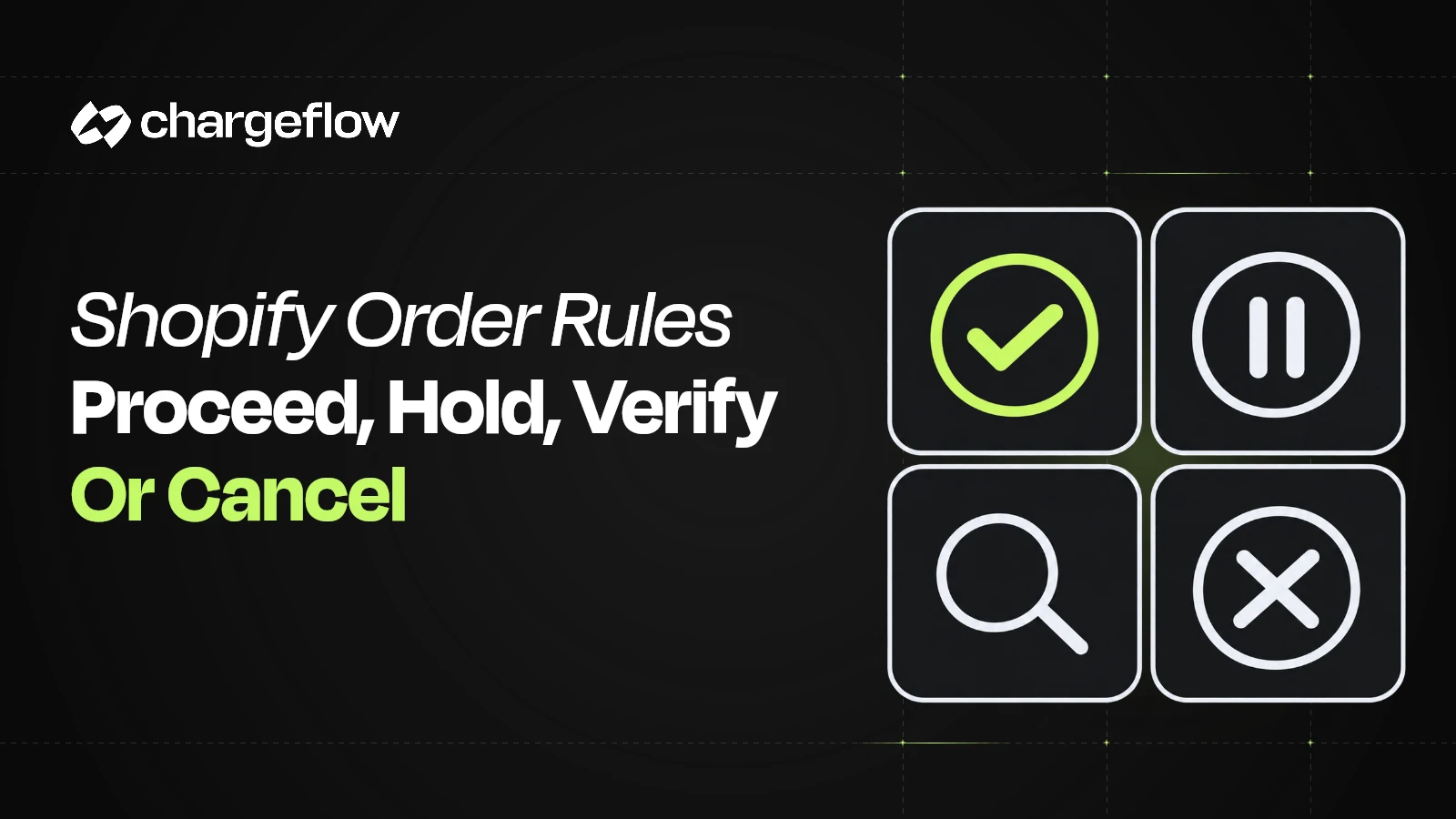
Chargeflow Prevent is positioned for real-time post-purchase scoring and Shopify-native workflow automation. Proceed, hold and cancel can support straight-through decisioning; automated buyer verification is still marked coming soon in the workflow Help Center; confirm availability before relying on it.
The team should validate actual latency, failure handling, public API needs and workload in its own Shopify environment. A 30-day pilot should measure the full operational path, not only risk accuracy.
{{cta}}
Foire aux questions
What percentage of orders should be manually reviewed?
There is no universal target; it should be the smallest cohort where human judgment changes enough outcomes to justify cost and delay.
What is tail latency?
The slowest meaningful portion of cases, such as the 95th percentile, which often determines missed warehouse cutoffs.
Should an outage release or block orders?
Define by exposure tier. Low-risk orders may fail open while extreme-exposure orders may remain held.
How do you prioritize review?
Use time remaining, estimated loss and whether additional evidence can resolve uncertainty.
What proves automation is working?
More straight-through decisions, lower manual time and controlled disputes without higher false positives or fulfillment delay.
Can Shopify Flow automate fraud review?
Shopify Flow can automate actions based on available order and risk conditions, but the merchant must still define the policy, fulfillment hold, timing and exception route. Confirm which plans, payment methods and order types receive the risk data required by the workflow.
How fast must pre-fulfillment risk scoring be?
Fast enough to reach an enforceable order state before the relevant warehouse cutoff. Measure the complete path from paid-order event through scoring, rule execution and Shopify or warehouse confirmation. A quick model response is not useful if the hold arrives after label creation.
Sources
- Chargeflow Prevent documentation
- Workflow automation in Chargeflow Prevent
- Getting started with Chargeflow Prevent
- Shopify Order Risk API (legacy REST reference; check the current GraphQL documentation for new integrations)
- Shopify fraud-filter and workflow guidance
- Shopify webhook delivery verification
- Shopify webhook best practices
- Shopify Order risk analyzed trigger
Keep Fraud Review Ahead of Fulfillment
Explore Prevent for post-purchase risk scoring and workflow controls before eligible orders ship.
rétrofacturation?
Ce n'est plus votre problème.
Récupérez 4 fois plus d'rétrofacturation s et PRÉVENTION jusqu'à 90 % des messages entrants, grâce à l'IA et à un réseau mondial de 20 000 commerçants.