How Payment Platforms Can Assemble Chargeback Evidence From Orders, Billing, CRM and Fraud Data


rétrofacturation?
Ce n'est plus votre problème.
Récupérez 4 fois plus d'rétrofacturation s et PRÉVENTION jusqu'à 90 % des messages entrants, grâce à l'IA et à un réseau mondial de 20 000 commerçants.


 Plus de 600 avis


En bref :
- Build evidence from a verified transaction timeline, not a folder of screenshots. Join the dispute to the order, fulfillment, billing, identity, communication and policy records, then select only the facts relevant to the reason code and preserve their source and timestamp.
- Treat evidence provenance as a product contract.
Build evidence from a verified transaction timeline, not a folder of screenshots. Join the dispute to the order, fulfillment, billing, identity, communication and policy records, then select only the facts relevant to the reason code and preserve their source and timestamp.
Payment platforms often hold better evidence than the processor because they can see the merchant's product workflow. The challenge is that the evidence lives in several systems with different identifiers, retention rules and meanings.
A strong evidence pipeline resolves those records into one transaction narrative, validates the data and creates a versioned package before the response deadline.
At a glance
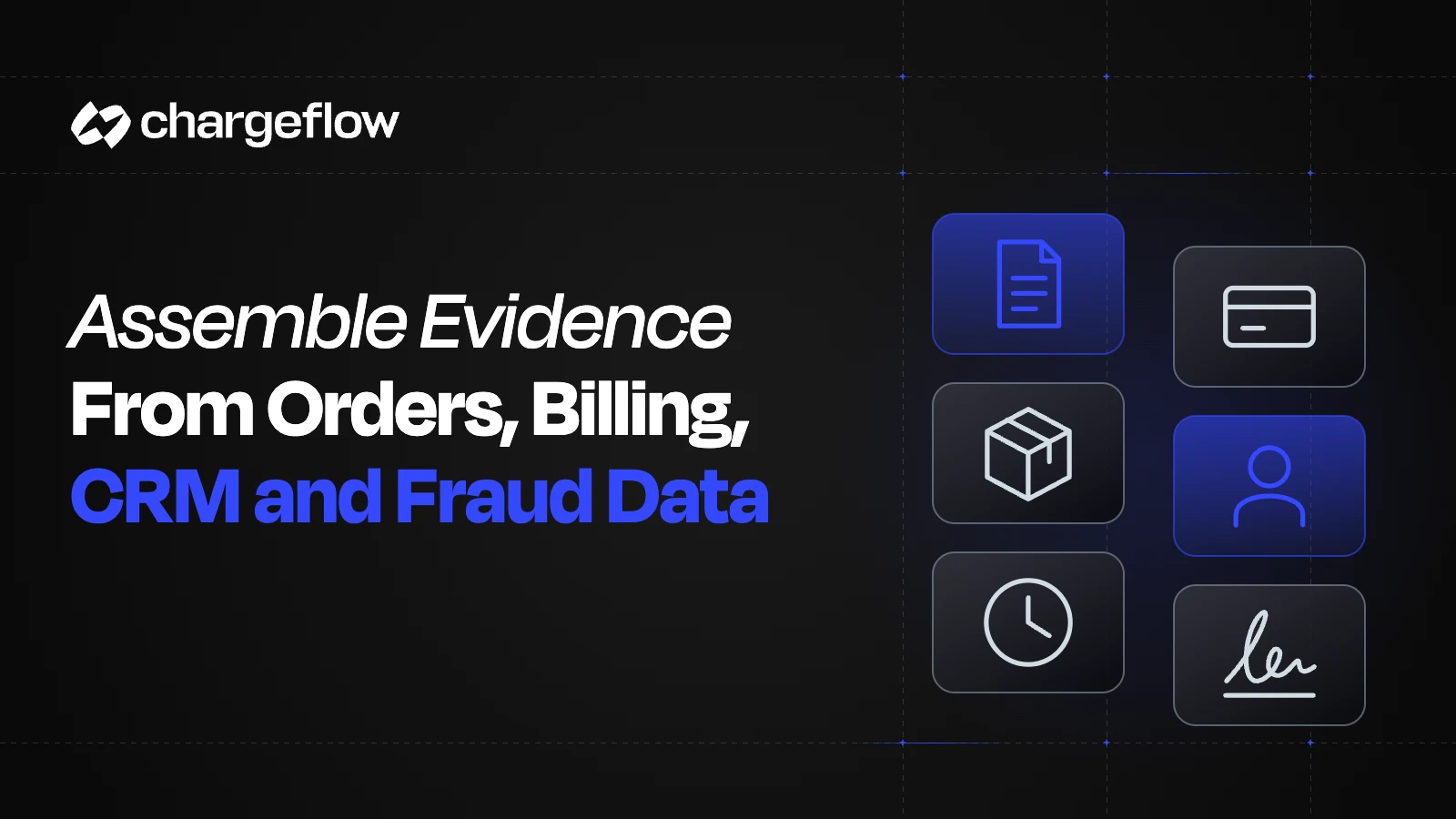
Items or service purchased, price, order time and accepted terms.
Authorization, capture, recurring agreement, invoices, cancellation and refund history.
Shipment, delivery, digital access, service usage or appointment completion.
Authentication, device, account history and verified risk signals.
Customer requests, merchant responses, promised dates and resolution attempts.
Return, refund, cancellation and delivery terms presented at purchase.
Reason, stage, amount, currency, deadline and processor identifiers.
Resolve every record to the authorized tenant, merchant and processor account before selecting facts.
Start with a deterministic evidence graph
The dispute should link to one processor account and one original payment. From there, resolve the platform merchant, order, customer account and related fulfillment or subscription records. Each edge needs a stable identifier or documented matching rule. Start from a normalized dispute model and carry the tenant context through the architecture.
Avoid joining from names, email addresses or amounts when a payment or order ID exists. When the match remains ambiguous, route the case for review instead of attaching another customer's data.
Match evidence to the claim
An unauthorized-transaction claim requires different facts from an item-not-received claim. Authentication, device and account history may matter to the first. Shipment, delivery and customer communications matter to the second. A cancellation dispute needs the agreement, cancellation request and billing timeline.
Create an evidence matrix by reason family. It should define required, useful and irrelevant data types. The matrix improves consistency and prevents large packages from hiding the strongest proof.
Illustrative reason-family matrix. Apply the processor and network’s actual reason-specific requirements.
| Reason family | Relevant facts to validate | Mismatch to avoid |
|---|---|---|
| Paiement non autorisé | Applicable authentication, account history and explained device or identity facts | Treating a risk score alone as proof |
| Article non reçu | Processor-specific delivery proof linked to the order and disputed payment | A shipping label that only proves dispatch |
| Cancellation or recurring billing | Agreement, notice, cancellation request, subsequent use and billing/refund timestamps | Terms that were changed after purchase |
Scroll horizontally when all columns do not fit.
Preserve provenance and human-readable meaning
For each fact, record the source system, source record, event time and time of retrieval. Explain technical signals in ordinary language. A signed-in session from a known device is more useful when the package states what made the device known and when the association was established.
Do not edit source facts to fit the narrative. If records conflict, surface the conflict for review. The evidence system should make omissions and inconsistencies visible before submission.
Version the package as the case changes
New delivery scans, customer messages or refund events may arrive after the first package is generated. Store each package as a version with the source records and rules used to create it. Approval and submission should point to that exact version. Tie approval to the submitted artifact using version-bound roles and permissions.
Chargeflow’s Evidence-as-a-Service returns a persistent evidence ID; regeneration increments the file version. Mirror the version in the case history and bind approval and submission to the exact file.
Measure evidence completeness before generation
A completeness check should verify required identifiers, dates, amounts and reason-specific artifacts. It should not invent a universal evidence score that implies certainty. Report what is present, what is missing and whether the missing item can still arrive before the internal deadline. Track generation and error events through a reliable webhook receiver.
This check is useful for merchant activation and data-quality work. If many disputes lack delivery or cancellation records, the platform can improve the integration rather than asking operators to fix every case manually.
Implementation sequence
Link processor dispute, payment, merchant and order with stable identifiers.
Map the source reason to a reason family without discarding the original code.
Query the evidence matrix for required and useful data sources.
Record source, event time, retrieval time and integrity for each artifact.
Order purchase, authentication, fulfillment, communication, refund and dispute events.
Create a versioned package and apply the merchant's approval policy.
Store the submitted version, submission reference and final outcome.
Failure modes and controls
| Failure mode | Business consequence | Control |
|---|---|---|
| Screenshot-only evidence | Facts are hard to validate, search and reuse. | Ingest structured source data and render it into the final package. |
| Same evidence for every reason | Packages become long but unpersuasive. | Use a reason-family evidence matrix. |
| Unverified joins | Another customer's records enter the case. | Require deterministic IDs or manual review for ambiguity. |
| No evidence version | Reviewers cannot prove what was submitted. | Bind generation, approval and submission to a version. |
| Over-sharing personal data | The package exposes information irrelevant to the claim. | Select the minimum evidence required for the specific reason. |
Scroll horizontally when all columns do not fit.
Treat evidence provenance as a product contract
A persuasive document is not enough if the platform cannot explain where each fact came from. Every evidence item should carry a provenance record that survives transformations and makes missing data measurable.
System, tenant, object type and source record ID.
When the customer action occurred, when the source recorded it and when the platform extracted it.
Transaction ID, order ID, subscription ID, customer ID or another deterministic relationship.
Normalization rule, policy or template version used to turn source data into evidence.
Original artifact reference and, where appropriate, a content hash or immutable version.
Team or system responsible for correcting the source if the record is incomplete.
Required, available, validated, selected or excluded, with the reason for exclusion.
These fields support an evidence coverage service level: the share of eligible cases that have every required fact validated before the internal review deadline. That metric is more diagnostic than document count because it shows whether a gap comes from data availability, mapping, validation or workflow timing.
Evidence base: Chargeflow Evidence Source Map; Klarna dispute evidence guidelines.
How Chargeflow Connect fits
Chargeflow Connect’s Evidence-as-a-Service accepts dispute and merchant context and returns a versioned evidence package. The platform must provide the dispute, download the package and submit it through its processor workflow. Access requires platform-level enablement by the account team; EaaS is not intended for merchants of record.
The platform's advantage is its first-party data. Connect's role is to turn that data into a consistent, reason-aware response without requiring the platform to maintain evidence templates and network-specific logic.
Turn the data already in your platform into chargeback evidence with Chargeflow Connect.
Foire aux questions
What is the most important chargeback evidence?
The most important evidence is the verified fact that directly addresses the dispute reason, such as delivery for non-receipt or cancellation and billing records for a recurring dispute.
Should platforms submit every available data point?
No. They should submit relevant, understandable evidence and avoid unnecessary personal or technical data.
How should evidence be linked to the merchant?
Use stable platform, processor account, transaction and order identifiers, with manual review when the mapping is ambiguous.
Why should evidence packages be versioned?
Versioning proves which source data, narrative and attachments were reviewed and submitted at each stage.
Can fraud-platform data improve representment?
Yes, when the underlying signals are relevant, permitted, accurately explained and linked to the disputed transaction.
Sources
Chargeflow Evidence-as-a-Service overview
Chargeflow platform webhook events
Chargeflow Platforms quickstart
Chargeflow dispute state machine
Visa dispute-resolution guidance
Visa guidance on friendly fraud and compelling evidence
Related platform guides
Add Chargeback Management to Your Platform
Use a platform-first integration to offer chargeback automation across your merchant base.
rétrofacturation?
Ce n'est plus votre problème.
Récupérez 4 fois plus d'rétrofacturation s et PRÉVENTION jusqu'à 90 % des messages entrants, grâce à l'IA et à un réseau mondial de 20 000 commerçants.