Como a IA detecta contas falsas em plataformas de comércio eletrônico

Chargebacks?
Não é mais problema seu.
Recupere 4 vezes mais chargebacks e PREVENÇÃO — até 90% dos e-mails recebidos —, com tecnologia de IA e uma rede global Rede de 20.000 Lojistas.


 Mais de 600 avaliações


Resumo:
- Treat an AI account score as a reason to investigate, and name the abuse first: bot signup, duplicate promo account, review manipulation, takeover, or brand impersonation.
- Set thresholds per stage (signup, login, redemption, checkout, post-checkout) instead of one account-level cutoff.
- The FTC rule on reviews has applied since October 2024, so moderate suspected fake reviews with criteria that treat positive and negative reviews alike.
- Fake brand profiles and look-alike stores drive support contacts and, through triangulation fraud, chargebacks.
- Judge any model by appeals, reversals, and lost good orders, not by accounts blocked.
AI detects potentially fake ecommerce accounts by combining behavioral, account, device, and transaction signals into a risk assessment. The output is a probability or review signal, not proof that an account is fake or that its owner committed fraud.
This page covers the account layer: fake signups, duplicate promo accounts, manipulated reviews, and profiles that impersonate your brand. For how scoring models work across the whole order, read our guide to AI fraud detection. For how criminals use AI to build these accounts, see AI-era payment fraud.
Start with the abuse you want to stop: repeated incentive claims, automated signups, manipulated reviews, unauthorized purchases, or return fraud. Each needs its own label and control. An unfamiliar customer, shared device, or short review is not enough to establish abuse.
Define the Account Behavior You Need to Detect
“Fake account” can mean an automated profile, a duplicate created to evade offer rules, a synthetic identity that blends real and invented details, or a genuine account controlled by an intruder. Keep these categories separate. A model trained on an inconsistent label can learn the wrong pattern and send legitimate customers into unnecessary reviews.
OWASP’s Automated Threat Handbook defines account creation (OAT-019) as bulk signup automation used to create multiple accounts for later misuse, including spam, fraud, and review manipulation. Coordinated signup waves often come from botnets; see botnet attacks for the network-level controls.
| Signal Group | Potential Use | Important Limitation |
|---|---|---|
| Signup and session behavior | Identify automated or unusually coordinated activity | Fast or repetitive actions can also be legitimate. |
| Device and network links | Find relationships between accounts | Households and shared networks create legitimate overlap. |
| Purchase and redemption history | Review repeated incentives or suspicious orders | A pattern needs the actual offer and payment context. |
| Payment and delivery data | Link accounts that share a payment token or delivery address, a common address fraud pattern | Dorms, offices, and gifting create legitimate shared addresses. |
| Reviews and profile content | Surface unusual repetition for review | Similar wording or an image does not prove a false identity. |
| Account changes | Investigate possible compromise | Recovery and device replacement can be legitimate. |
Use the promo abuse guide for eligibility-related duplication and the account takeover guide when an established profile may be compromised. Those are different decisions from identifying automated signup traffic.
Check Each Stage of the Customer Journey Separately
One score at login does not protect the whole journey. Each stage asks a different question and needs different evidence, so set thresholds per stage instead of using a single account-level cutoff.
| Palco | Decision | Example checks |
|---|---|---|
| Signup | Is this a person or a script, and is it a repeat? | Bot challenge, signup velocity, disposable-email and device checks |
| Login and account changes | Is the owner still in control? | New-device alerts, step-up authentication on password, email, or address changes |
| Offer redemption and referrals | Is one customer claiming one benefit once? | Per-customer limits across device, payment, and delivery data |
| Finalizar a compra | Did the cardholder authorize this payment? | Card-testing velocity, address checks, 3D Secure 2 challenges |
| After checkout, before fulfillment | Should this order ship? | Order-level screening on device, IP, email, and payment behavior, which is where Chargeflow Prevent operates |
Use AI to Prioritize Review, Then Verify the Facts
An account-risk system can combine signals that are difficult to inspect manually across many events. Keep the evidence behind the decision visible: what changed, which behavior was unusual, and what action followed. A score without an explanation is hard for support to investigate or correct.
The OWASP bot-management guidance supports layered detection and response. Apply controls to the relevant feature, such as signup or redemption, rather than assuming a single check at login protects the entire customer journey.
Not every automated visitor is a fake account. Shopping agents acting for real customers are a separate category, and AI agent fraud explains how to tell them apart from malicious ones. For payment-attempt abuse, use the card-testing response workflow. For unauthorized purchases, use the card-not-present fraud guide. An account model should complement the payment integration’s controls, not replace them, as the ecommerce fraud prevention guide lays out.
Treat Reviews and Images as Limited Signals
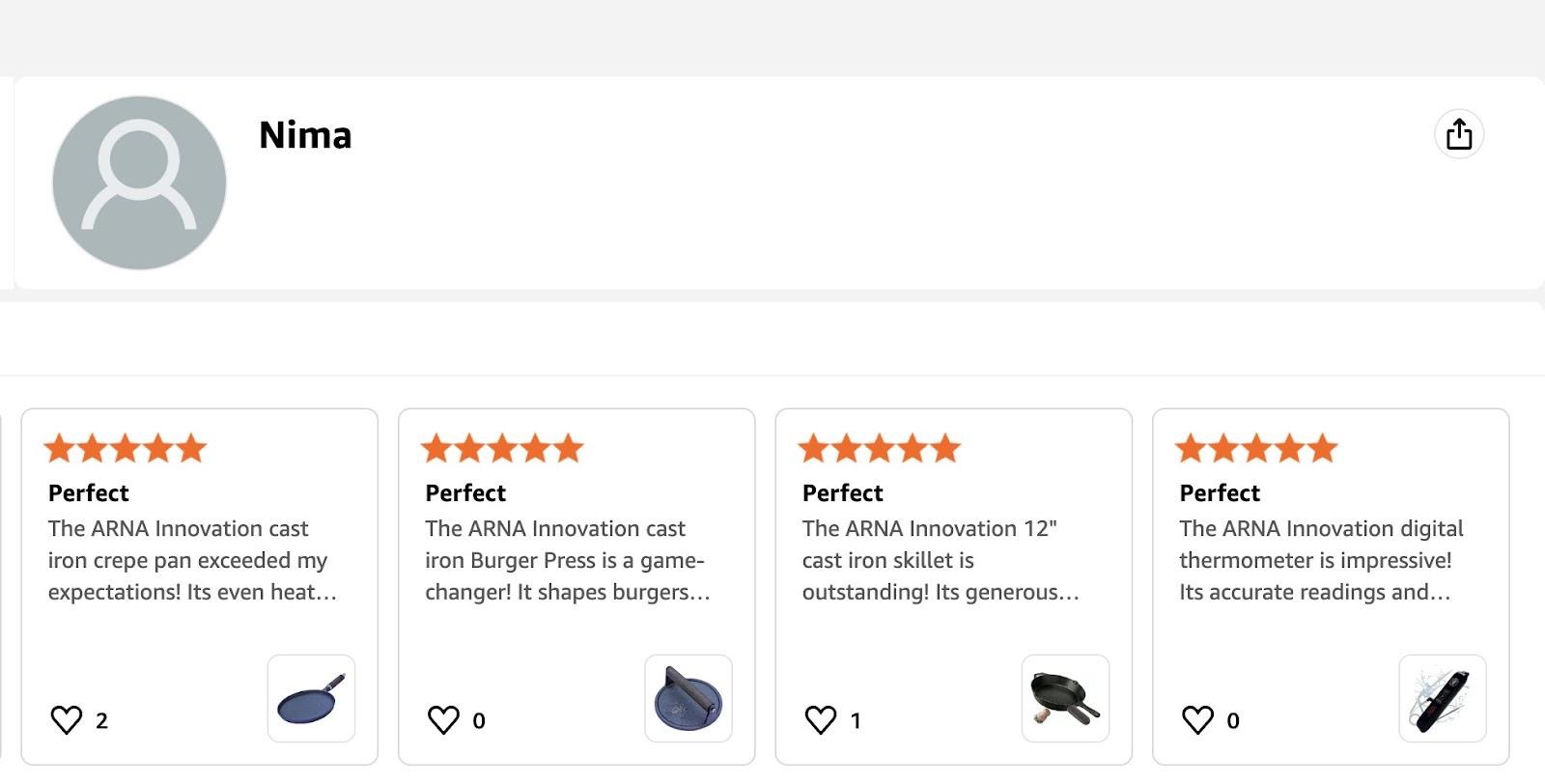
Repeated review language can justify investigation, but it can also reflect templates, product naming, translation, or short ordinary feedback. Image similarity can reveal reuse without establishing that the person behind the account is fictitious.
The profile below shows four five-star reviews with the same title, each praising a different product from one brand in similar wording. A pattern like this justifies a review, not a verdict.
Reviews also carry legal weight. The FTC’s Trade Regulation Rule on Consumer Reviews and Testimonials (16 CFR Part 465) has applied since October 21, 2024. It bans fake or AI-generated reviews, paid reviews conditioned on sentiment, undisclosed insider reviews, and buying or selling fake followers and views. It also bars suppressing reviews through unjustified legal threats or intimidation. If you run reviews on your own store, write moderation criteria that apply equally to positive and negative reviews, and have counsel check them. Preserve the relevant events, avoid exposing personal information in routine analyst exports, and apply the platform’s stated rules consistently.
Detect Fake Brand Profiles and Look-Alike Stores
A fake brand profile is a social account, marketplace listing, or website that uses your name, logo, or product images to collect orders, payments, or customer details. Customers who pay an impostor often contact your support team first. Fake storefronts can also push chargebacks onto real merchants: in triangulation fraud, the storefront buys from a legitimate store with stolen cards and ships to its own customers, so the chargebacks land on the store that shipped.
$3.5B reported lost to imposter scams in the US in 2025 | Nearly 1 in 3 US fraud reports to the FTC in 2025 were imposter scams | $503.4M reported lost to non-payment and non-delivery crimes in 2025 | 100+ scam and fake-review websites shut down through Amazon legal actions in 2025 |
Sources: FTC imposter scam data (June 2026), FBI IC3 2025 Internet Crime Report (56,478 non-payment and non-delivery complaints), Amazon’s 2025 Trustworthy Shopping Experience report.
AI helps here by comparing strings, images, and behavior at a scale you cannot review by hand. Useful signals include:
- Look-alike domains and handles that differ from yours by one character, a swapped extension, or an added keyword.
- Recently registered domains or newly created profiles reusing your product photos and descriptions.
- Checkout pages that accept only bank transfer, crypto, or gift cards when your store takes cards.
- Sudden follower or engagement spikes on a profile that carries your brand name.
A match is a lead to confirm, not a conclusion. Capture screenshots, URLs, timestamps, and any affected order IDs, then report the profile through the platform’s impersonation channel and the domain registrar or host’s abuse contact. Tell your payment processor if customers report charges to an unfamiliar descriptor. Customers can report losses to the FTC at ReportFraud.ftc.gov and the FBI at ic3.gov. List your official domains and social accounts on your site so support can point customers to them.
Match the Response to the Risk and Customer Impact
| Risk Level | Typical Evidence | Response |
|---|---|---|
| Baixo | Isolated or ambiguous signals with no history of abuse | Allow, and keep monitoring |
| Médio | Several linked signals, or one strong signal on a high-value action | Request proportionate verification, such as a 3D Secure 2 challenge or digital identity verification |
| Alto | Confirmed links to prior abuse or coordinated automation | Limit the abuse-prone feature or hold the order for review |
| Suspected compromise | Unexpected device, credential, or contact changes on an established account | Escalate to account recovery |
Every restriction needs a review route and a record of corrections. Keep the friction proportionate; balancing checkout friction and fraud protection covers how to set that threshold. Once abuse is confirmed, follow the guides to block fraudulent customers on Shopify safely or block and blacklist customers on Stripe.
The OWASP business-logic guidance explains why feature-level rules matter for coupons, referrals, and other value-issuing workflows. AI screening cannot repair a redemption endpoint that issues duplicate rewards because its underlying state logic is wrong.
Use the repeat-claim investigation workflow to maintain a distinction between a suspected relationship and confirmed misuse. Shared signals should help prioritize the review, not substitute for its conclusion.
Evaluate the Model With Reliable Outcome Labels
Record which accounts were reviewed, what was confirmed, which decisions were overturned, and how much legitimate customer effort the control created. A high number of blocked accounts is not a sufficient success measure. Compare prevented abuse with lost good orders and unnecessary support contacts, using fraud analytics that tie scores to downstream chargeback outcomes.
Review performance across channels, products, and customer groups, and preserve decision and outcome dates so the team can tell model drift from a temporary shift in traffic after a campaign, checkout change, or product launch.
Keep suspected fraud, confirmed unauthorized payment fraud, support errors, and intentional friendly fraud separate in feedback data. Feeding every lost chargeback back into the model as confirmed account fraud can reinforce inaccurate conclusions.
Questions to Ask Before Buying a Fake-Account Detection Tool
- Which signals does it see at signup, and can you add your own, such as promo codes and referral IDs?
- Does every decision return reasons that support and risk teams can read?
- Can you feed back confirmed abuse, false positives, and appeal results, separately from chargeback outcomes?
- Can you set different thresholds for signup, redemption, and reviews?
- What happens when the service times out: does the account proceed or get blocked?
- How long does it retain customer data, and does that meet the privacy rules in your markets?
Connect Account Review to Dispute Evidence Carefully
When an order becomes a chargeback, the account score is background context. The response needs evidence that addresses the actual claim, such as accepted terms, delivery, cancellation, or payment facts. Use the evidence standardization guide to assemble those records.
Chargeflow Prevent scans orders after checkout and before fulfillment, using device, IP, email, and payment method behavior across a network of 20,000+ merchants, and it reports a false positive rate under 0.1%. It screens orders, not signups, so pair it with a signup control, and confirm which signals reach it through your Shopify or Stripe integration. Keep a clear owner for customer appeals. No model output creates chargeback-proof evidence or guarantees an issuer decision.
Perguntas frequentes
Can AI prove that an ecommerce account is fake?
AI can identify patterns associated with suspicious accounts, but its output is not conclusive proof. Confirm the relevant facts and provide a way to correct mistaken decisions.
How do you detect fake accounts at signup?
Combine signup velocity, device and network links, disposable-email checks, and a bot challenge, and score them per feature rather than once at login. OWASP classes bulk signup automation as an automated threat, so treat repeated attempts from related devices or addresses as a lead to review.
Does a shared IP address mean accounts are fraudulent?
No. Households, workplaces, and shared networks can produce legitimate overlap. Use IP address analysis alongside other evidence rather than as an automatic fraud label.
Are similar reviews proof of fake accounts?
Similar reviews can be a review signal, but wording alone does not prove account fraud. Templates, translation, and ordinary short feedback can produce similarities.
Can AI detect fake brand profiles and look-alike stores?
Yes, as a way to surface candidates. It can compare domain spellings, copied product images, and profile behavior against your brand assets, but a person should confirm each match before you file a takedown or contact a processor.
Can you find out who is behind a fake account?
You can link accounts through shared devices, payment tokens, and delivery addresses for internal review. Naming the person behind an account usually requires a platform or law enforcement process, so document the evidence and report it to the platform, the FTC, or the FBI IC3 instead of confronting the account holder.
Are fake reviews illegal in the US?
Since October 21, 2024, the FTC rule at 16 CFR Part 465 prohibits fake reviews, including AI-generated ones, along with undisclosed insider reviews and bought followers or views. The FTC can seek civil penalties for knowing violations.
Explore Chargeflow’s automated chargeback recovery to organize evidence and manage supported dispute responses.
Chargebacks?
Não é mais problema seu.
Recupere 4 vezes mais chargebacks e PREVENÇÃO — até 90% dos e-mails recebidos —, com tecnologia de IA e uma rede global Rede de 20.000 Lojistas.