














Enterprise Chargeback Automation Maturity: 2026 Survey Findings


Chargebacks?
Não é mais problema seu.
Recover 4x more chargebacks and prevent up to 90% of incoming ones, powered by AI and a global network of 20,000+ merchants.


 Mais de 600 avaliações


Resumo:
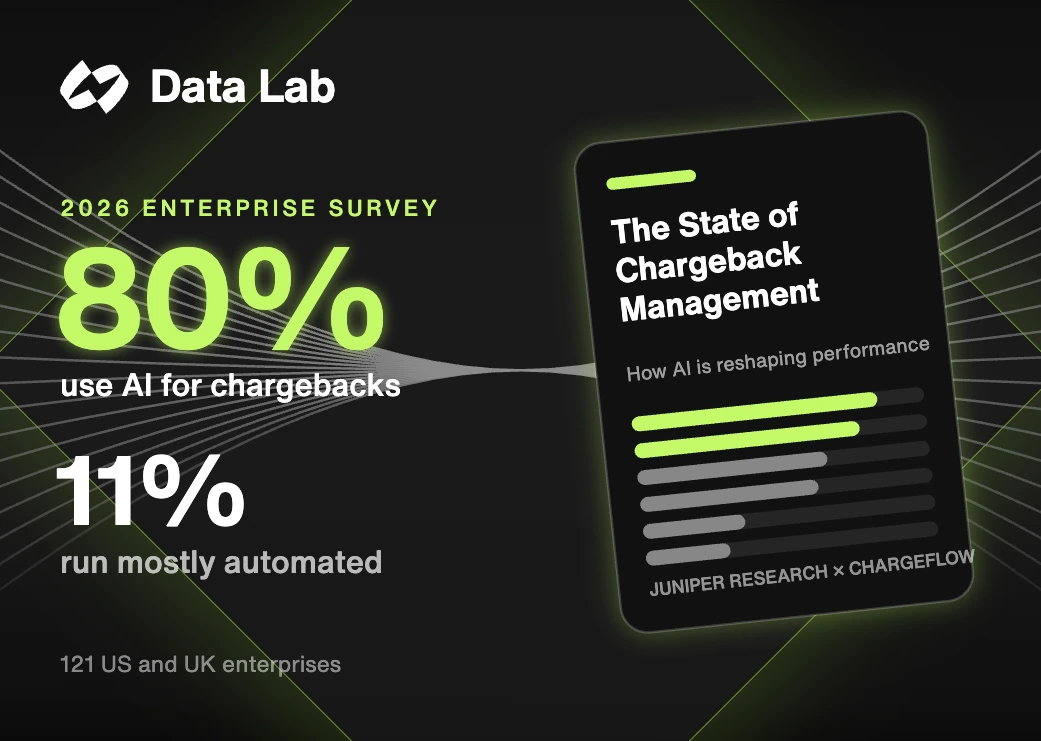
- 80% of 121 US and UK enterprises use AI for chargebacks, but only 11% run mostly or fully automated processes.
- Automated representment (35%) and preemptive refunds (29%) are the least used chargeback tools.
- AI users report a 38% median win rate vs 27.75% for non-users, yet both dispute and win 6.65% of eligible chargebacks.
- Data quality (72%) and security (70%) lead buying decisions, and total cost ranks last (31%).
- Rate automation step by step, from evidence to reconciled recovery, and keep people on exceptions.
Chargeback automation maturity is how much of the dispute process runs on its own, from intake to evidence, submission and reconciled recovery. Using AI for one step is not the same thing. In a 2026 survey, 80% of enterprises used AI, but only 11% ran mostly or fully automated processes.
80% use AI in chargeback management | 11% run mostly or fully automated processes | 68% mix automation and manual work |
Source: Juniper Research and Chargeflow, The State of Chargeback Management, survey of 121 US and UK enterprises, September 2026. AI use (Q22) and automation level (Q17) were separate questions.
{{cta}}
What Does the Survey Say About Chargeback Automation?
Most enterprises sit in the middle. Two in three run a mix of automated and manual work, and about one in five is still mostly or fully manual. Only 2% describe their process as completely automated.
Figure 8, Q17, n=121. Mostly plus completely automated equals 11%.
The survey was run by Juniper Research with Chargeflow in September 2026. It covered 121 senior leaders at US and UK businesses with at least $100 million in yearly sales. The full State of Chargeback Management report has every chart and question.
Does Using AI Mean Your Chargebacks Are Automated?
No. AI use and automation measure different things. An AI tool can summarize a support chat while an analyst still finds the order, pulls tracking, picks evidence and submits the response. That is real AI use inside a manual workflow.
Adoption also varies by country: 84% of US respondents use AI against 73% in the UK. See US vs UK enterprise chargeback trends for the full split.
How enterprises buy AI points the same way. Most add a third-party AI tool to the system they already run. Fewer use one end-to-end AI platform for the whole dispute process.
Figure 14, Q23, n=97 AI users.
A bolt-on AI tool often speeds up one task, such as drafting. The steps around it can stay manual. So when you read an AI adoption figure, ask which steps the AI actually completes.
Do not divide the 11% by the 80% to estimate how many AI users are automated. The questions were answered separately, so only respondent-level data could show that overlap.
Which Chargeback Tools Do Enterprises Use Most?
Prevention and alerts are standard. Automated representment, the step that builds and sends the dispute response, is one of the least used tools. That gap explains much of the manual work that remains.
Figure 9, Q18, n=121.
Pre-dispute tools are close to universal: 82% use a pre-dispute service such as chargeback alerts. Yet 65% still saw chargebacks rise over 18 months. Alerts stop some disputes early. They do not replace a recovery process for the ones that get through. See prevention vs alerts vs dispute automation for how the layers fit.
Is AI Improving Chargeback Win Rates?
Yes, on the cases teams fight. AI users report a median win rate of 38%, against 27.75% for non-users. But both groups dispute the same median share of eligible chargebacks, 17.5%. So the share of eligible chargebacks that is both disputed and won is the same: 6.65%.
Figure 16, Q14. Each median is calculated on its own, so the rows do not multiply.
The takeaway is about coverage. AI can make each response stronger. Recovery only grows when the business also fights more of the chargebacks worth fighting. In the survey, 81% of AI users said their win rate rose by 10% or more. These are self-reported gains, not audited results.
Our win-rate and recovery guide explains the denominators. For a closer look at the AI side, read can AI improve chargeback win rates.
How Mature Is Your Chargeback Automation?
Rate each step of the workflow on its own. A team can be advanced at evidence collection and still submit every response by hand. The four stages below are an editorial framework, not a survey result.
For the mechanics behind stage 3, see how automated chargeback management works. To trace where each fact should come from, use the evidence source map.
Where Should You Automate Next?
Start with the step that fails most often. Enterprises put evidence gathering first: 60% rated it very important to automate.
Figure 18, Q29, n=121.
Keep a manual path for valid complaints, unclear facts, unsupported processors and cases worth less than the cost to fight. A mature process sends each case to the right decision. It does not push every case through the same response.
Example: Automating 60 of 100 Disputes
This example is made up to show how to measure a rollout. It is not survey data or Chargeflow customer performance.
60 routine cases with full records | 25 need a specialist decision | 15 10 valid claims, 5 missing records |
An enterprise reviews 100 disputes from one payment account. Sixty have complete records and a set response path, so the system prepares their evidence automatically. That automates preparation for 60 cases. It does not mean 60 cases are won.
The team still checks which packages passed review, which submissions the processor accepted and which cases returned money. The 25 specialist cases get an owner and a deadline. The 5 missing-record cases show which source failed. The 10 valid claims feed a prevention fix rather than a fight.
Classification matters here. If finance and risk label the same case differently, routing breaks. Read how finance and risk teams rank friendly fraud for a shared review method.
What Should You Measure After Automating?
Agree on the case group and time window first. Then track each result on its own line:
- Response coverage: eligible cases that got an accepted response.
- Win rate: resolved, disputed cases that were won.
- Recovered money: funds actually credited back.
- Net recovery: recovered money minus fees and handling cost.
- Exception load: cases that still need staff, and why.
Set a target before you start. In the survey, 69% of enterprises want at least an 11-point gain in win rate from a new solution, and 68% want recovered funds to grow by at least 11%. The finance reporting guide shows how to tie these numbers to settled funds.
What Do Enterprises Check Before Buying AI Chargeback Software?
Data quality and security come first. Price comes last. Buyers want to see where answers come from and keep people in control.
Figure 17, Q28, n=121.
Use this list as a test plan. Ask each vendor to show its data sources, its audit trail and the cases it routes to people. The build vs buy guide covers the cost side.
Does In-House or Outsourced Change Automation?
Not by itself. 54% of enterprises manage chargebacks in-house, 42% split the work with a partner and 4% outsource fully. An in-house team can run automated workflows, and a provider can still rely on people. Decide who owns refunds, exceptions and final submission first. The operating-model comparison covers the tradeoffs.
Test Chargeback Automation on Your Own Cases
Run a pilot on one payment account and a fixed group of cases. Check source coverage, accepted submissions, exceptions and recovered money against your baseline. Chargeflow Automation collects connected evidence and submits supported responses, and you can check product fit against your own processors and contract.
{{cta}}
Perguntas frequentes
What is chargeback automation maturity?
It is how reliably a business runs dispute steps without manual work, from evidence and submission to exceptions and reconciled recovery. Adding an AI tool to one step does not make the whole process mature.
What percentage of enterprises have automated chargebacks?
In the September 2026 Juniper Research and Chargeflow survey, 11% of 121 US and UK enterprises ran mostly or fully automated chargeback processes. 68% mixed automation with manual work.
Does using AI mean chargebacks are fully automated?
No. 80% of the same enterprises used AI, but only 11% were mostly or fully automated. AI often helps with one task while people handle the rest.
Does AI improve chargeback win rates?
AI users reported a median win rate of 38% against 27.75% for non-users. Both groups disputed a median of 17.5% of eligible chargebacks, so the share disputed and won was the same, 6.65%.
Should an enterprise automate every chargeback response?
No. Automate supported cases with complete records and clear rules. Valid complaints, unclear facts and low-value cases need a person to decide whether to refund, accept or fight.
Sources and Survey Methodology
Findings come from The State of Chargeback Management: How AI Is Reshaping Performance, by Juniper Research with Chargeflow. Juniper Research surveyed 121 C-level executives and senior managers in September 2026: 80 in the US and 41 in the UK. All worked at businesses with at least $100 million in yearly gross merchandise value.
- Figure 8, Q17: automation level, n=121.
- Figure 9, Q18: tools in use, n=121.
- Figure 14, Q23: AI adoption model, n=97 AI users.
- Figure 16, Q14: median dispute and win rates, n=121.
- Figure 17, Q28: decision factors, n=121.
- Figure 18, Q29: automation priorities, n=121.
Percentages are rounded as published. The maturity stages, bottleneck table and example are Chargeflow editorial guidance, not survey findings.
The State of Chargeback Management
Read the full Juniper Research survey of 121 enterprises: AI results, win rates, costs and what buyers expect.
Chargebacks?
Não é mais problema seu.
Recupere 4 vezes mais chargebacks e PREVENÇÃO — até 90% dos e-mails recebidos —, com tecnologia de IA e uma rede global Rede de 20.000 Lojistas.