












Country and Card-Network Dispute Breakdowns: What You Can Conclude


rétrofacturation?
Ce n'est plus votre problème.
Recover 4x more chargebacks and prevent up to 90% of incoming ones, powered by AI and a global network of 20,000+ merchants.


 Plus de 600 avis


En bref :
- Country and network breakdowns show where disputes concentrate, not which country or network is riskier.
- Country in Chargeflow Insights is the payment country with a billing fallback, not the shipping destination.
- Keep unknown-country cases in the total: 40 of 100 is 40%, but 40 of 70 known is 57.1%.
- Label PayPal and BNPL separately from Visa and Mastercard, since their dispute processes differ.
- A rate needs matching payment volume; without it, report concentration and say so.
Country and card-network chargeback breakdowns show where your disputes concentrate. They help you pick what to investigate. They do not prove that a country, network or payment method is riskier unless you also have matching payment volume, clear field definitions and a comparable case mix.
Start by writing down what each row represents. The country field may come from payment or billing data, not delivery. A network view may mix card schemes with wallets and buy now, pay later. A clear label stops a good-looking chart from backing the wrong decision.
{{cta}}
What Does Country Mean in Your Dispute Data?
In Chargeflow Insights, country comes from the payment details, with the billing country as a fallback. That does not tell you where the customer lives, where the order shipped or where any fraud happened. If some records fall back to a different field, two rows can look alike while holding different information.
A quick first check: trace a few records from the chart back to their source fields. Include a normal record, a fallback record and an unknown one if they exist.
Keep Unknown Country in the Population
A known-country chart can look very different from the full dispute set. In a hypothetical 100-case group, Country A has 40 cases, Country B has 30 and 30 have no country.
40% A's share of all 100 disputes | 57.1% A's share of the 70 known-country disputes |
Both numbers are valid when labeled, but they answer different questions. Keep the unknown count visible. Do not assign unknown cases to a country or guess their risk. Check how your own report handles unknown rows before you compare charts.
Are PayPal and BNPL Card Networks?
No. A payment breakdown can list Visa and Mastercard next to PayPal or a buy now, pay later provider. These follow different dispute processes, so keep their type in the label.
This hypothetical set adds to 100% only because the groups do not overlap. In real data, check whether a wallet-funded card payment lands under the card scheme, the wallet or both. If groups overlap, report them separately instead of forcing 100%. For how these disputes differ, see PayPal disputes vs chargebacks and BNPL dispute evidence.
Is a Large Share the Same as High Risk?
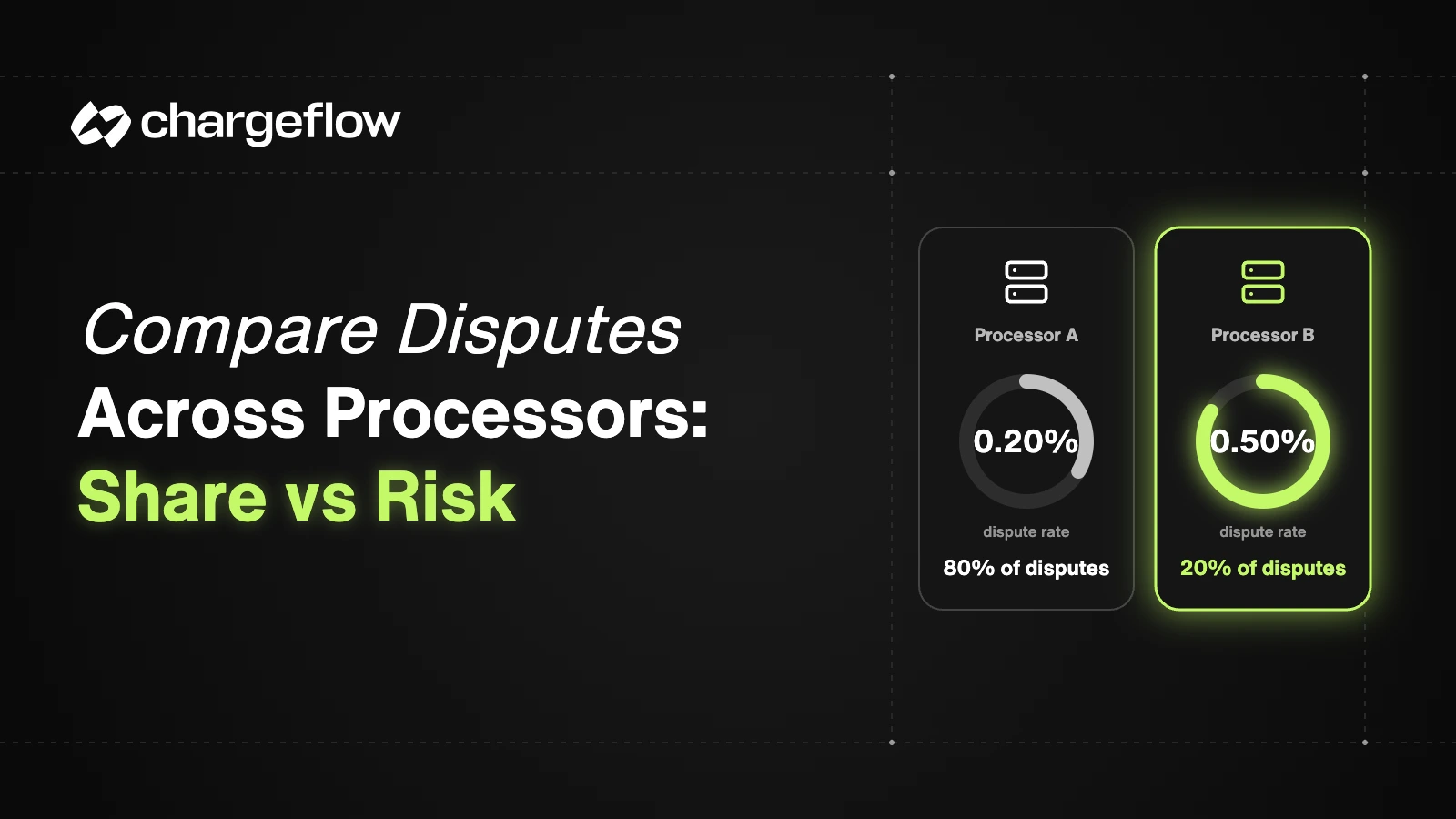
No. Share is concentration. A rate needs a denominator. Suppose Country A has 60 disputes and Country B has 40, so A holds 60% of disputes. Now add matching payment volume:
The rate reverses the first impression. It still does not prove a geographic cause: product mix, payment methods, sales channels, fulfillment or reporting lag may differ.
Use a payment-cohort method for eventual disputes from a set of payments, and a labeled same-period method for an operating snapshot. Do not compare one country's cohort result with another's same-period number. For the math, see comparing disputes across processors.
Example: The US and UK Look Different, but Why?
In a 2026 survey of 121 enterprises, 78% of UK respondents saw chargebacks rise over 18 months, against 59% in the US. That is a share of businesses reporting a rise, not a dispute rate. The survey did not test causes.
Source: Juniper Research and Chargeflow, The State of Chargeback Management, September 2026.
Country rules can also change which disputes appear. UK ecommerce card payments have required Strong Customer Authentication since 2022, and an authenticated 3D Secure payment can shift fraud liability to the issuer.
So the fraud and non-fraud mix may differ by country before any risk difference exists. See US vs UK enterprise chargeback trends and 3D Secure 2.0 and the liability shift.
What Should You Check Before Changing a Policy?
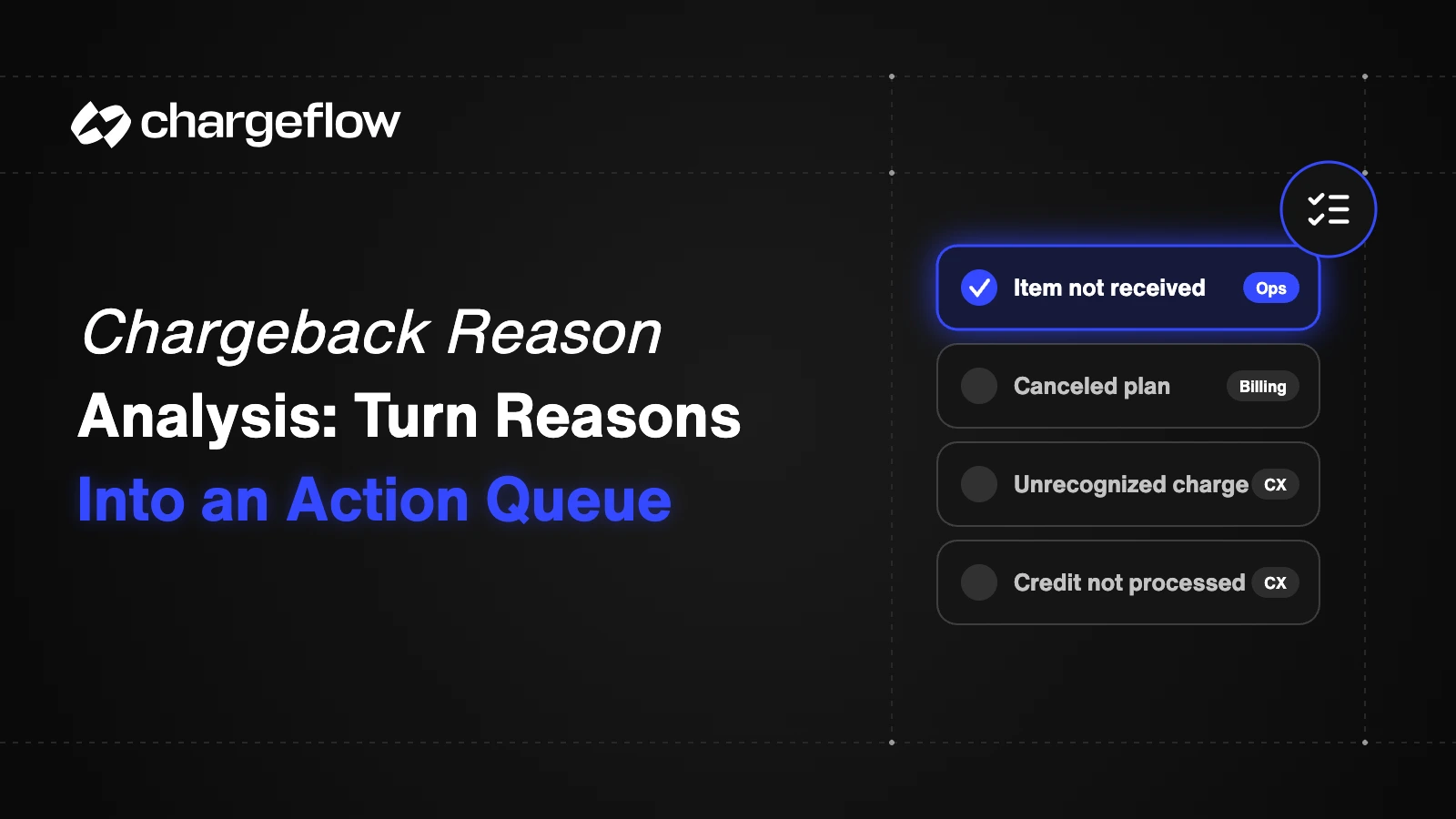
Cross-check the country or network pattern with reasons, ticket sizes, stores and case status. A shipping incident needs a different fix from a renewal-billing problem. Many new open cases call for patience, not a verdict. See chargeback reason analysis for the case-sample method.
Example (hypothetical): one country shows a sharp rise in item-not-received disputes. Operations finds most affected orders used one delayed delivery route. The next step is an exception or messaging review for that route. The evidence does not justify blocking every buyer with that country field.
Give the action an owner and a follow-up measure, and note what evidence would change the decision. For cross-border context, see cross-border ecommerce.
Compare Outcomes Within the Right Scope
Recovery rates need resolved won and lost totals. A country or network split does not show a recovery rate by itself, and a case-count win rate is not a value recovery rate.
In Chargeflow Insights, the With Chargeflow / Before Chargeflow switch changes only the two headline metrics, and the managed performance table always shows With Chargeflow. Losses flagged as intentional fraud are treated differently in managed and historical rates. Keep those notes beside any comparison. See the chargeback analytics guide.
Write a Breakdown Review Note
Use this format: "Payment or billing country records show [count and value] in [period]. We checked [coverage and source fields]. The pattern sits in [reason, store or segment]. [Owner] will inspect [records] by [date]. The rate [was / was not] assessed using [denominator]."
Chargeflow Insights shows country, network and reason breakdowns in one place. The decision becomes useful once the team understands the field, checks the records and picks a proportionate action.
{{cta}}
Foire aux questions
Does country mean the shipping destination?
Not in Chargeflow Insights. It uses the payment country with a billing-country fallback. Label your analysis with the actual source field.
Does a country's large dispute share mean high fraud risk?
No. Share shows concentration among disputes. You need matching payment volume and verified case evidence for a risk conclusion.
Are PayPal and BNPL providers card networks?
No. Keep payment-service and BNPL labels separate from card schemes, and check how your report assigns wallet-funded card payments.
What if the percentages do not add to 100%?
Check rounding, missing rows, overlapping groups and mappings. Report the limit instead of adjusting the numbers.
Should we block a country after a spike?
Treat a spike as a lead. Check source fields, payment volume and operational causes before changing any policy.
Sources
- Juniper Research and Chargeflow: The State of Chargeback Management, 2026
- Stripe Docs: Measuring disputes
The tables and examples are hypothetical and are not customer results.
See Where Your Disputes Concentrate
Use Chargeflow Insights to review disputes by country, network and reason in one place. Free forever.
rétrofacturation?
Ce n'est plus votre problème.
Récupérez 4 fois plus d'rétrofacturation s et PRÉVENTION jusqu'à 90 % des messages entrants, grâce à l'IA et à un réseau mondial de 20 000 commerçants.