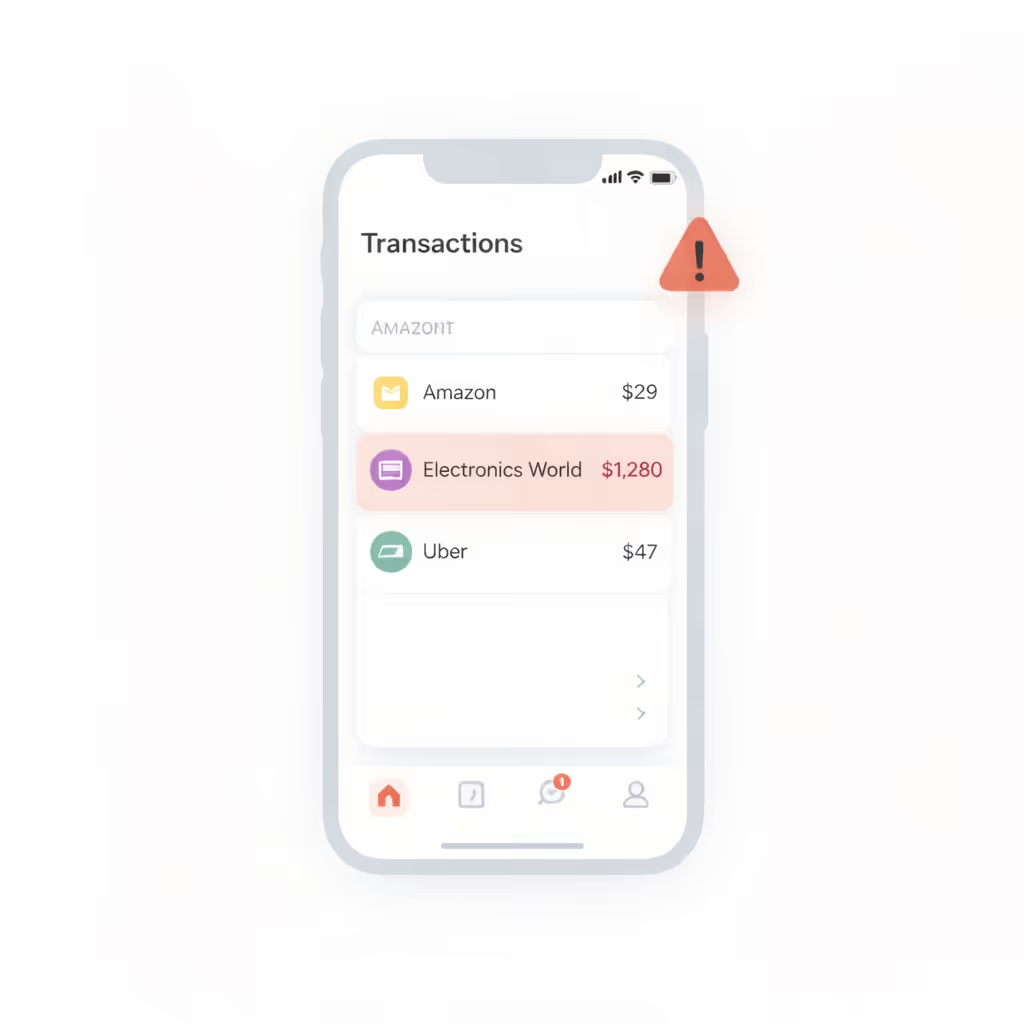
Recover 4x more chargebacks and prevent up to 90% of incoming ones, powered by AI and a global network of 15,000 merchants.
Payment fraud is an organized global industry targeting instant payments, digital wallets, and online commerce. Because funds can move in seconds, traditional fraud detection is simply pointless. Effective fraud prevention requires layered, real-time defenses, such as behavioral analytics, adaptive authentication, cross-network intelligence, and customer education.
In the few seconds it takes to read this passage, thousands of dollars will be lost to instant payment fraud.
As Mastercard reported, payment fraud has grown into a billion-dollar industry. Losses from the most prevalent instant payment fraud, Authorized Push Payment (APP) fraud, are projected to reach $7.6 billion across six major real-time payment markets by 2028.
Despite this escalation, many organisations and institutions rely on outdated strategies that sophisticated fraudsters have already bypassed. There is a massive gap between whitepaper ideals and operational reality.
While guidance often touts “advanced AI,” research tells a different story. Many entities operate innovation and fraud on separate tracks, creating fatal blind spots. Meanwhile, smaller firms often receive generic advice that assumes the existence of dedicated fraud teams or advanced transaction monitoring they simply don’t have.
This guide moves beyond the security theater. It is the implementation roadmap that bridges the gap between vendor promises and tactical reality. If you are responsible for protecting assets in the era of instant payments, what follows will fundamentally change your approach.
Payment fraud is the intentional exploitation of payment systems to illicitly obtain funds, goods, and services, or data through deception, theft, or manipulation. Payment fraud weaponizes vulnerabilities in technology, processes, and crucially, human psychology.
While payment fraud spans channels like cards, ACH, wires, digital wallets, and checks, the core categories remain:
This classic payment fraud model is when criminals compromise accounts or credentials (through phishing, malware, credential stuffing, or breaches) and execute transactions without the victim’s awareness or consent.
Banks can often detect anomalies, freeze accounts, or reverse funds post-event, under strong consumer protection instruments, such as Reg E in the U.S.
Here, victims are psychologically manipulated into willingly authorizing and initiating the transfer themselves, believing it’s legitimate.
This emerging category of payment fraud is harder to combat and is epitomized by Authorized Push Payment fraud. Examples include paying a fake invoice, securing funds in an investment scam, or helping a “loved one” in distress.
The transaction passes authentication checks because it's genuinely from the account holder.
Payment fraud has historically manifested in different ways depending on the channel, technology, and customer interaction involved.
While overlays exist, modern attacks can be captured in three broad categories: online payment fraud, digital payment fraud, and instant payment fraud. Each presents unique risks depending on how transactions are initiated and processed.
Online payment fraud primarily occurs in eCommerce, digital marketplaces, and other card-not-present (CNP) environments where transactions happen remotely without the physical card.
Fraudsters exploit stolen credentials or weaknesses in merchant policies to obtain goods or refunds.
Common examples of online payment fraud include:
Instant payment fraud is primarily psychological, making prevention far more dependent on real-time detection and user intervention.
Digital fraud encompasses payment fraud committed on broader digital channels, such as mobile wallets, P2P platforms, neobanks, and always-on banking apps. Unlike traditional card fraud, these environments combine payments, identity, and communication channels in a single ecosystem.
Hence, fraudsters increasingly target digital platforms with industrialized attacks through automation, stolen identity data, and AI-assisted social engineering. Common forms of digital payment fraud include:
These attacks blur the lines between intrusion and social manipulation. They often target both institutions and end users simultaneously.
Instant payment fraud is the fastest-growing category of payment crime. It is driven by the expansion of real-time payment networks and peer-to-peer platforms. Unlike traditional fraud models that rely on stolen credentials, Authorized Push Payment (APP) fraud victims are deceived into sending money voluntarily.
Examples of instant payment fraud include the following:
While online and digital fraud often involve technical exploits with post-event recourse, instant/APP fraud is predominantly psychological.

Payment fraud prevention is the proactive, real-time orchestration of layered defenses to intercept and neutralize threats before funds are moved from the holder’s account or digital portal.
Traditional fraud strategies focused on post-transaction investigations. But in today’s era of instant payments and AI-assisted scams, that’s not sufficient. Merchants and institutions need predictive and behavioral approaches that identify risk before a transfer is completed.
Modern fraud prevention relies on a coordinated set of defenses that work together to detect anomalies, interrupt suspicious activity, and limit financial exposure. These include:
Behavioral analytics examines how users normally interact with devices, accounts, and payment flows. When behavior deviates significantly, such as unusual typing patterns, navigation paths, or transaction timing, systems can flag potential fraud before a transfer completes.
Modern fraud platforms evaluate dozens of contextual signals in milliseconds, including transaction size, payee history, device fingerprints, location data, behavioral patterns, and several other user-related data points.
Each transaction receives a dynamic risk score. This allows systems to trigger additional verification, temporary holds, or automated rejection when risk thresholds are exceeded.
Fraud rarely happens in isolation. Leveraging shared data pools through federated learning or consortia, AI fraud prevention tools identify mule accounts, high-risk payees, and scam networks across networks.
This upstream visibility blocks laundering chains that single-institution or company misses.
Authentication systems combine several identity signals, including biometrics, device pulse, and confirmation-of-payee checks.
Rather than applying the same friction to every transaction, modern systems introduce adaptive verification. It escalates security only when risk increases.
Because many scams rely on psychological manipulation, customer awareness plays a crucial role in fraud prevention.
Merchants and institutions increasingly deploy contextual warnings during high-risk transactions to help customers recognize scam patterns before authorizing a transfer.
Regulatory frameworks, like Nacha, increasingly require institutions to maintain fraud monitoring programs and regularly reassess risk controls.
Periodic reviews ensure that detection models remain effective against evolving threats such as agentic AI scams and large-scale social engineering campaigns.
The subsequent section outlines payment fraud prevention techniques for online transactions
Online payment fraud thrives on stolen details, synthetic identities, and chargeback fraud. Prevention balances fraud reduction with approval rates and low friction.
Here are proven techniques, illustrated by real-world sample incidents and merchant responses.
With projected global losses reaching $28.1 billion this year, CNP fraud remains a leading threat. Card testing equally ranks as a top attack vector. In high-volume eCommerce, merchants face bot attacks; fraudsters exploit weak sessions, leading to multiple high-value fraudulent transactions.
To prevent these kinds of payment fraud issues, deploy:
Subscription brands are a primary target of chargeback abuse. Case in point, Chargeflow customer, The Bear Club, an eCommerce beard grooming subscription company, faced significant operational challenges with chargeback management.
Christine Well, their Operations Manager, reported that the team spent approximately 40 hours a week manually answering chargebacks. She saw a recurring pattern. Strong holiday sales in November and December, followed by a chargeback surge in January and February.
Rather than fraud, the chargebacks were forgotten gift subscriptions; customers who didn’t understand renewal terms.
After implementing Chargeflow, the team saw immediate improvement:
Watch the video below to hear Christine in her own words:
Fake storefronts harvest card data and then use it elsewhere for unauthorized transactions. Leverage network tokenization and domain-locked tokens, and pair this with Chargeflow Prevent to blacklist repeat offenders. Prevent helps you extract the upstream oversight that single merchants lack.
Most high-risk CNP fraud eventually leads to costly chargebacks. Layer strict AVS/CVV and confirmation checks, and apply Prevent for consortium data sharing.
The Beard Club's experience, shifting from 40 hours to 1 hour weekly, is proof positive that deploying specialized AI tools could automatically address both fraud-induced chargeback prevention and recovery.
Fraud risks in eCommerce and digital payments are increasingly interconnected. Attackers often move between channels. They use stolen cards to fund wallet accounts, launder proceeds through marketplaces, or manipulate victims into initiating transfers on their own.
Thus, effective defenses must address both technical vulnerabilities and behavioral manipulation across the entire eCommerce and digital payment ecosystem.
Subscription businesses frequently experience spikes in chargebacks following holiday promotions, free trials, or during peak seasons.
Clear billing descriptors, proactive renewal reminders, and accessible cancellation options help reduce disputes caused by confusion or forgotten subscriptions.
While these operational improvements may not prevent determined scammers from trying to steal from you, they can reduce friendly fraud caused by policy confusion.
Fraudsters often exploit marketplace platforms by creating fake seller accounts to run scams, harvest card data, or launder funds.
Strong onboarding procedures, including identity verification, device intelligence, and ongoing behavioral monitoring, can help detect fraudulent sellers before they reach customers.
Modern attacks span multiple channels. It can begin with phishing or social media contact before evolving into email conversations or payment platforms.
Unifying fraud signals across login activity, checkout flows, and payment transfers allows platform owners to detect coordinated attacks earlier.
Fraudsters frequently use digital wallets and P2P systems to rapidly transfer stolen funds between mule accounts. A widely cited example of this laundering pattern emerged in scams conducted over the Zelle instant payment network.
Dynamic transaction limits, new-payee restrictions, and temporary holds for suspicious transfers can interrupt laundering chains before funds leave the ecosystem.
Payment gateways and processors are the infrastructure bridge between merchants and the financial system. This upstream position allows them to provide controls and protections that individual merchants typically cannot implement on their own.
Below are the core categories of gateway-level fraud prevention, with factual contexts on why they matter.
Payment gateways harden the core transaction path with multiple security instruments that operate before payment data reaches the merchant’s systems. These include:
Why it matters: These controls reduce the attack surface, protect private data by design, and provide real-time signals that feed into fraud scoring and decision logic upstream of merchant endpoints.
Because gateways process traffic across many merchants and payment types, they can detect distributed patterns.
Gateways monitor how often a card, IP, or device tries to transact across different merchants. Modern fraud engines use machine learning to track anomalies in payment methods. Gateways and processors can trigger alerts, apply multifactor triggers, or route transactions through additional validation flows based on aggregated risk signals.
Why it matters: Coordinated attacks are more likely to surface when signals are correlated.
Gateways also enforce industry-wide standards and mechanisms that help shift liability and maintain regulatory compliance, thereby reducing risks for merchants.
Multi-factor authentication frameworks, such as EMV 3DS2, verify the cardholder with issuer involvement. When applied correctly, liability for certain payment fraud accrues to the issuer.
Gateways often integrate with dispute management platforms like Chargeflow to help merchants manage chargebacks. They also implement advanced regulatory compliance tools to safeguard sensitive data and ensure adherence to evolving industry standards.
Why it matters: These mechanisms reduce operational burden and financial exposure for merchants while embedding industry-standard fraud defenses at the payment-flow level.
The $43 billion fraud prevention technology space has evolved considerably in recent years. You have access to a wide range of specialized solutions and tools for different parts of the fraud lifecycle.
The key is to identify the platform that best aligns with your specific business model, average transaction volume, and typical risk exposure. Modern fraud prevention systems generally consist of three main phases: pre-transaction screening and blocking, real-time detection during the payment attempt, and post-authorization risk evaluation and monitoring.
When evaluating eCommerce fraud prevention platforms, consider these factors beyond marketing claims:
For startups and growing businesses, begin with platforms offering broad coverage and low false positive rates, then add specialized tools as fraud patterns emerge. Enterprise merchants and institutions often deploy multiple specialized solutions that coordinate decision-making across platforms.
Payment fraud prevention is a shared responsibility across multiple roles and departments:
For smaller teams, the roles can overlap. One person wears many hats. And success requires onboarding specialised tools that streamline the process, and still support the metrics discussed earlier.
Payment fraud inflicts severe, multi-layered damage beyond direct financial losses.
Merchants absorb unauthorized transactions, chargebacks, and friendly fraud. Juniper projects global eCommerce fraud losses to reach $66 billion by year’s end, with each incident often costing larger businesses several thousand dollars.
Fraud also attracts processor penalties and higher processing fees when chargebacks happen. Merchant reputation equally takes a hit.
There’s also operational strain and opportunity cost as team efforts are dedicated to remediation. Yet, the impact of payment fraud on businesses is the regulatory exposure when issues persist. This can lead to business failures when processing rights are withdrawn.
That’s why fraud prevention is a crucial aspect of staying alive as a business or financial institution.
Payment fraud has graduated from opportunistic crime into a highly industrialized global economy. Today’s fraud rings operate with the efficiency of a SaaS business. They use the same technology you use and pair them up with mule networks willing to go the extra mile.
As payment rails move toward total instantaneity, the detection window gradually shrinks. In this environment, once funds move, they are almost always gone. This reality makes reactive fraud management more than just obsolete. It’s simply a liability.
Moving forward, the merchants and institutions that survive will be those that treat payment fraud prevention as core infrastructure rather than a back-office cost center. Seriously, the era of security theater is effectively over. Success now requires a shift towards real-time behavioral intelligence and cross-network visibility embedded directly into the payment flow.
Again, fraudsters are innovating at the speed of AI. To protect revenue and maintain customer trust, your defenses must anticipate the next move before the payment flow is ever completed. Chargeflow Prevent does this, and much more. Want to learn more? Schedule a demo today.
Recover 4x more chargebacks and prevent up to 90% of incoming ones, powered by AI and a global network of 15,000 merchants.
Chargeflow collects data from dozens of third party signals, automatically. This allows for much more coverage and much better win rates because the evidence submitted is much more comprehensive and compelling.
Chargeflow collects data like order info, customer messages, and payment details. It builds a full dispute case for you, so you don’t have to lift a finger.
Yes! Chargeflow works with 50+ payment processors. That means one tool for all your chargebacks, no matter how you process payments.
You only pay a percentage of the revenue we help you recover. No upfront fees, no subscriptions — just success-based pricing.
Yes. Chargeflow is SOC 2 Type 2, GDPR, and ISO certified. We use top security standards to keep your data safe.
Have a question? We’re here to help. Just hit the chat button to initiate a conversation with support.