Which Fraud and Friendly-Fraud Prevention KPIs Should Ecommerce Merchants Track?


Chargebacks?
Não é mais problema seu.
Recupere 4 vezes mais chargebacks e PREVENÇÃO — até 90% dos e-mails recebidos —, com tecnologia de IA e uma rede global Rede de 20.000 Lojistas.


 Mais de 600 avaliações


Resumo:
- An ecommerce prevention scorecard should combine coverage, action mix, latency, verification, mature disputes, customer impact and economics.
- Coverage equals eligible paid orders scanned before irreversible fulfillment divided by all eligible paid orders.
- Recent orders must not be counted as clean before the business’s delivery, return and dispute windows have matured.
- Observed actions and outcomes should remain separate from modeled prevented loss.
- Canceled order value is not confirmed savings; prevention ROI requires a risk-adjusted counterfactual.
- Every KPI needs a stable numerator, denominator, owner, data source, refresh cadence and known limitation.
Ecommerce merchants should track coverage, action mix, decision latency, verification completion, fulfillment avoided, downstream dispute rate, false-positive indicators and net economic impact. Report observed outcomes separately from estimated prevented loss, and define every rate with a stable denominator and cohort.
Chargeback rate can fall because sales mix changed, more good orders were canceled or disputes have not matured. A useful scorecard connects leading operational decisions to mature financial outcomes.
The buying group also needs different views: Risk needs quality, Operations needs latency, CX needs customer impact and Finance needs incremental net value.
Cobertura
Eligible paid orders scanned before irreversible fulfillment
Shows whether the control can influence the population.
Action mix
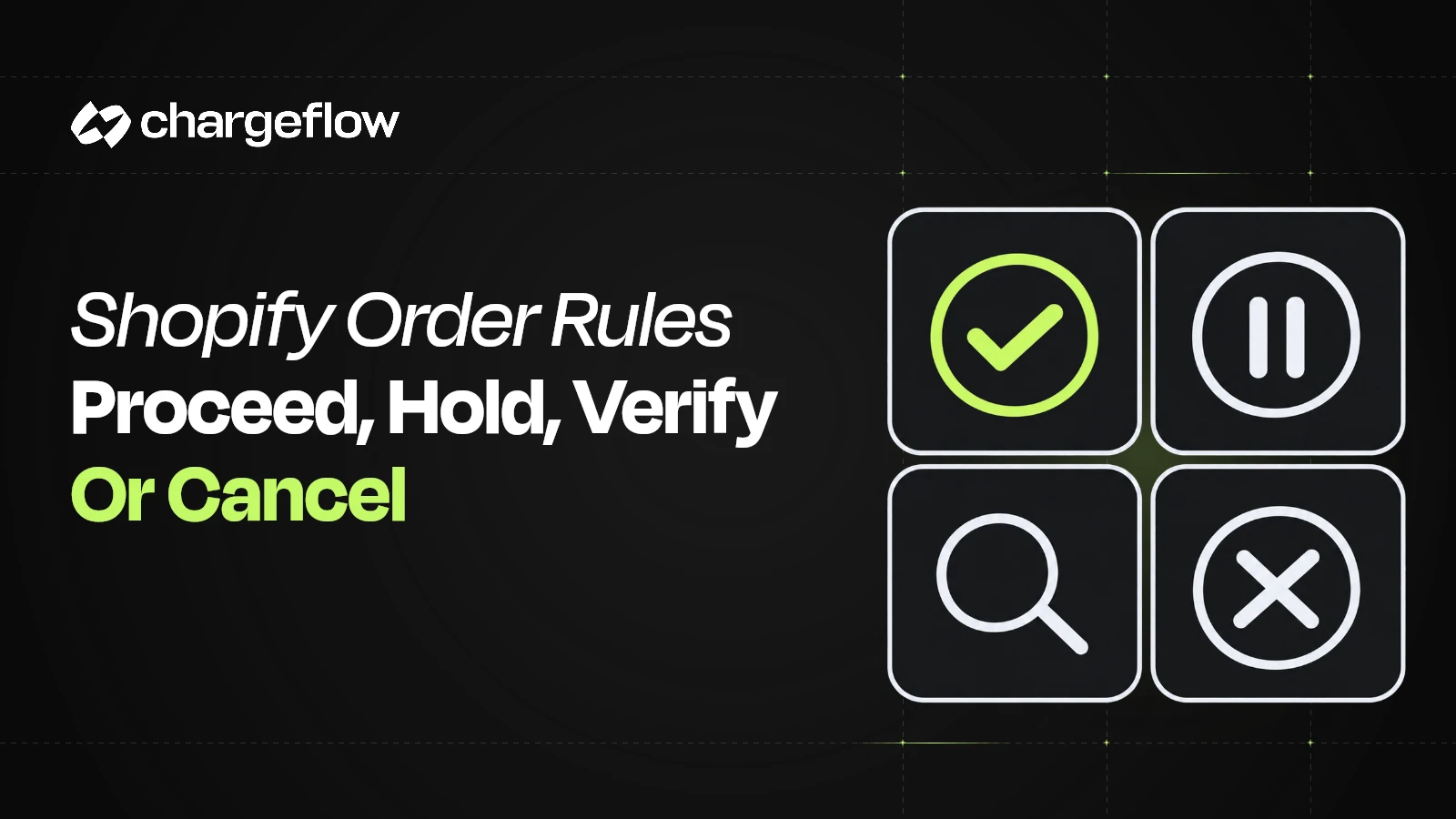
Proceed, hold, verify and cancel share by cohort
Reveals friction and workload.
Decision latency
Time from order event to enforceable final state
Protects fulfillment promises.
Outcome quality
Mature dispute and confirmed-abuse rate by original decision
Tests calibration.
Customer cost
Verification failure, support contact and good-order cancellation indicators
Surfaces false positives.
Economics
Avoided fulfillment and estimated loss minus tool, review and friction cost
Tests incremental value.
Define the eligible and mature populations
Eligibility should specify shop, payment route, order status, fulfillment path and exclusions. Coverage is scanned eligible orders divided by all eligible orders; not all site sessions or all historical transactions.
Outcome windows must mature. Compare orders only after enough time has passed for delivery, refund and dispute. Label immature cohorts rather than treating missing disputes as wins.
Separate observed from estimated prevention
Observed metrics include scans, actions, response, shipment, refund and disputes. Estimated prevention uses a counterfactual: what might have happened without intervention. Keep assumptions and ranges visible.
Do not call the full value of every canceled order “saved.” A better estimate uses calibrated risk probability, net loss and verification or cancellation outcome, with a conservative scenario.
A worked scorecard that does not confuse cancellation with savings
Coverage: 95%
Of 1,000 eligible paid orders, 950 were assessed before the deadline and 50 were late or unassessed: 950 ÷ 1,000.
First-action mix: 90%, 8%, 2%
Of those 950 timely assessments, 855 first proceeded, 76 first held for review and 19 were canceled: each count ÷ 950.
Review outcomes remain separate
A held order that later proceeds is counted once in initial action mix and again only in the separate transition report.
Savings remain unknown
These action counts establish coverage and workload. They do not establish how many canceled buyers would have disputed, or whether the program produced a net profit.
Illustrative numbers only; no merchant results or Prevent performance claim is implied. Keep this recent operating cohort out of mature loss comparisons until the relevant windows have elapsed.
Measure customer and operational cost
Track review minutes, queue size, late decisions, fulfillment delay, buyer verification completion, support contacts, appeals and reorders. Segment by new versus returning customer and value band.
A program that cuts disputes while creating excessive good-order cancellation may reduce profit. Finance should evaluate contribution and retained customer value, not only fraud loss.
Avoid survivorship bias and double-counted ROI
Keep two views: mature dispute outcomes among fulfilled orders, and the whole original eligible cohort including canceled and held orders. Otherwise, canceling more orders can improve the fulfilled-order dispute share while hiding lost legitimate margin.
Estimate incremental value by comparing like-for-like cohorts or a carefully governed pilot design. Historical replay and analyst review help assess policy, but do not reveal the unrealized outcome of every canceled order. Report uncertainty and corrections rather than assigning every intervention a win.
Swipe or scroll horizontally to view every column.
| Line item | How to record it | Do not do this |
|---|---|---|
| Estimated prevented loss | Use an explicit baseline, calibrated assumptions and net loss severity; report a range. | Multiply every canceled order by its selling price. |
| Fulfillment cost avoided | Record costs genuinely not incurred and their counterfactual. | Add these again if they are already included in modeled net loss. |
| Customer and operating cost | Deduct tool charges, review, refunds or fees, delay and lost legitimate contribution as applicable. | Assume a completed check or no complaint proves zero friction. |
| Incremental net value | Sum distinct attributable benefits and subtract distinct incremental costs. | Treat the same goods, shipping or fees as both a saved loss and separate savings. |
A decision framework, not a verified ROI estimate. A risk score such as 80 is not automatically an 80% probability of loss.
Use cohort and version discipline
Break metrics down by rule version, product, value, geography, customer tenure, fulfillment method and signal availability. Aggregate averages can hide one damaging segment.
Publish a short executive scorecard and keep the detailed dictionary behind it. Every metric needs owner, formula, source, refresh cadence and known limitations.
KPI dictionary: name the denominator
Swipe or scroll horizontally to view every column.
| Métrico | Definição | Limitation |
|---|---|---|
| Timely coverage | Eligible paid orders assessed before the irreversible step ÷ all eligible paid orders. | A late scan does not enter the numerator. |
| Initial action mix | Unique orders first routed to each action ÷ assessed eligible orders. | Use mutually exclusive first actions; track later transitions separately. |
| Manual-review share | Unique orders entering manual review ÷ assessed eligible orders. | Repeated review events are not additional orders. |
| Decision latency | Confirmed enforceable action time − eligible paid-order event time; report median and p95. | Count unresolved or late cases separately; do not silently drop them. |
| Verification completion | Successful responses ÷ requests delivered in the defined request cohort. | Use only the verified flow actually deployed; show pending and expired cases. |
| Mature fulfilled-order dispute share | Unique disputed orders ÷ fulfilled orders in the same mature original-decision cohort. | An internal order-level measure; not a processor or card-network ratio. |
| Confirmed-good cancellation share | Canceled orders confirmed legitimate ÷ reviewed canceled orders. | A sampled diagnostic with selection bias; not a complete false-positive rate. |
Record the shop, payment route, order unit, observation window, owner, source and version for each measure. A confirmed legitimate order can still have non-fraud service disputes.
Implementation sequence
- Write the population definition: Specify eligible orders, exclusions and outcome-maturity window.
- Create an event model: Link scan, recommendation, action, fulfillment, refund and dispute.
- Define formulas: Name numerator, denominator, currency and time window.
- Add cost metrics: Include tooling, review, delay and customer impact.
- Build cohorts: Segment by decision, version and commercial attributes.
- Review on two cadences: Use weekly operations and monthly mature financial outcomes.
Failure modes and controls
Swipe or scroll horizontally to view every column.
| Failure mode | Business consequence | Control |
|---|---|---|
| Chargeback rate is the only KPI | Friction and cancellations are hidden. | Pair loss with customer and operational measures. |
| Canceled value equals saved loss | ROI is inflated. | Use risk-adjusted counterfactual ranges. |
| Immature orders counted as clean | Recent cohorts look artificially good. | Apply a maturity window. |
| Denominators change silently | Trends become incomparable. | Maintain a metric dictionary and version changes. |
These operating principles apply across ecommerce platforms: the merchant needs reliable order, payment, fulfillment and dispute records. Prevent currently deploys through Shopify; other platform support is on the roadmap, and the public Prevent API is not yet available. General ecommerce guidance does not imply a live integration for every platform.
Shopify’s fraud reports define acceptance rate as the share of orders not flagged high risk; this is not a payment-authorization approval rate. Shopify Payments supplies the chargeback reports, and Shopify Protect reports depend on that feature. Preserve these source definitions when joining them to an internal cohort ledger.
Use the automation guide to instrument the timing boundary and the rule-state guide to distinguish initial decisions from later transitions. Segment high-AOV order exposure and subscription renewals where their outcomes and coverage differ.
This guide builds on Shopify chargeback prevention before fulfillment. Chargeflow Prevent acts after checkout; it does not replace payment authorization or resolve every post-delivery service issue.
Availability checked October 27, 2026: the workflow Help Center documents Proceed, On Hold and Cancel; automated Verify is marked coming soon. A merchant can define a manual verification policy, but should not promise an unavailable automated flow.
How Chargeflow Prevent fits
Chargeflow Prevent produces scan and action data that can populate leading indicators, while Shopify and payment outcomes provide fulfillment, refund and dispute labels.
Any Chargeflow performance claim should keep its published comparison and scope. The merchant's scorecard should validate incremental outcomes in its own mix, including false positives and cost.
{{cta}}
Perguntas frequentes
What is the primary KPI?
Net incremental economic impact is the decision metric, supported by coverage, latency, action quality and customer-cost measures.
How do you estimate prevented loss?
Use a documented counterfactual, calibrated probability and net loss severity; account for incremental intervention effect, subtract costs and report a range. Do not count avoided shipping twice.
When is a cohort mature?
After the business's delivery, return and dispute windows are sufficiently complete.
How should false positives be measured?
Use reviewed cancellations, analyst overturns, appeals and later verified reorders as diagnostic evidence. Completed verification alone does not prove legitimacy. Name the sampling method and denominator; the full rate may remain unknown.
Should chargeback rate use orders or revenue?
Track both transaction-count and value-based rates because they answer different risk questions.
How do I see the chargeback rate on Shopify?
For eligible Shopify Payments data, Shopify provides fraud reports such as overall chargeback rate, fraud chargeback rate and fraud chargeback amount. Use those reports as observed outcomes, then join them to the original prevention cohort and maturity window for a defensible program scorecard.
Which Shopify fraud reports matter for prevention?
Acceptance rate, high-risk order rate and canceled-due-to-fraud show decision mix; chargeback count and amount show mature losses; Shopify Protect reports show coverage and protected orders where available. None alone proves incremental impact, so preserve the baseline and false-positive measures.
Fontes
Measure the Full Impact of Prevention
Explore ecommerce fraud and friendly-fraud prevention with Prevent, available through Shopify today.

Chargebacks?
Não é mais problema seu.
Recupere 4 vezes mais chargebacks e PREVENÇÃO — até 90% dos e-mails recebidos —, com tecnologia de IA e uma rede global Rede de 20.000 Lojistas.