Recover 4x more chargebacks and prevent up to 90% of incoming ones, powered by AI and a global network of 15,000 merchants.
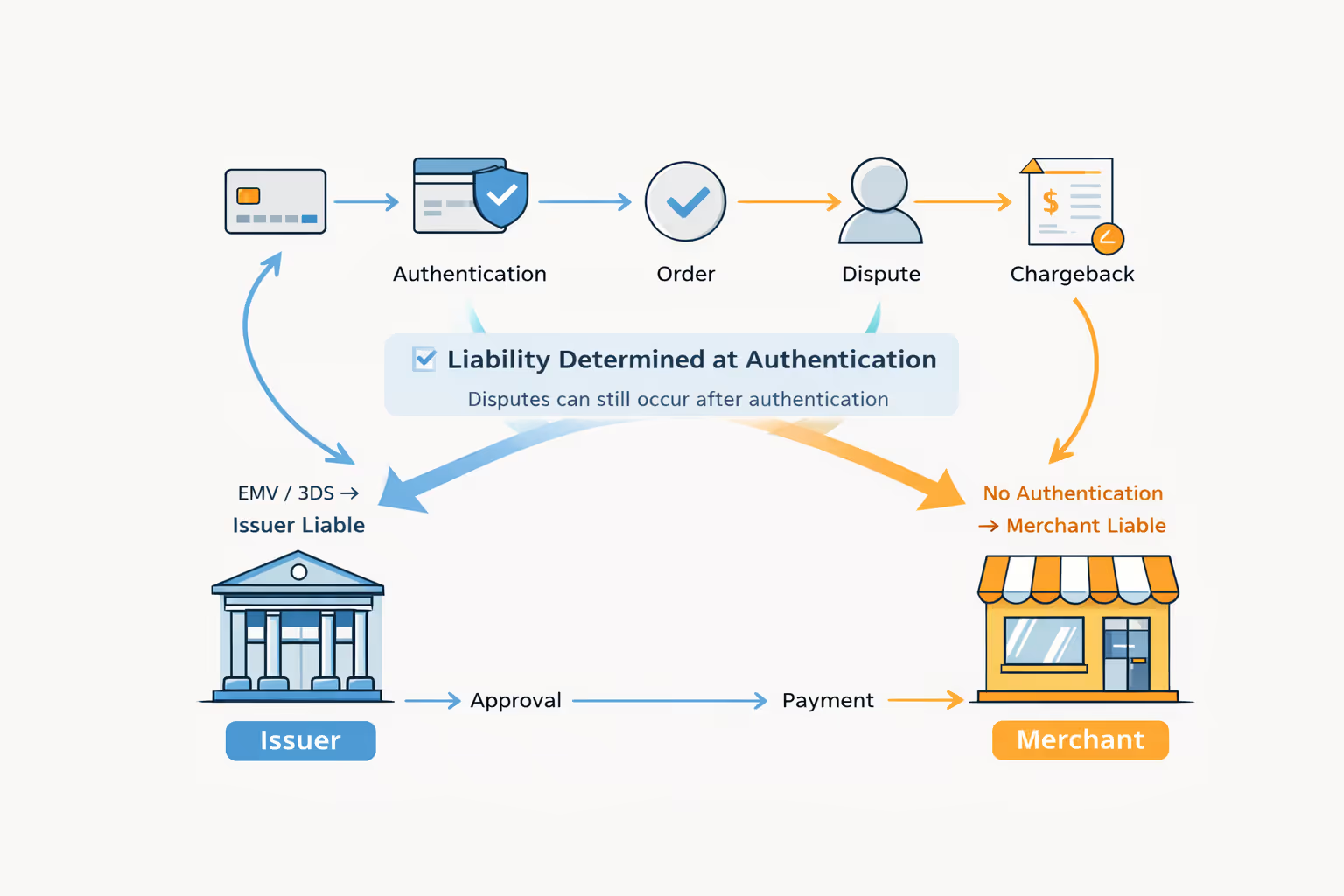
Chargeback alerts provide merchants with early warning when a customer disputes a transaction, providing a short window to resolve the issue before it becomes a formal chargeback. This early intervention can prevent dispute fees, protect ratios, and reduce operational costs. Alerts, including Chargeflow Alerts, are delivered through card network platforms like Verifi and Ethoca. These systems promptly inform merchants as soon as issuers receive a dispute request, enabling faster response and resolution.
Imagine you received advance notice of a serious issue about to affect your portfolio. You’d act immediately to reduce risk. Right? That’s exactly what chargeback alerts do for merchants. They provide an early chargeback warning that helps limit exposure before damage occurs.
Chargebacks are a persistent revenue killer. Global estimates suggest that by 2028, there could be 324 million chargeback cases, with card-not-present (CNP) fraud losses reaching 28.1 billion this year alone. These losses are driven in part by rising friendly fraud and third-party disputes. When you factor in the downstream costs, the total chargeback-related costs to merchants could reach $42 billion by 2028.
That’s why early dispute alerts are crucial. They give you the proactive edge to prevent disputes from escalating into costly chargebacks. Because in today’s dispute-prone eCommerce environment, it’s not a matter of if chargebacks will happen. It’s whether you can stay ahead of scammers when they try to steal from you with false claims.
Chargeback prevention alerts are pre-dispute notifications from issuing banks to help merchants know when cardholders initiate disputes. They are routed through networks such as Verifi (a Visa subsidiary with strong U.S. coverage) and Ethoca (a Mastercard subsidiary with stronger coverage in Canada, Europe, and Asia).
When a merchant signs up for a chargeback prevention alert, the service provides them a 24-72-hour window to resolve a dispute and halt it from escalating into a chargeback.

Chargeback alerts use card network data to help you intercept an impending chargeback and decide how best to handle the case. Chargeflow Alerts are connected directly to the card schemes. The system is notified immediately when a dispute is initiated.
Here’s how it works:

💡 Chargeflow Alerts charge for prevented chargebacks, not for alerts. This means Chargeflow handles locating transactions and issuing refunds on your behalf, and you won’t receive duplicate alerts from different providers.
According to Visa literature, “chargebacks can be time-consuming and resource-intensive. And, for merchants, the process of responding to disputes, gathering evidence, and waiting for resolution can pull focus from day-to-day operations.”
We’ve done several research experiments on the chargeback multiplier effect. Every $100 chargeback costs 3-4.6x
The 4.6x multiplier for every $1 chargeback is not arbitrary. It’s the true cost merchants face when cardholders initiate fraudulent chargebacks, according to LexisNexis. A single spike amplifies this cost exponentially. It drives merchants towards network monitoring programs and severe penalties. We’ll examine this further in a subsequent section.
To help you see why chargeback alerts make such a big difference, here’s a real-world case study.
Dizzy Path runs a small subscription box business. Things had been going pretty well. Until one morning. She woke up to the most frustrating chargeback situation ever.
A customer signed for the subscription, paid for two months, and received both boxes. She had tracking information and proof that the customer opened her emails. Still, they filed two “unauthorized transaction” chargebacks. She submitted full evidence, but the banks sided with the customer both times.

Your guess is as good as mine: this is a classic case of friendly fraud. Small businesses rarely win.
But the story could have been very different. If Dizzy Path had chargeback alerts, she could have acted immediately by refunding the transaction. She could have avoided losses equivalent to 4.6 times the transaction value.
When disputes surge, whether from seasonal fraud waves, policy abuse, or scaling issues, the fallout is rapid and multifaceted:
When you do the math on the cost of chargeback alerts, you’ll realize the service practically pays for itself.
“By sharing fraud and dispute data from issuers in near-real-time, chargeback alerts enable merchants to quickly respond to potential chargebacks by stopping order fulfillment, refunding the purchase, and effectively stopping the need for chargebacks altogether. For merchants and issuers alike, this speeds up the dispute process and not only gives customers a better experience but also reduces the operational costs associated with chargeback management.” -- Mastercard.
Chargeback alerts are typically priced per alert. Costs vary depending on the provider, transaction volume, and the card network involved.
Overall, Chargeflow Alert pricing is the most flexible model that makes alerts accessible, offering you Verifi and Ethoca for broader coverage without dual integrations.
Many providers say they can realistically guarantee a 30-40% overall chargeback reduction. Conversely, the case study of Chargeflow merchants shows ~90% chargeback deflection, even as dispute win rate doubled within the review period.
So here are the facts:
Again, do the math. The ROI reality is that at a $29 pay-per-success instance, Chargeflow Alerts deliver fast breakeven. Near VAMP thresholds, they avert fines far exceeding costs, making them high-ROI infrastructure rather than optional add-ons.
If you’re wondering whether your business needs chargeback prevention alerts, there are certain telltale signs to look out for. Certain patterns and risk signals make chargeback alerts most essential. Use the following indicators to determine whether alerts could save you time, money, and dispute remediation headaches.
Strong Indicators:
There may be exceptional cases not covered in the checklist. Feel free to consult with our experts for an informed decision, especially if you’re beginning to scale.
Sure, you can. Just like you can do your own accounting with spreadsheets.
Here’s what salesmen never tell you about self-managing alerts: You’re not just “checking a dashboard.” You’re logging into Ethoca’s portal, then Verifi’s, then your processor’s RDR interface. Each alert requires you to play detective and everything in between. You must locate the transaction, retrieve order details, verify if it has shipped, check if there’s a refund already in process, determine your best response, execute it, and document everything.
For five alerts, this is annoying but manageable. But for fifty? You’ve spent your entire Tuesday on data entry instead of building your business.
The real cost isn’t the hours, though. It’s what you’re missing. Without aggregated data, you can’t see that the same customer disputes every third order from every store. Or that a specific product line generates 10x more alerts, or that your fraud rate spiked after that TikTok campaign. You’re flying blind, paying $30 per alert for the privilege.
Is it worth it when you have a more excellent alternative? Your guess is as good as mine!
Card disputes generally happen in two stages:
Network inquiries precede alerts. Through programs like Visa’s Order Insight and Mastercard’s Consumer Clarity, inquiries enable you to stop disputes at that discovery stage.
Here’s how network inquiries work to strengthen chargeback prevention (following the chargeback process highlighted earlier):
In a nutshell, network inquiries help merchants resolve disputes before the issuer initiates the chargeback. Hence, an accurate and timely response is crucial. That requires real-time integration between inquiry networks and your order management system.

The chargeback prevention ecosystem is a fragmented network of inquiry systems, alert providers, dispute resolution programs, and your own transaction data scattered across payment processors, order management systems, and fulfillment platforms.
Running these separately creates operational chaos. An inquiry comes in. But your generic merchant descriptor doesn’t help recognize purchases. An alert notifies of an impending dispute. But you’re manually romaging through systems to find the order. The process goes on.
Some merchants solve this by choosing a prevention platform. But not all platforms are built the same. Here’s a quick overview:
The difference, though, is the level of automation, AI sophistication, and whether they handle representment or just prevention.
The strategy should be simple. Analytics help you stop cases at source, alerts catch the rest, and representment comes in for leftovers. A full-stack chargeback coverage maximizes coverage and VAMP exemptions.
The choice between managing alerts yourself or outsourcing to a fully managed platform isn’t about capability. It’s about economics and scale. Let’s examine the pros and cons of each strategy:
For scaling merchants, especially those approaching or exceeding the card network limit, fully managed alerts are a non-negotiable risk management instrument.
Activating Chargeflow Alerts is straightforward. Follow the steps below for a quick and successful setup.
1. Go to the Alerts tab and click “Activate Now.”
2. Select your relevant payment processor(s).

3. Add your statement descriptor, exactly as it appears in your processor or gateway dashboard (including correct capitalization). You can usually find this under Transaction, Payment, or Statement Descriptor settings.

💡 Need help? Read: How to find your payment descriptor.
4. Add a payment method if you haven’t already.
💡 Chargeflow places a temporary $100 hold for 7 days to verify eligibility. The funds are fully refunded afterward.
5. Watch for emails from the Chargeflow team requesting refund access to your payment processor. This step is mandatory; alerts will not go live until access is granted.

🚨 Complete this step promptly to avoid onboarding delays.
Once complete, you will start receiving alerts within 24 hours. While the complete Alerts Enrollment process can take up to 14 days due to varying enrollment times of different providers, you’ll begin getting alerts from some providers almost immediately.
When there’s early visibility into a risk, the smart move is to act before it turns into a loss. That’s the role chargeback alerts play in modern payments: early intervention, controlled outcomes, and predictable costs in an otherwise reactive system.
We’ve covered how the system works. Cardholders dispute, providers like Chargeflow route through Verifi, Ethoca, and proprietary infrastructure, and you respond before it escalates. We’ve also examined why self-managed options break down at scale, how automated setup involves a seamless plug-and-play process, and how network inquiries add pre-alert protection.
In today’s landscape, alerts aren’t optional for high-growth merchants. With VAMP tightening and fraud spiking, proactive interception puts you in the driver's seat. Again, if ratios are creeping or chargeback spikes loom, implementing chargeback prevention alerts now is a smart move. The cost of inaction is lost revenue.
Schedule a call with our sales team for onboarding support, or click here to get started right away.
Recover 4x more chargebacks and prevent up to 90% of incoming ones, powered by AI and a global network of 15,000 merchants.
Chargeflow collects data from dozens of third party signals, automatically. This allows for much more coverage and much better win rates because the evidence submitted is much more comprehensive and compelling.
Chargeflow collects data like order info, customer messages, and payment details. It builds a full dispute case for you, so you don’t have to lift a finger.
Yes! Chargeflow works with 50+ payment processors. That means one tool for all your chargebacks, no matter how you process payments.
You only pay a percentage of the revenue we help you recover. No upfront fees, no subscriptions — just success-based pricing.
Yes. Chargeflow is SOC 2 Type 2, GDPR, and ISO certified. We use top security standards to keep your data safe.
Have a question? We’re here to help. Just hit the chat button to initiate a conversation with support.