


















%201.svg)




































4 Chargeback Response Templates and Evidence Checklists


Chargebacks?
No longer your problem.
Recover 4x more chargebacks and prevent up to 90% of incoming ones, powered by AI and a global network of 20,000 merchants.


 600+ reviews


TL;DR:
- Reuse a chargeback response template as a structure only: the allegation, dates, amounts, exhibits, and requested outcome have to be rewritten for each case.
- Four copyable templates cover physical goods not received, digital goods not received, not as described, and unauthorized transaction claims, with Amex, Discover, Mastercard, and Visa reason codes.
- Check each draft against the validation table: delivery, AVS, or an email match does not prove the cardholder authorized the payment.
- A Visa 10.4 friendly fraud claim can shift back to the issuer under Compelling Evidence 3.0 when two prior undisputed transactions, 120 to 365 days old, share two data elements including the IP address or device ID.
- Submit before the due date shown on your own case, because network windows vary and a missed date is an automatic loss.
A chargeback response template is a reusable structure for explaining a merchant's position on a disputed payment. It must be adapted to the actual claim and supported by transaction-specific evidence. It is also called a chargeback rebuttal letter, a chargeback dispute template, or a representment letter, and the same core structure applies whether the claim is fraud, an authorization issue, a consumer complaint, or a processing error.
People look for it under several names: a chargeback rebuttal letter sample, a chargeback rebuttal template, a chargeback dispute letter template, a chargeback letter template, a chargeback form template, or a chargeback representment template and chargeback representment letter sample. The four templates below serve all of those searches, and each one is labeled by dispute type so you can pick the right one.
Fighting fraudulent chargebacks takes time, and a reusable structure saves rework only when each letter is checked against the actual claim. Cost pressure is a reason to get this right: Mastercard cites 2026 Mastercard/Datos research forecasting 359 million global chargebacks a year by 2029, 37% growth from 2025, and 2026 Mastercard/Javelin research estimating US merchant operational cost at USD 128 per chargeback (USD 82 internal plus USD 46 third-party), excluding lost goods or services. See the Mastercard analysis of the true cost of a chargeback for the scope of those estimates, and Chargeflow's chargeback statistics report for wider context.
Many disputes are described as friendly fraud, where a cardholder disputes a payment that the merchant believes was valid. Visa puts friendly fraud at around 20% of all fraudulent disputes globally and up to 30% for high-volume online merchants, citing the 2025 Global eCommerce Payments & Fraud Report (see Visa's friendly fraud insights). A dispute claim alone does not show the cardholder's intent, so a response should state what the records establish and stop there.
A response succeeds or fails on two things:
- Following the processor's representment procedure and case due date
- Gathering relevant evidence that answers the actual claim
This article gives four ready-to-use chargeback response templates, with chargeback rebuttal letter examples, plus a deeper line-by-line writing walkthrough. Adapt each chargeback template letter to the case, and submit before your response deadline. For the complete list of codes by network, see our guide to chargeback reason codes.
{{cta}}
The Universal Chargeback Rebuttal Letter Framework
Every chargeback rebuttal letter, whatever the reason code, can be built from the same five structural elements. Explain what each exhibit establishes, and leave out records that do not address the claim, because unrelated evidence and unsupported identity assertions weaken clarity (see Stripe's dispute evidence best practices).
- Transaction identification. Open with the transaction ID, chargeback case number, dollar amount, transaction date, and the last four digits of the card used. This lets the reviewer match your letter to the correct case.
- Direct rebuttal of the specific claim. State the cardholder's claim in plain language, then state your counter-position in one sentence. Do not make the reviewer infer what you are disputing.
- Supporting evidence list. Reference each exhibit by letter (Exhibit A, B, C) and describe what it proves. This is the largest part of the letter, and where reason-code-specific evidence belongs.
- Policy or terms reference. Quote the specific line from your refund policy, terms of service, or shipping policy that the cardholder saw at checkout, with the date it applied.
- Closing ask. End with a direct, unemotional request that the reviewer rule in your favor based on the attached evidence, plus contact details for follow-up questions.
The four templates below apply this framework to the reason codes merchants dispute most often. Template #4 covers an unauthorized-transaction claim, the category where friendly fraud is most often alleged.
Chargeback Template Emphasis by Reason Code Category
Not every exhibit matters equally for every dispute. Use this table to decide what to lead with in your evidence list before you start drafting:
| Reason code category | Example codes | What to emphasize in your rebuttal |
|---|---|---|
| Fraud codes (card-absent, unauthorized use) | Visa 10.4, Mastercard 4837/4863, Amex F29, Discover UA02 | 3DS2 authentication results, AVS and CVV outcomes, device and IP logs, and prior order history linked to the same account, each presented as context rather than proof of who the cardholder is |
| Authorization codes | Visa 11.x, Mastercard 4808 | The original authorization approval code and timestamp, proof the transaction matched the authorized amount and currency, and confirmation the authorization had not expired at settlement |
| Consumer dispute codes (not as described, quality) | Visa 13.3, Mastercard 4853, Amex C31, Discover RM | Product listing screenshots from the time of purchase, your stated refund or return policy, and any customer service correspondence describing the alleged defect |
| Processing error codes | Visa 12.x, Mastercard 4834 | Transaction logs showing a single authorization and settlement (to rebut duplicate processing claims), and the exact credit or refund date if one was already issued |
Chargeback Reason Codes by Network (Quick Reference)
Each template below maps to one of these common dispute types. Match your chargeback to the correct reason code before you start your rebuttal, and read how to fight each reason code for the evidence each one calls for:
| Dispute type | Amex | Discover | Mastercard | Visa |
|---|---|---|---|---|
| Goods/Services Not Received | C08 | RG | 4853 | 13.1 |
| Not as Described / Defective | C31 | RM | 4853 | 13.3 |
| Unauthorized / Fraud (card-absent) | F29 | UA02 | 4837 / 4863 | 10.4 |
Mastercard now routes most not-received and not-as-described claims through 4853 (Cardholder Dispute); 4855 and 4842 are legacy codes that can still appear in older processor dashboards, mapped to 4853 and 4834. For the full lists, see the American Express chargeback reason codes, Discover chargeback reason codes, Mastercard chargeback reason codes, and Visa chargeback reason codes guides.
Validate the Template Before You Submit It
A template only helps when every field matches the case. Dispute categories need different records: authentication does not answer a cancellation timeline, and delivery does not establish every alleged product attribute (see Stripe's dispute categories and evidence). Run this check before sending any of the four templates below.
| Template | Required Case Inputs | Do Not Assert Without Proof | Final Crosscheck |
|---|---|---|---|
| Physical goods | Disputed line items and every shipment | The whole order arrived based on one parcel | Amounts equal the goods addressed in the response |
| Digital goods | License or account ID and access event | The cardholder personally used the account | Access record belongs to the disputed purchase |
| Not as described | Listing at purchase and exact complaint | Delivery proves product conformity | Each alleged discrepancy receives an answer |
| Unauthorized payment | Authentication result and linked account history | AVS or email proves cardholder identity | Defense matches the processor's fraud instructions |
Copyable template opening (illustrative structure, not a real case): "We contest the [amount] dispute concerning payment [ID] because [specific fact addressing the claim]. Exhibit E1 records [fact]; Exhibit E2 connects [record] to the disputed order. Any prior credit is listed separately below." Replace every bracketed field before submission.
One owner per case. Name a single person or system as the submitter for each case. If your team responds manually, Chargeflow automation should not also submit that case, and the reverse.
Chargeback Response Template #1: Physical Goods Not Received
Order-not-received fraudulent chargeback notices are represented by the following reason codes:
- AMEX C08: Goods/Services Not Received or Only Partially Received
- Discover RG: Non-Receipt of Goods, Services, or Cash
- Mastercard 4853: Cardholder Dispute, goods or services not provided (legacy code 4855)
- Visa 13.1: Merchandise/Services Not Received
Before your representment, consider contacting the customer directly to understand the issue, and keep a record of any tracking details you send them. That communication can be useful documentation in the case file. A sample chargeback letter to customer for this step should state the order, the amount, and the tracking details, and nothing about intent.
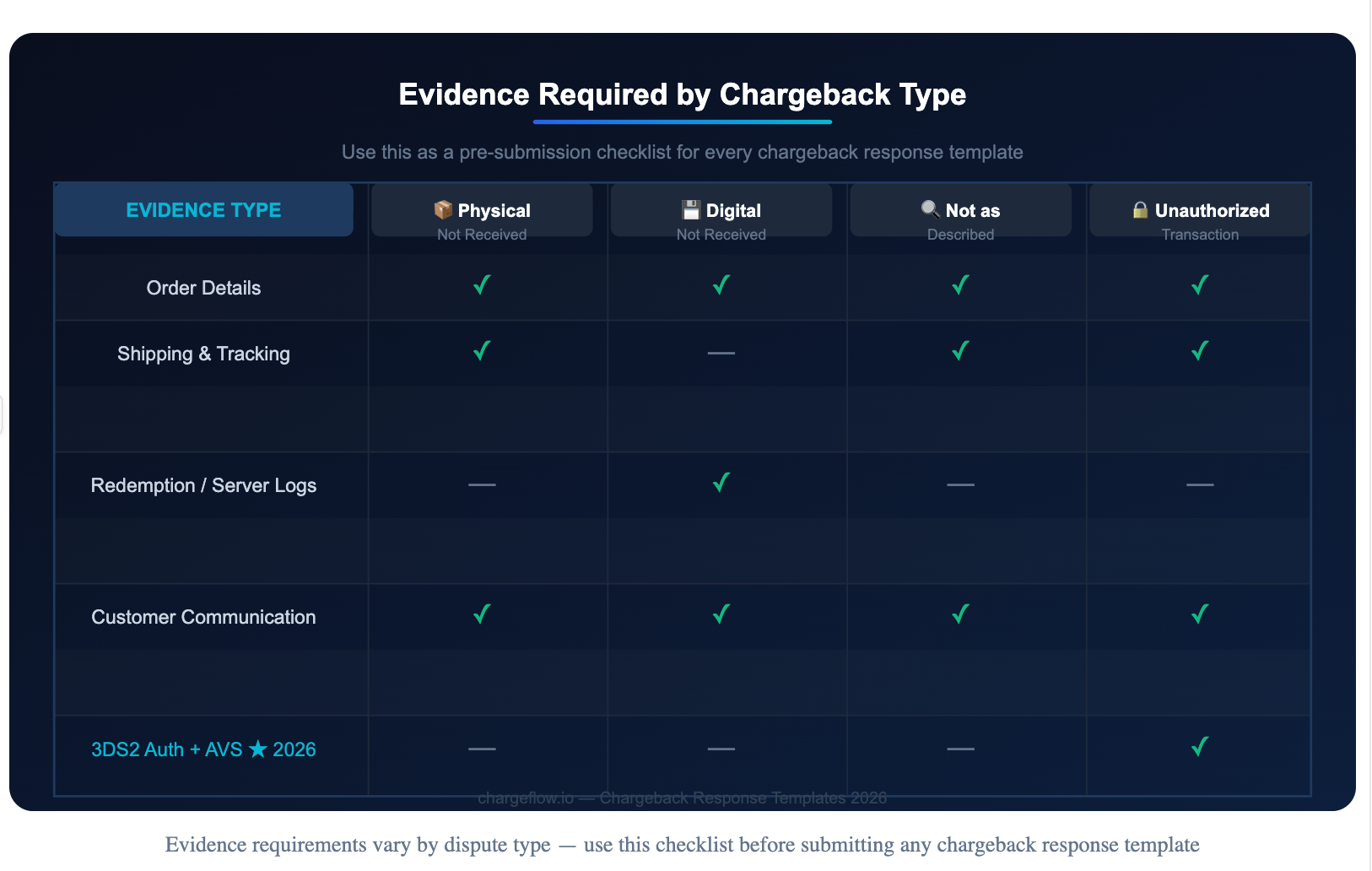
Important documentation to include in your representment:
- Order details (exclude personally identifiable information)
- Shipment information for every package in the order, including delivery confirmation and tracking numbers
- Relevant customer communication and any other corroborating evidence
How to write a chargeback dispute template letter to the bank:
Subject Line: TRN #XYZ, CHG-BK CODE: XXX X
To whom it may concern,
We have carefully reviewed TRN XYZ and would like to contest the chargeback [add chargeback number] for $[add dollar amount] with the reason code: "Order Not Received."
{Exhibit A}: [Include the customer's name] made the credit card transaction on [add date] with a credit card ending in [add the last four digits of the payment card].
{Exhibit B}: We delivered [list the disputed line items and every shipment] to the stated address on [add order delivery date] through [add the shipping carrier] with the tracking number XXXXXX.
{Exhibit C}: [Include only if true] We contacted the cardholder on [add date] with the order tracking details. The attached record shows [the response received, or that no response was received].
We ask that you please review the attached documents addressing the cardholder's claim that the product was not received, and find this dispute in our favor.
If you have any questions or need further details, please reply directly to this email.
Sincerely,
[Add your details]
Pro tip: If your shipping carrier provides GPS confirmation or delivery photos, add them as an additional exhibit, since they can serve as compelling evidence for physical goods disputes. Confirm with your processor which file types it accepts for the case, and do not assert that the whole order arrived based on one parcel.
Chargeback Response Template #2: Digital Goods Not Received
This category of fraudulent chargeback is represented by the following reason codes:
- AMEX C08: Goods/Services Not Received or Only Partially Received
- Discover RG: Non-Receipt of Goods, Services, or Cash
- Mastercard 4853: Cardholder Dispute, goods or services not provided (legacy code 4855)
- Visa 13.1: Merchandise/Services Not Received
Responding to a Digital Goods Not Received claim can be hard because there is no physical tracking number. Records of access to the purchase-linked account take its place. For more on this dispute type, see our guide to digital goods chargebacks. Before you respond, capture a screenshot or log showing that the digital good was delivered or accessed, and attach it as an exhibit rather than sending it to the issuer separately.
Necessary documentation to include in your representment:
- Order details (exclude personally identifiable information)
- Email confirmation and redemption code
- Date of redemption, server logs, and timestamps
- Device and IP address data showing access to the digital product
- Relevant customer communication
How to write a chargeback rebuttal letter to the bank using this chargeback dispute template:
Subject Line: TRN #XYZ, CHG-BK CODE: XXX X
To whom it may concern,
We have carefully reviewed TRN XYZ and would like to contest the chargeback [add chargeback number] for $[add dollar amount] with the reason code: "Merchandise Not Received."
{Exhibit A}: [Include the customer's name] made the transaction on [add date] with a credit card ending in [add the last four digits of the payment card].
{Exhibit B}: We sent the order confirmation and redemption code to the email address provided at the time of the transaction on [add date].
{Exhibit C}: The purchase-linked account [add license or account ID] accessed the digital good on [add date] at [add time and timezone], as recorded in the attached server logs and IP address records. These records show access to the account, and they do not by themselves identify who was using it.
{Exhibit D}: [Include only if true] We contacted the cardholder on [add date] with the redemption details.
We ask that you please review the attached documents addressing the cardholder's claim that the digital goods were not received, and find this dispute in our favor.
If you have any questions or need further details, please reply directly to this email.
Sincerely,
[Add your details]
Pro tip: Session logs and device or IP records can tie access to the purchase-linked account. Work with your platform or hosting provider to pull them before the case due date, and include only the records relevant to the disputed purchase.
Stripe Digital Goods Representment Evidence Template
For Stripe cases on digital goods, use this annotated version within the template above. For a worked example of an evidence packet, see what proof Stripe accepts for digital goods disputes. Complete every bracketed field before submission.
We contest the [amount and currency] [claim] concerning Stripe payment [payment ID] and order [order ID]. The purchase provided [specific digital entitlement]. Exhibit E1 joins the successful payment to entitlement creation at [timestamp and timezone]. Exhibit E2 records access delivery to [purchase-linked account] and [relevant access event]. Exhibit E3 records the [purchase-time description or cancellation and billing chronology] addressing the allegation. A prior completed credit of [amount] is recorded as refund [ID] on [date], leaving [actual disputed balance]. These records establish [specific fulfillment or chronology fact]; they do not independently prove cardholder authorization.
- E1: ties the payment to the entitlement, so the reviewer sees the same purchase on both records.
- E2: shows delivery or access, and only for the account linked to the purchase.
- E3: answers the specific allegation, such as what was described at purchase or when a cancellation occurred.
- Prior credit: list any refund separately so the disputed balance is accurate.
For an unauthorized claim, use the relevant supported authentication and account evidence rather than the fulfillment paragraph alone. Include only relevant records, redact unrelated personal data, and confirm final submission through the actual Stripe case controls. Submission is final, and Stripe forwards the evidence while the issuer decides, so validate before you send (see Stripe's guide to responding to disputes). These rules are specific to Stripe, not all processors.
Chargeback Response Template #3: Product or Service Not as Described
This category of fraudulent chargebacks is represented by the following reason codes:
- AMEX C31: Goods/Services Not As Described
- Discover RM: Cardholder Disputes Quality of Goods or Services
- Mastercard 4853: Cardholder Dispute, not as described or defective
- Visa 13.3: Not as Described or Defective Merchandise/Services
Product not as described disputes are a common chargeback category, and social commerce, where imagery can diverge from the physical product, adds to them. Before responding, ask the cardholder to specify how the product or service differs from what you advertise. That communication helps you answer each alleged discrepancy.
Necessary documentation to include in your representment:
- Order shipping details, including delivery confirmation, proof of delivery, and tracking number
- Your refund or cancellation policy as shown on your website at the time of purchase
- Relevant customer communication
- Detailed product information, images, product description, and product URL
- Screenshots of your website's product listing at the time of the transaction (use archive tools if needed)
How to write a chargeback response template letter to the bank for this dispute type:
Subject Line: TRN #XYZ, CHG-BK CODE: XXX X
To whom it may concern,
We have carefully reviewed TRN XYZ and would like to contest the chargeback [add chargeback number] for $[add dollar amount] with the reason code: "Not as Described."
{Exhibit A}: We delivered the package to the address provided by the cardholder at the time of the transaction on [add date] via [add the shipping carrier] with the tracking number XXXXXX.
{Exhibit B}: Per our refund policy, "[add your refund policy text]." The policy was shown at checkout on [add date].
{Exhibit C}: On [add date] we asked the cardholder to specify how the product received differs from what was ordered. The cardholder described the item as "xxxxxxxxx." The email thread (Exhibit D) and the listing show [how each alleged discrepancy compares with the listing].
{Exhibit D}: Screenshots of our product listing page at the time of purchase, showing the item description and imagery displayed before checkout.
We ask that you please review the attached documents addressing each point in the cardholder's claim and find this dispute in our favor.
If you have any questions or need further details, please reply directly to this email.
Sincerely,
[Add your details]
Pro tip: If you have product demonstration or unboxing video, include a link or file as supplemental documentation where your processor accepts that format. Delivery alone does not establish that the product matched every attribute in the listing, so answer each alleged discrepancy separately.
Chargeback Response Template #4: Unauthorized Transaction
This category of fraudulent chargeback claims is represented by the following reason codes:
- AMEX F29: Card Not Present
- Discover UA02: Fraud - Card Not Present Transaction
- Mastercard 4837: No Cardholder Authorization
- Mastercard 4863: Cardholder Does Not Recognize - Potential Fraud
- Visa 10.4: Fraud - Card-Absent Environment
Unauthorized transaction chargebacks are the category where friendly fraud is most often alleged, because the cardholder may say they did not make a purchase that the merchant's records link to their account. These cases are hard to win when the cardholder did fall victim to fraud, so the response should rest on records tied to the actual payment and should not assert more than those records show. Many merchants lean on chargeback alerts to intercept disputes early.
If the transaction was authenticated through 3DS2 (3D Secure version 2), include the authentication result and response code in your chargeback rebuttal letter template. Whether liability moves to the issuer depends on the authentication outcome, the network rules, and your processor's treatment, so follow the processor's fraud dispute instructions. Treat AVS and CVV results, email confirmations, and delivery to the billing address as context that supports the account history, and avoid presenting any of them as proof of cardholder identity. If an AI agent placed the order on the cardholder's behalf, add the delegated-payment consent record as an exhibit; see AI agent chargeback liability and the agentic commerce chargebacks evidence playbook.
Necessary documentation to include in your chargeback representment:
- Order details (exclude personally identifiable information)
- Order confirmation email
- Order shipping details, including delivery confirmation and tracking number
- 3DS2 authentication response code (if applicable)
- Device fingerprinting and IP address logs at the time of the transaction
- AVS (Address Verification System) and CVV match results
- Prior order history on the same account
- Relevant customer communication
How to write a chargeback rebuttal letter example to the bank using this chargeback dispute template:
Subject Line: TRN #XYZ, CHG-BK CODE: XXX X
To whom it may concern,
We have carefully reviewed TRN XYZ and would like to contest the chargeback [add chargeback number] for $[add dollar amount] with the reason code: "Unauthorized Transaction."
{Exhibit A}: [Include the customer's name] is the name on the transaction on [add date] with a credit card ending in [add the last four digits of the payment card]. [If applicable] The transaction was authenticated via 3DS2 with authentication response code [add code]. The processor's fraud dispute instructions govern how that result applies to this case.
{Exhibit B}: At [add time] on [add date], we sent an order confirmation to the email address provided with the order, which is linked to the account history in Exhibit E.
{Exhibit C}: We delivered the package to the stated address on [add order delivery date] through [add the shipping carrier] with the tracking number XXXXXX.
{Exhibit D}: [Include only if true] On [add date] we contacted the cardholder with the order tracking details. The attached record shows [the response received].
{Exhibit E}: Prior orders and account activity linked to this account: [add dates and order IDs].
We ask that you please review the attached documents addressing the cardholder's claim and find this dispute in our favor.
If you have any questions or need further details, please reply directly to this email.
Sincerely,
[Add your details]
Visa Compelling Evidence 3.0 Checklist for Friendly Fraud Claims
For a Visa 10.4 dispute, Visa Compelling Evidence 3.0 (CE 3.0) lets you replace the identity argument in Template #4 with a data match that, when every criterion is met, shifts liability back to the issuer. CE 3.0 took effect on 15 April 2023 and applies only to reason code 10.4. Check each row before you add a CE 3.0 exhibit (source: Visa CE 3.0 merchant readiness guide):
| CE 3.0 check | Rule | What to attach |
|---|---|---|
| Reason code | Visa 10.4 (Fraud, Card-Absent Environment) only | The dispute record showing condition 10.4 |
| Prior transactions | At least two prior undisputed transactions with your business | Transaction IDs and dates for both |
| Age window | 120 to 365 days old, counted from the dispute date | Dates showing each transaction falls inside the window |
| Matching data | Two of four elements match the disputed transaction: user ID, IP address, shipping address, device ID or fingerprint; at least one must be the IP address or device ID | A side-by-side record of the matched elements |
| Exclusions | A prior transaction with an active fraud report or fraud dispute does not qualify | Confirmation that neither prior transaction was disputed as fraud |
| Attempts | CE 3.0 data can be submitted once per dispute | A reviewed, final packet before submission |
Worked example (illustrative, not a real case): A cardholder disputes a $180 order on 1 September 2026 under Visa 10.4. Your records show undisputed orders on 2 March 2026 (183 days earlier) and 10 November 2025 (295 days earlier), each placed from the same user ID and device ID as the disputed order. Both fall inside the 120 to 365 day window and two elements match, one of them the device ID, so the case qualifies. Add one exhibit to Template #4:
{Exhibit F}: CE 3.0 data. Prior undisputed transactions [ID 1, date] and [ID 2, date] share user ID [value] and device ID [value] with the disputed transaction.
If only the shipping address and user ID match, the case does not qualify, because neither is an IP address or device ID, and the standard Template #4 evidence applies.
Mastercard First-Party Trust. Mastercard announced its First-Party Trust program in October 2023, with rollout starting in the United States in 2024 (The Paypers). Merchants share data in three categories: device identity (IP address, device ID, fingerprint), proof of delivery (shipping address, email), and additional identity factors such as account login or phone number, and disputes that meet the data-sharing requirements receive chargeback protection (see Mastercard's First-Party Trust overview). Ask your acquirer whether it supports the program before you build a Mastercard friendly fraud response around it.
How to Strengthen Any Chargeback Response Template
Regardless of which chargeback template you use, strong rebuttal packages share a few traits:
- Lead with a clear, concise cover letter. Open your chargeback template letter with a one-paragraph summary of the case before presenting exhibits, so the argument is scannable.
- Label and reference every exhibit. Label each piece of evidence in your chargeback response templates (Exhibit A, B, C) and cross-reference it in the body of the letter.
- Keep it factual, not emotional. Reviewers evaluate evidence against reason codes and network rules. Your chargeback dispute template should read like a brief, not a complaint.
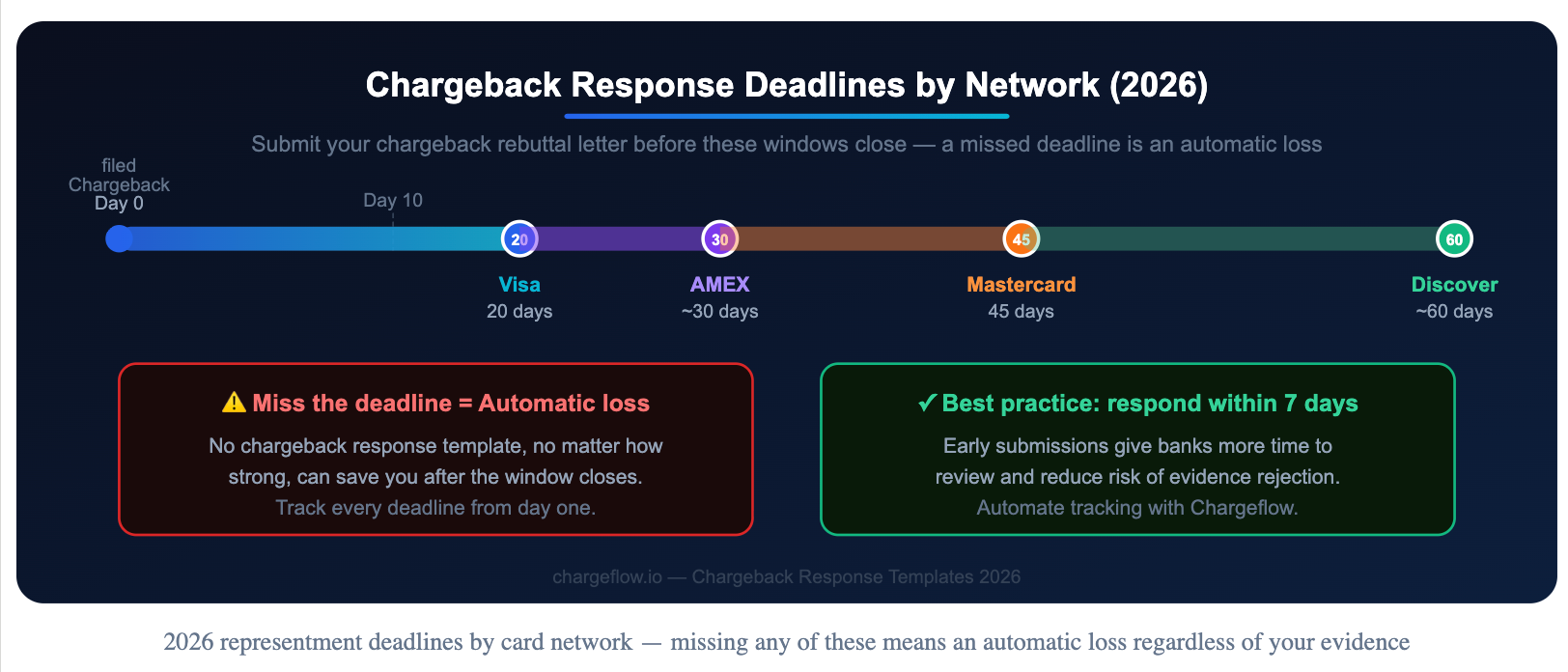
- Track the case due date. The case-specific due date in your processor's dispute record controls your response, and network windows differ by network, region, and dispute stage. Processors often set shorter internal dates, so see our chargeback time limit guide and respond before the date shown on the case. A missed deadline can mean an automatic loss.
- Customize for each network. The structure of a chargeback rebuttal letter template stays consistent, but reason codes, evidence requirements, and deadlines vary by card network. Verify against current card network chargeback rules and processor instructions before submitting.
- Pull data from your payment stack. Your payment service provider can usually supply AVS, CVV, and 3DS2 authentication data. Request it as soon as a dispute notification arrives, and see the chargeback evidence sources map for where each record comes from.
A stronger, more complete factual record can support a well-reasoned response, but it does not guarantee the issuing bank's decision. Issuers weigh evidence against their own network rules, and outcomes vary case by case.
When to Use Automated Chargeback Management Instead
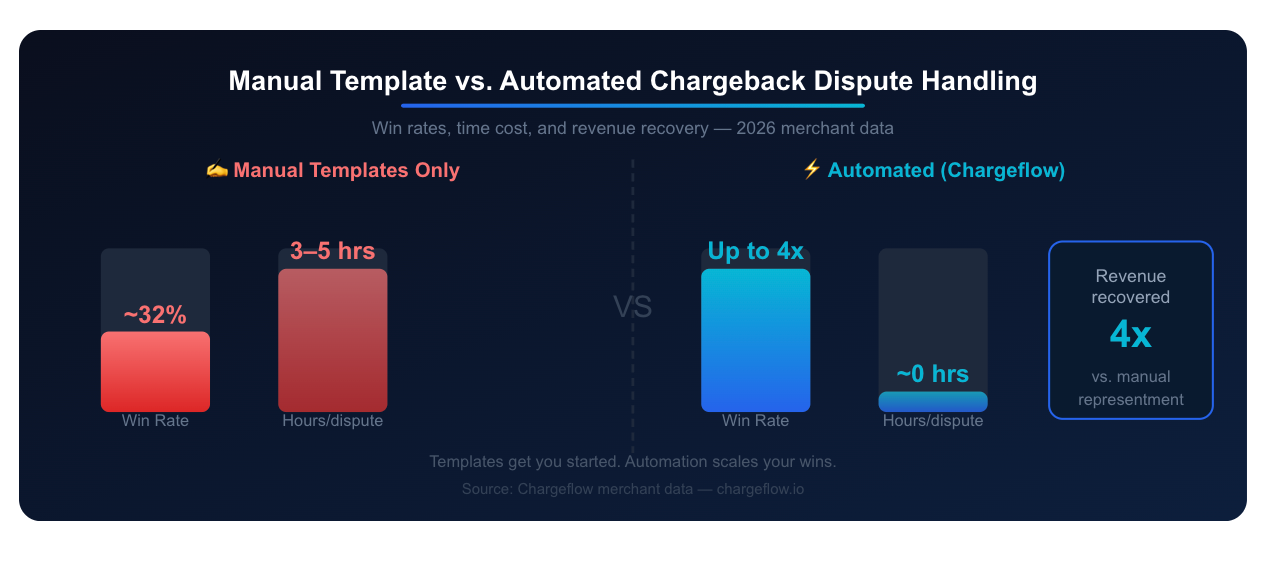
Using a chargeback response template manually is a solid starting point, but it has limits as volume grows. Each dispute needs research, customization, and timing against its own due date. Automated chargeback management tools can assemble evidence and track deadlines, and pairing chargeback protection with template-based representment, alongside a broader ecommerce fraud prevention strategy, covers both prevention and recovery. See how merchants use Chargeflow for examples.
{{cta}}
Frequently Asked Questions About Chargeback Response Templates
Can I reuse a chargeback response template?
A chargeback response template can be reused as a structure, but the allegation, dates, amounts, exhibits, and requested outcome must match each case.
What should I remove from a chargeback response?
Remove unsupported accusations, irrelevant policy text, unverified win-rate claims, and statements that your records do not establish.
What should a chargeback response template include?
A strong chargeback response template includes a subject line with the transaction number and chargeback code, a brief opening paragraph stating your intent to contest, clearly labeled evidence exhibits (order records, shipping confirmation, customer communications), and a closing request for a ruling in your favor. Tailor each chargeback template letter to the reason code and the actual claim.
What is a chargeback rebuttal letter?
A chargeback rebuttal letter, sometimes called a representment letter, is the written argument you submit through your processor to contest a chargeback. It is the core document in chargeback representment, presenting your evidence and explaining why the transaction was valid. For a broader look at how chargebacks work end to end, see what is a chargeback. A well-written chargeback rebuttal letter example references each exhibit and addresses the cardholder's stated reason for disputing.
Can I use the same chargeback dispute template for all reason codes?
The general structure of a chargeback dispute template stays consistent across reason codes, but the evidence must be specific to the dispute type. For example, a "not as described" template needs the product listing at purchase and your return policy, while an "unauthorized transaction" template needs authentication and account history records. Always match your evidence to the applicable network rules and processor instructions.
How many chargeback response templates should a merchant have?
At a minimum, maintain chargeback response templates for the four common dispute categories on this page: physical goods not received, digital goods not received, not as described, and unauthorized transactions. Merchants with other dispute types, such as subscription cancellation or credit not processed claims, may want specialized chargeback template letters for them.
What is the deadline for submitting a chargeback response?
The case-specific due date shown in your processor's dispute record controls. Card network windows vary by network, region, and dispute stage, and processors may set shorter dates, so track the date on your own case and submit before it. Missing it can result in an automatic loss regardless of how strong your chargeback rebuttal letter template is.
Does using a chargeback response template guarantee a win?
No. A template gives structure, but the issuer decides based on the quality and relevance of your evidence against the reason code and network rules. A response with complete, well-organized records that answer the actual claim is easier to review than an improvised or incomplete one.
What evidence is most persuasive in a chargeback rebuttal letter?
Evidence that directly answers the cardholder's claim. For delivery disputes, that means carrier confirmation for every shipment, with GPS or photo proof where available. For digital goods, it means access logs and timestamps for the purchase-linked account. For unauthorized transactions, it means the authentication result and linked account history, presented without claiming they prove identity. Organize evidence chronologically and reference it in your chargeback dispute template.
How do I format a chargeback template letter?
A chargeback template letter should have a subject line identifying the transaction and reason code, a professional salutation ("To whom it may concern"), a structured body with sequentially labeled exhibits, and a polite, firm closing requesting a ruling in your favor. Keep the format of your chargeback response templates clean and free of emotional language, because you are presenting evidence.
What's the difference between a chargeback rebuttal letter and a chargeback response template?
They describe the same document from two angles: a chargeback response template is the reusable structure you fill in each time, while a chargeback rebuttal letter is the finished, transaction-specific letter you submit. Every rebuttal letter on this page follows the five-part framework above.
What is friendly fraud in a chargeback?
Friendly fraud is a chargeback filed by a cardholder on a purchase they made or authorized, often because they forgot it, did not recognize the billing descriptor, or wanted a refund without returning the item. Visa puts it at around 20% of fraudulent disputes globally and up to 30% for high-volume online merchants. Merchants answer a friendly fraud chargeback with records tied to the disputed payment, not with claims about the cardholder's intent.
How do you dispute a friendly fraud chargeback?
Dispute a friendly fraud chargeback by matching the response to its reason code, usually Visa 10.4, Mastercard 4837 or 4863, Amex F29, or Discover UA02, and attaching authentication results, device and IP logs, delivery records, and prior undisputed order history. For Visa 10.4, check Compelling Evidence 3.0 first: two prior undisputed transactions 120 to 365 days old that share two data elements with the disputed one, including the IP address or device ID, shift liability back to the issuer.
Is there a sample chargeback rebuttal letter to send to the bank?
Yes. This page has four sample chargeback rebuttal letters: physical goods not received, digital goods not received, not as described, and unauthorized transaction. Each sample uses a subject line with the transaction and reason code, labeled exhibits, and a closing request. Merchants submit the finished letter through their processor or acquirer, which forwards it to the issuing bank, after replacing every bracketed field with the facts of the case.
How do merchants win a chargeback dispute?
Merchants win chargeback disputes by answering the exact reason code with evidence that addresses the cardholder's claim, submitting before the case due date, and leaving out anything the records cannot prove. Carrier confirmation for every shipment answers not-received claims, listing screenshots and correspondence answer not-as-described claims, and authentication results plus CE 3.0 data answer Visa card-absent fraud claims. Even a complete response does not guarantee the issuer's decision.
Connect relevant evidence collection and response submission with Chargeflow Automation. Get started now.
Recover Chargebacks Without the Paperwork
Chargeflow Automation builds and submits evidence for the chargebacks that still arrive.

Chargebacks?
No longer your problem.
Recover 4x more chargebacks and prevent up to 90% of incoming ones, powered by AI and a global network of 20,000 merchants.


.png)