%201.svg)




































WooPayments Chargeback Help: A Practical Merchant Guide

Chargebacks?
No longer your problem.
Recover 4x more chargebacks and prevent up to 90% of incoming ones, powered by AI and a global network of 20,000 merchants.


 600+ reviews


TL;DR:
- Open Payments > Disputes and record the case deadline and owner.
- Use WooPayments guidance for fees and payment-method differences.
- Match order, delivery, cancellation, or refund evidence to the claim.
- Confirm submission and reconcile the final outcome before closing the case.
WooPayments chargeback management is the process of reviewing disputed payments, deciding whether to accept or challenge them, and submitting relevant evidence through the available case workflow. Start in Payments > Disputes, read the claim, and use the response deadline shown for that case. The outcome depends on the evidence and the applicable payment-method rules.
Find the Dispute and Assign an Owner
WooPayments notifies merchants by email and through the store dashboard. The official dispute-management documentation explains the notifications, response process, and differences between payment methods. Use that guidance for your WooPayments account rather than assuming instructions or fees for a separate processor account apply.
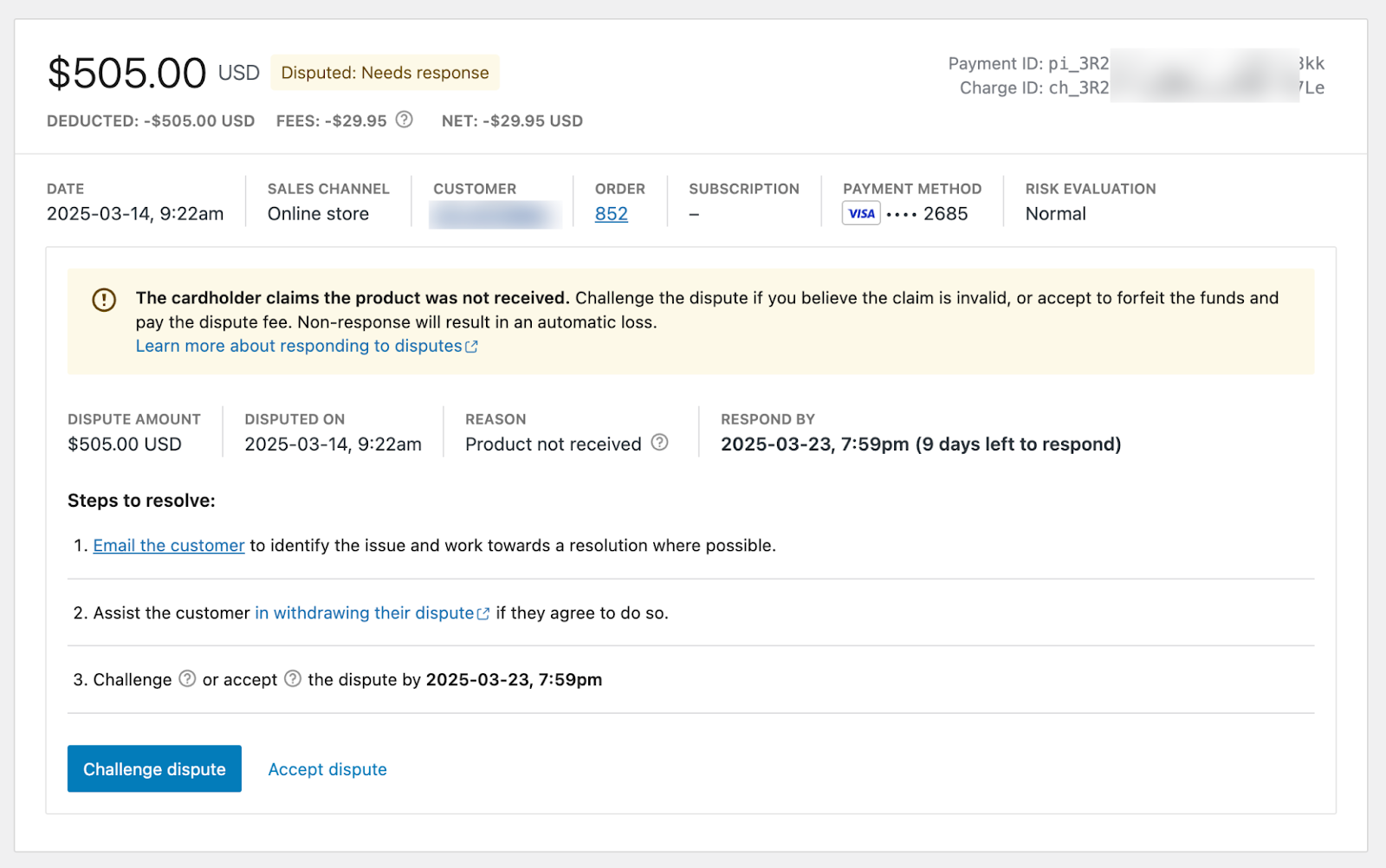
Screenshot example: dashboard appearance, amounts, fees, and dates may differ from your current case.
Connect the dispute to the original order, payment, and support ticket. Record its reason, amount, currency, deadline, and owner in one working record. If several people handle customer support and payments, agree who can authorize refunds and who submits evidence. This support and payments handoff reduces conflicting actions.
Understand the Deadline and Financial Impact
WooPayments describes a typical response window of 7–21 days and an issuer review period of 60–75 days. These are general expectations, not a substitute for the case deadline. Its documentation also explains that disputed funds and applicable fees are deducted, with standard dispute funds and fees returned when a dispute is won. Check the rules for your country, payment method, and case type.
Keep the operational deadline separate from your cash-flow forecast. A submitted response is not recovered revenue. Track the disputed principal, fee, existing refund, and final settlement separately so finance can reconcile the outcome without double counting. Escalate unexpected differences with the case and transaction identifiers available.
Decide Whether to Accept or Challenge
Read the customer’s allegation before gathering attachments. If your business charged twice, missed an agreed cancellation, or did not provide the promised service, resolve the underlying issue. A clear policy does not override what actually happened. When records support a challenge, identify the specific facts needed to answer the claim.
Use the reason-code guide to structure your review. Do not label a customer dishonest simply because delivery occurred or they contacted their bank. Friendly fraud is one possible explanation for a disputed legitimate transaction, but a complaint alone does not establish intent.
Prepare Evidence That Answers the Claim
| Dispute Type | Useful Records | Avoid This Gap |
|---|---|---|
| Not received | Order, promised delivery date, carrier events, delivery location, service records | Providing only proof that a label was created |
| Not recognized | Transaction details, authentication records, relevant account activity | Assuming an email address proves authorization |
| Canceled recurring payment | Accepted terms, renewal record, cancellation timeline | Submitting the current policy without the terms accepted at purchase |
| Refund not received | Completed credit, date, amount, transaction reference | Confusing an approved refund request with a completed refund |
| Duplicate charge | Separate purchases, amounts, transaction IDs, fulfillment | Showing two charges without explaining why both were due |
Write a short chronology and label attachments. Explain the relationship between the order number and payment ID where they differ. Keep records legible and limited to the case. For subscription or digital orders, use access and delivery records for digital goods instead of treating physical shipping evidence as the default.
A consistent evidence checklist helps staff find records quickly, but each response still needs a case-specific explanation. Remove repeated material and unrelated personal information. Before submission, check that every amount and date matches the order and transaction history.
Handle Refund Overlap Carefully
A dispute can arrive after a full or partial refund. WooPayments advises supplying the refund amount, date, and supporting transaction information. Check the existing credit and current case state before issuing another refund. Document what has already been returned and what remains in dispute.
Our guide to refund and chargeback overlap can help your team build a reconciliation checklist. Give the customer a clear status update without promising an issuer decision or a settlement date you cannot control. Record customer communications as part of the same case history.
Submit, Monitor, and Learn From the Outcome
Complete the submission in the case interface and retain confirmation. Do not treat an internal draft or a customer’s promise to withdraw the claim as a completed response. Monitor the final result and reconcile the ledger, including any refund already processed. Review the actual outcome before closing the support ticket.
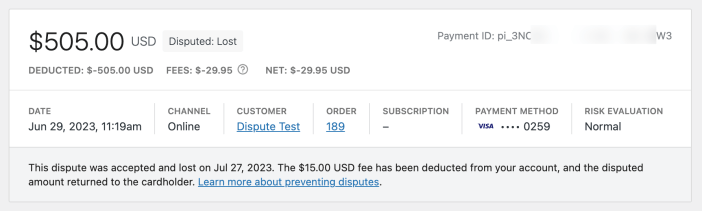
Screenshot example: a completed dispute has a different status from a case awaiting a response. Use your live case for its current amounts and outcome.
Review patterns by reason, product, and fulfillment method. A cluster of delivery complaints may call for clearer delivery promises or better tracking. Recurring-payment complaints may require stronger renewal and cancellation communication. Winning a dispute does not remove the operational reason it happened.
Use Automation With Clear Responsibilities
Chargeflow’s WooCommerce integration provides a starting point for evaluating a connected workflow. Confirm the payment connection and supported account setup before relying on automated evidence handling. Assign an owner to incomplete data and any response requiring review.
Compare response coverage, handling time, missed deadlines, and recovery across similar cases. The manual versus automated processing guide helps frame that evaluation without assuming every case can be handled identically.
Frequently Asked Questions
Does WooPayments Decide Who Wins?
For ordinary card disputes, the issuer evaluates the response under the applicable process. WooPayments provides the merchant workflow. Other payment methods and exceptional case types can follow different rules.
Can Every WooPayments Dispute Be Challenged?
No. Challenge options depend on the payment method and dispute type. Read the live case and official documentation before preparing a card-style evidence package for another method.
What if the Customer Says They Withdrew the Dispute?
Preserve their message, follow the case instructions, and monitor its status. Do not assume the case is closed or ignore the response deadline based only on that message.
Explore Chargeflow’s automated chargeback recovery to organize evidence and manage supported responses.
Chargebacks?
No longer your problem.
Recover 4x more chargebacks and prevent up to 90% of incoming ones, powered by AI and a global network of 20,000 merchants.


.png)