





























%201.svg)




































Shopify Chargeback Fee: How Much It Costs and How to Avoid It Legally


Chargebacks?
No longer your problem.
Recover 4x more chargebacks and prevent up to 90% of incoming ones, powered by AI and a global network of 20,000 merchants.


 600+ reviews


TL;DR:
- Shopify's chargeback fee typically runs $20 to $30 per dispute, and Shopify refunds it if you win.
- Staying under a 1% chargeback rate (Visa's stricter threshold is 0.9%) helps you avoid reserves and account reviews.
- Shopify's Network Dispute Resolution Program (NDRP) auto-resolves some disputes for a per-dispute fee, it does not eliminate the cost.
- You reduce chargeback fees legitimately through fraud prevention, fast evidence submission, and automated tools, not by trying to dodge legitimate charges.
The Shopify chargeback fee is a flat, non-negotiable charge your payment processor bills per dispute, typically $20 to $30 in the United States, whether you win or lose the case. It is not a penalty for doing anything wrong, it is how card networks and payment providers cover the administrative cost of processing a dispute.
This guide covers exactly how much Shopify charges per dispute, the chargeback percentage that can trigger a reserve or account review, how Shopify's Network Dispute Resolution Program (NDRP) works, and the legitimate ways to reduce how often you pay the fee at all. Shopify's chargeback fee typically runs $20 to $30 per dispute, and it is refunded if you win. Stay under the informal 1% chargeback-rate threshold (Visa's own Acquirer Monitoring Program is stricter, at 0.9%) to avoid a reserve or account review. If Shopify auto-enrolls your store in the Network Dispute Resolution Program (NDRP), disputes get resolved automatically, but you still pay a per-dispute resolution fee. The real fix is prevention and stronger evidence, not trying to dodge a legitimate cost of accepting card payments. For a broader look at fighting disputes on the platform, see our full guide to Shopify chargebacks.
{{cta}}
Why Does Shopify Charge a Fee for Every Dispute?
Every time a customer disputes a charge, it costs money to process, regardless of who wins. That cost is why you pay a non-negotiable fee alongside the reversed sale.
Here is how the system actually works.
After U.S. lawmakers established chargebacks as a consumer protection tool in 1974, cardholders gained the right to seek remediation for a transaction issue directly through their bank rather than the merchant. That process takes real administrative work on the bank's side, so banks and card networks introduced a dispute fee to offset it.
In practice, the chargeback fee covers the administrative cost your Shopify Payments provider (or third-party payment service provider) absorbs when handling chargebacks and disputes tied to your account. Card networks also use the fee, together with your chargeback percentage, to discourage the kind of fraud and poor fulfillment practices that lead to disputes in the first place. For a deeper breakdown of how these costs work across processors, see our guide to chargeback fees and costs.
How Much Is the Shopify Chargeback Fee?
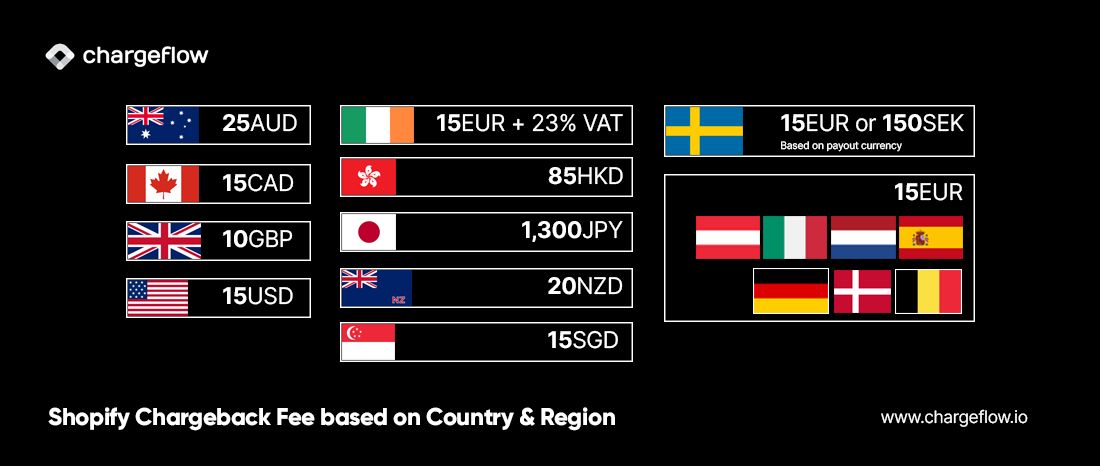
The exact amount depends on your store's country or region, but in the United States the Shopify chargeback fee typically runs $20 to $30 per dispute, charged regardless of the outcome. Here is a quick overview by region:
| Region | Approximate Chargeback Fee |
|---|---|
| United States | 15 USD |
| United Kingdom | 10 GBP |
| Canada | 15 CAD |
| Australia | 25 AUD |
| Austria, Belgium, Denmark, Germany, Italy, the Netherlands, Spain | 15 EUR |
| Ireland | 15 EUR plus VAT |
| Sweden | 15 EUR or 150 SEK, based on payout currency |
| Singapore | 15 SGD |
| Hong Kong SAR | 85 HKD |
| Japan | 1,300 JPY |
| New Zealand | 20 NZD |
These fees are non-negotiable on a per-dispute basis, but Shopify refunds the fee whenever you win a dispute, which is exactly why prevention and strong evidence matter more than the sticker price of any single fee.
What Chargeback Percentage Should Shopify Merchants Stay Under?
Fees are only part of the cost. Once your dispute volume crosses a certain chargeback percentage, Shopify and the card networks start paying closer attention to your account.
- Shopify's informal threshold for a reserve or account review sits around 1% of processed volume in a rolling 30-day window.
- Visa's own Acquirer Monitoring Program applies a stricter 0.9% threshold, which your acquiring bank has to answer to even if Shopify does not flag you first.
Use our chargeback ratio calculator guide to check where your store stands, and treat 1% as a ceiling, not a target.
What Is Shopify's Network Dispute Resolution Program (NDRP)?
Some merchants are automatically enrolled in Shopify's Network Dispute Resolution Program after a risk review. NDRP auto-resolves eligible disputes on your behalf, which sounds convenient, but each resolved dispute still carries its own per-dispute resolution fee. It is not a way to avoid paying for disputes, it is Shopify managing them for you at a cost.
If you are enrolled in NDRP, Shopify shares the specific dispute-rate threshold you need to hit to exit the program. Getting your chargeback percentage below that number, through prevention and stronger evidence, is the only real way out.
How to Avoid Paying Shopify Chargeback Fees Legally
For some processors, regardless of the dispute outcome, you must pay a chargeback fee. But Shopify has practical chargeback mitigation protocols you can leverage to avoid paying chargeback fees.
Here’s how it works:
Option 1: Avoid Chargeback Fees with Early Dispute Alerts
Most how to win chargebacks shopify trace back to a short list of causes:
- The product was not as described
- An order was not delivered
- An unauthorized transaction, double billing, or billing for a canceled recurring payment
- A cardholder does not recognize a particular charge on their statement
- Buyer's remorse
Several of these are fraud-related, which is why dispute alerts work best alongside a broader ecommerce fraud prevention strategy rather than on their own.
Most merchants only learn about a dispute after the fact, which leaves little time for remediation. If you know about a potential chargeback before it is officially filed, you can refund the order proactively or prepare stronger evidence in advance.
Without that early warning, you are only reacting after the customer has already made their move, and that puts you at a real disadvantage in disputes you might otherwise win.
With a chargeback alert solution, you can readily get just-in-time notification on the disputes. In that sense, a chargeback alert solution is a service that, if a merchant signs up for, will send an alert of an incoming chargeback within 24 hours. If the merchant refunds the transaction within the said period, he/she will not get a chargeback. And by extension, they will not pay any Shopify chargeback fee.
That's smart because you also get to save time and financial resources that you'd otherwise spend in the lengthy chargeback process. And it's a non-negotiable solution for your business if you are in an industry that’s prone to disputes -- like the SAAS industry.
You get chargeback alerts and the rest of these benefits when you onboard Chargeflow. It analyzes your transaction data to flag orders that are likely to turn into a Shopify chargeback, so you can act before the dispute is filed.

Option 2: Win Disputes So Shopify Refunds the Chargeback Fee
Shopify refunds merchants the chargeback fee on any dispute resolved in their favor, which makes winning your cases the single biggest lever you have.
That takes some groundwork.
Make sure you capture adequate authorization for each transaction, keep your refund and return policy well-drafted and easy to find, and make your billing descriptors easy for cardholders to recognize. Ship orders insured, tracked, and on time to the correct address, and back it up with responsive customer service, since most of these steps double as evidence if a dispute is filed.
When a dispute does land and you have kept your end of the bargain, you can fight back with the documentation to prove it and recover the transaction. Integrating Chargeflow's Shopify integration automates that evidence-gathering and submission process, which is how merchants push their win rate up instead of writing off every chargeback fee as a cost of doing business.
What's Next as Shopify's Merchant Base Keeps Growing?
As Shopify's merchant base and transaction volume keep growing, dispute volume grows right along with it, and so does the total you could spend on chargeback fees if you leave prevention to chance. This is especially true for merchants on Shopify Plus, where higher order volume and cross-border complexity can push dispute counts up even faster.
Dispute complexity is also shifting. As more purchases run through AI shopping agents, questions about who is liable when an AI agent completes a purchase are becoming part of the conversation, and merchants are already building an evidence playbook for agentic commerce chargebacks to stay ahead of it.
The Bottom Line on Shopify Chargeback Fees
Chargebacks are a normal part of running an e-commerce business, and the fee is a real, non-negotiable cost tied to each one. What is optional is how many disputes you actually pay that fee on. Resolve disputes early, before they become full-blown chargebacks, and win the ones that do get filed so Shopify refunds the fee.
That combination, prevention plus a strong win rate, is what actually limits your financial exposure to Shopify chargeback fees.
If you have been treating chargeback fees purely as a cost of doing business, there is a better way. Merchants using Chargeflow's automated chargeback management push their chargeback win rate to 75%, well above the roughly 12% industry baseline, at effectively no manual work.
Frequently Asked Questions
What is the Shopify chargeback fee?
It is a flat, non-negotiable fee your Shopify Payments provider or acquiring bank charges per dispute to cover the administrative cost of processing it. In the United States it typically runs $20 to $30 per dispute, and Shopify refunds it if you win the case.
What is a safe Shopify chargeback percentage?
Aim to stay under 1% of your processed volume in any rolling 30-day window, which is Shopify's informal threshold for a reserve or account review. Visa's own Acquirer Monitoring Program is stricter, at 0.9%, so treating 1% as a hard ceiling gives you a buffer.
What is NDRP on Shopify?
NDRP stands for Shopify's Network Dispute Resolution Program. Some merchants are automatically enrolled after a risk review, and it auto-resolves eligible disputes on their behalf for a per-dispute resolution fee. It is not free, and exiting the program requires bringing your dispute rate below a threshold Shopify shares once you are enrolled.
Can you get a Shopify chargeback fee refunded?
Yes. Shopify refunds the chargeback fee whenever a dispute is resolved in the merchant's favor, which is why submitting strong, timely evidence matters as much as preventing the dispute in the first place.
Where do I manage chargebacks in Shopify Admin, and how much time do I have?
Disputes appear under Orders, then Chargebacks and Inquiries, in Shopify Admin. You typically have 7 to 21 days from notification to submit your evidence, so check that section regularly rather than waiting for an email alert.
Win Back Chargebacks on Shopify, Automatically
Chargeflow integrates directly with your Shopify store to fight chargebacks and disputes for you, with no manual work required.
Chargebacks?
No longer your problem.
Recover 4x more chargebacks and prevent up to 90% of incoming ones, powered by AI and a global network of 20,000 merchants.


.png)
.webp)
.webp)
.webp)