























%201.svg)


































Chargeback Prevention: The Definitive Guide

Chargebacks?
No longer your problem.
Recover 4x more chargebacks and prevent up to 90% of incoming ones, powered by AI and a global network of 15,000 merchants.


 600+ reviews
Chargebacks are a systemic risk that scales with your revenue. Prevention requires three layers: blocking bad transactions before authorization, intercepting disputes in the 24-72 hour alert window before they post, and feeding dispute data back into your operations to fix the root causes. Manual processes break at scale. If your chargeback rate is climbing toward network thresholds, the gap is infrastructure. That's why Chargeflow exists.
If you’re dealing with a chargeback hangover right now, you’re not alone. The pattern is well-established: as eCommerce scales, chargebacks scale with it.
Most cases surface 45-60 days after a transaction. These cases are often triggered by statement surprises, buyer’s remorse, budget regrets, or return hassles. Many chargebacks aren’t outright malicious. And a good number of them are preventable.
The good news? Now is the prime time to implement or strengthen your chargeback prevention systems. If you do it right, you’ll stop that excited signup from turning into a “I don’t recognize this” dispute months later.
This definitive guide breaks down how chargeback prevention works in today’s landscape. It’s comprehensive. You’ll discover why friendly fraud now drives 70-80% of disputes, what you can realistically prevent, credit card chargeback prevention best practices for eCommerce, and when automation tools become essential to slash dispute rates.
Chargeback Prevention Explained
Before we examine the meaning of chargeback prevention, it’s helpful to refresh your memory on what chargebacks are and why they occur.
What Are Chargebacks?
Chargebacks are consumer-initiated payment reversals forced by the card issuer. Chargebacks are supported by law. They give cardholders the ability to go over merchants’ heads and reverse transactions they believe to be fraudulent, unauthorized, or unsatisfactory. In other words, chargebacks exist to protect cardholders.
But merchants? The odds are stacked against merchants. They must represent transactions, which attract steep financial and operational expenses, as highlighted in our chargeback cost guide.
So What Is Chargeback Prevention?
Chargeback prevention refers to all the strategies, tools, systems, and best practices merchants use to reduce or avoid chargebacks. Effective chargeback prevention spans the entire customer journey. These protocols start before a transaction is authorised and continue well after the purchase is complete.
Merchant Chargeback Prevention Strategies: The Lifecycle Approach
Comprehensive chargeback prevention (pre-auth screening, post-transaction controls, alert interception, and automated evidence) typically cuts disputes by 40-60% within 90 days for most merchants.
Pre-Transaction Chargeback Prevention
- Fraud detection: Tools like address verification, CVV checks, 3D Secure authentication, and AI-based fraud screening (such as Chargeflow Prevent) block unauthorized transactions.
- Clear policies and communication: Transparent product descriptions, pricing, refund/return terms, automated delivery confirmation, and harmonised customer support help minimise misunderstandings that could result in disputes.
- Pre-dispute alerts: Deploying chargeback alerts helps intercept potential disputes 24-72 hours before they become formal chargebacks. We’ll explore this in detail in a subsequent passage.
Post-Transaction Chargeback Prevention
- Repeat abuser suppression: Tools like Chargeflow Insights use hashed emails, devices, IPs, or payment credentials to help flag chargeback perps. You can easily restrict refunds, access, or future transactions and prevent these serial fraudsters from inflating post-transaction losses.
- Subscription Lifecycle Controls: Recurring billing providers implement systems, such as retry logic, cancellation confirmations, pause options, or pre-renewal reminders to prevent post-transaction disputes tied to forgotten subscriptions.
Now that you’ve understood how chargeback prevention works, let’s review the types of chargebacks merchants encounter.
The Three Chargebacks Vectors That Matter Most
There are dozens of chargeback reason codes across networks and issuers. In practice, these codes can be grouped into three meaningful vectors. Understanding the differences is critical because each requires a different response strategy.
1) Friendly Fraud
Friendly fraud is intentional (and sometimes, unintentional) abuse of the chargeback system. These are disputes that ideally shouldn’t happen because the cardholder actually received the product or service.
The instigator is not a masked criminal but your customer or someone close to them. Examples of friendly fraud include:
- Claims of non-delivery despite confirmed fulfillment.
- Subscription charges the customer forgot they agreed to.
- A family member or colleague using a saved payment method.
- Refunds are initiated, but not visible on the statement quickly enough.
What makes friendly fraud uniquely difficult is credibility. From the bank’s perspective, the dispute originates from a genuine cardholder with a plausible narrative. Manual processes rarely hold up at scale.
2) Merchant Error
Merchant error chargebacks occur when mistakes on the merchant’s side trigger disputes. Common examples of merchant missteps that result in this chargeback category include the following:
- Billing errors,
- Misprocessed transactions,
- Technical or authorization failures (expired cards or failed captures), and
- Refunds or credits that were promised but never processed.
These disputes are structurally preventable, as we’ll cover subsequently. When they occur repeatedly, then you know you’re dealing with broken processes, rather than bad actors.
3) Criminal Fraud
Criminal fraud chargebacks are disputes caused by third-party fraud: stolen credentials, identity theft, or account takeover.
Examples of chargebacks induced by criminal fraud include:
- Card-not-present fraud using compromised card data as was perpetuated during Operation Chargeback in 2025.
- Account takeovers that lead to unauthorized purchases.
- Card testing campaigns that probe for valid credentials.
From the issuer’s standpoint, these disputes are valid. Once a fraudulent transaction clears authorization and the real cardholder notices, a chargeback is unavoidable. Prevention here must happen before approval.
Disputes You Can (and Can’t) Prevent With Chargeback Prevention Systems
Chargeback prevention is about influence, not absolutes. Each category behaves differently. Here’s what you can and can’t realistically prevent:
1) Merchant Error: Structurally Preventable
Because these disputes originate from internal failures, merchants have full agency. Prevention requires:
- Clean authorization and capture logic
- Fast, visible payment processing
- Descriptors that are easy for the customer to understand
When merchant errors persist, it’s rarely a tooling issue. It’s a coordination failure between payments, finance, and support.
2) Friendly Fraud: Interceptable, Not Preventable
You cannot objectively stop a customer from attempting to dispute a charge wrongly. What you can do is remove the conditions that make disputes easy and attractive.
This includes:
- Reducing statement confusion.
- Making it easier for customers to talk to you before talking to their bank.
- Intercepting disputes before they harden into fee-bearing chargebacks.
Friendly fraud is a timing as much as a trust issue. The earlier you intervene, the higher your leverage.
That’s where Chargeflow Prevent comes in. It uses real-time data to deflect disputes at the point of authorization. Over 7,000 merchants are already using it to stop digital shoplifters.
3) Criminal Fraud: Fairly Preventable
For criminal fraud, prevention is entirely upstream. Once a stolen card is charged and approved, the outcome is largely predetermined.
Effective criminal fraud chargeback prevention includes:
- Strong authentication (e.g., 3DS where appropriate)
- Velocity and anomaly detection
- Device and identity intelligence
Post-transaction controls do little here. This is a gatekeeping problem, not a recovery one.
Notable eCommerce and Credit Card Chargeback Prevention Best Practices
It’s worth re-emphasizing the fact that eCommerce chargebacks are a big deal for the entire industry. Banks and payment processors are legally responsible for the funds moving through their network. If they are found to be facilitating “dirty” or fraudulent money, they face massive regulatory fines from governing bodies and card brands.
By making chargebacks expensive and punitive for merchants, the system forces every player in the supply chain to be aggressively vigilant.
Below are vital vertical-specific chargeback prevention best practices:
Digital Products and Services
- Implement email verification and account authentication before purchase
- Log IP address, device IDs, and download/access timestamps
- Send usage confirmations ("You accessed this course on [date]")
- Consider additional verification steps for high-value digital products
Physical Products
- Require signature confirmation on high-value shipments
- Use trackable shipping methods for all orders
- Photograph items before when feasible
- Consider delivering photographic proof services
Subscription Businesses
- Send pre-charge notifications 3-7 days before billing
- Make cancellation processes simple and accessible
- Offer pause or downgrade options as alternatives to cancellation
- Implement smart dunning management for failed recurring payments
- Use clear, recognizable billing descriptors that include the subscription period
High-Risk Industries (travel, electronics, luxury goods)
- Implement 3D Secure 2.0 authentication for liability shift
- Set lower transaction limits for first-time customers
- Require additional verification for expedited shipping requests
- Monitor for unusual ordering patterns (multiple orders, mixed addresses)
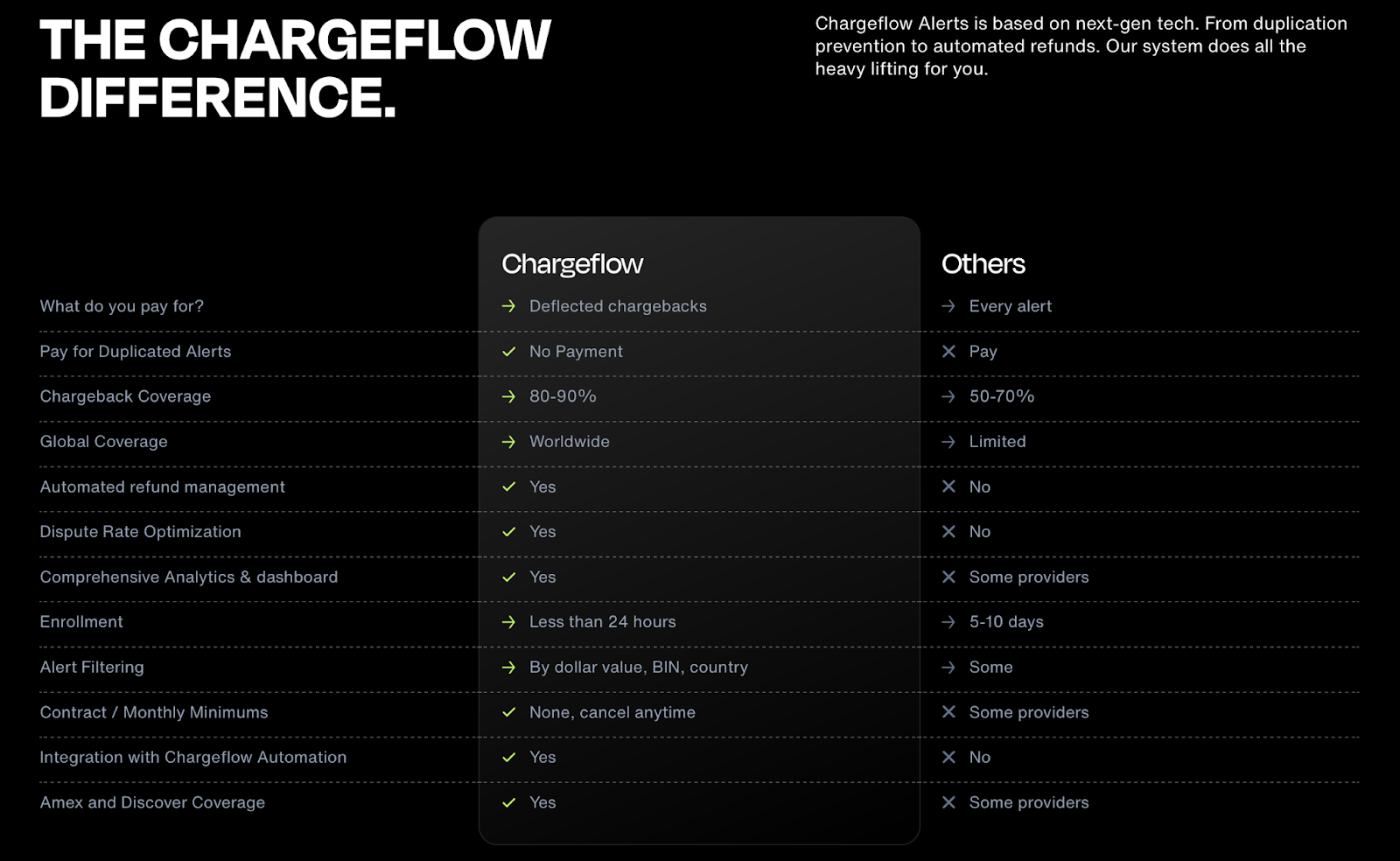
A best practice is to deploy alerts and chargeback deflection across all verticals to catch disputes early.
How Chargeback Alerts Promote Chargeback Prevention
Chargeback alerts deliver just-in-time notifications immediately after a buyer files a dispute. It integrates transaction data into merchant accounts and obtains direct dispute notifications from banks. That freezes the chargeback process momentarily, giving merchants time to plan their response.
Key Benefits
- Merchants can proactively resolve disputes directly with customers or auto-refund the transaction before the chargeback posts.
- Prevents chargebacks from being filed if the merchant refunds within the alert window.
- Eliminates the need for lengthy chargeback representment processes.
- Helps merchants avoid excessive chargeback programs.
- Particularly valuable for high-ticket merchants or those in high-risk verticals.
Using Dispute Data as a Control System in Chargeback Prevention
Think of dispute data as the error signal in a control system. It’s diagnostic, not just reactive. Your goal is to close the gap between the money you make and the money that actually stays in your bank account.
Merchants who reduce chargebacks consistently do three things:
- Segment disputes by product, channel, and customer cohort.
- Map reason codes to operational failures.
- Feed insights back into checkout, fulfillment, and support.
Take the steps below to operationalize this objective:
Categorize by true source
Don’t just look at reason codes (which are often misleading). Tag disputes by product line, marketing channel, or shipping carrier. If 40% of Item Not Received claims stem from a specific regional carrier, that’s a logistics failure, not a fraud problem.
Identify friendly fraud patterns
Analyze the time-to-dispute. Genuine fraud usually happens within 48 hours of a transaction. Friendly fraud often peaks at the 30-day mark when the credit card statement arrives.
Implement threshold triggers
Set automated alerts. If the dispute rate for a specific SKU exceeds a pre-defined threshold (e.g., 0.5%), the system should trigger an automatic review of that product’s description or packaging.
Monitor your chargeback ratio
Exceeding the card network chargeback ratio (disputes divided by total transactions) triggers fines, increased processing fees, or even permanent account termination.
Chargeflow Insights centralizes and analyzes chargeback data in real time. Merchants that adopt that feedback approach typically see 20-40% reductions in preventable disputes within months.
Chargeback Prevention Tools and Platforms: When to Get Outside Help
The $125 billion global chargeback problem isn’t evenly distributed. Our chargeback statistics indicate that friendly fraud now drives ~75% of all disputes.
Yet most merchants over-index on criminal fraud prevention while under-investing in friendly fraud interception. This creates a strategic gap: defenses optimized for the least common threat.
Again, manual prevention and representment may work when you have 1 or two cases. But they break at scale.
Chargeback automation is non-negotiable when:
- Chargeback volumes exceed internal review capacity.
- Alert windows are missed due to time or staffing constraints.
- Evidence assembly becomes fragmented across systems.
- Friendly fraud dominates the dispute mix.
- Tracking chargeback causes is becoming challenging beyond reason codes.
- Chargeback rate is approaching the card-network threshold.
At that point, prevention is no longer about individual decisions. It’s about systems that connect payments, identity, fulfillment, and support data fast enough to matter.
Platforms like Chargeflow exist to address this execution gap. It unifies early-warning alerts, automates evidence generation, and friendly fraud deflection into a single workflow. This level of orchestration is what allows prevention (and recovery) at scale.
Final Thoughts on Chargeback Prevention
Effective chargeback prevention is about eliminating systemic failures that create dispute exposure.
Most merchants lose revenue because their defenses are reactive, fragmented, or misaimed.
True prevention builds infrastructure that:
- Blocks invalid transactions upfront;
- Ensures every approved order is unmistakable (clear descriptors, confirmations, policies);
- Intercepts disputes in the narrow 24-72-hour alert window;
- Feeds dispute insights back to fix the root causes.
Achieving this manually or with rule-based systems is not possible. As Mastercard says, “The most effective chargeback prevention solutions are based on a robust global collaboration network. Automated tools securely provide rich merchants and purchase information to cardholders within their banking apps, and to FIs’ call center and back-office staff, helping call center staff resolve or deflect a dispute – by providing back-office teams the right data about the transaction to enable a faster resolution.”
It’s time to rethink your strategy. See chargebacks for what they are: the blueprint for a more resilient, profitable business. The next billing cycle awaits no one. Turn your data into your primary defense with Chargeflow.
Chargebacks?
No longer your problem.
Recover 4x more chargebacks and prevent up to 90% of incoming ones, powered by AI and a global network of 15,000 merchants.


.png)



Questions?
we’ve got answers.
Chargeflow collects data from dozens of third party signals, automatically. This allows for much more coverage and much better win rates because the evidence submitted is much more comprehensive and compelling.
Chargeflow collects data like order info, customer messages, and payment details. It builds a full dispute case for you, so you don’t have to lift a finger.
Yes! Chargeflow works with 50+ payment processors. That means one tool for all your chargebacks, no matter how you process payments.
You only pay a percentage of the revenue we help you recover. No upfront fees, no subscriptions — just success-based pricing.
Yes. Chargeflow is SOC 2 Type 2, GDPR, and ISO certified. We use top security standards to keep your data safe.
need more help?
Have a question? We’re here to help. Just hit the chat button to initiate a conversation with support.


